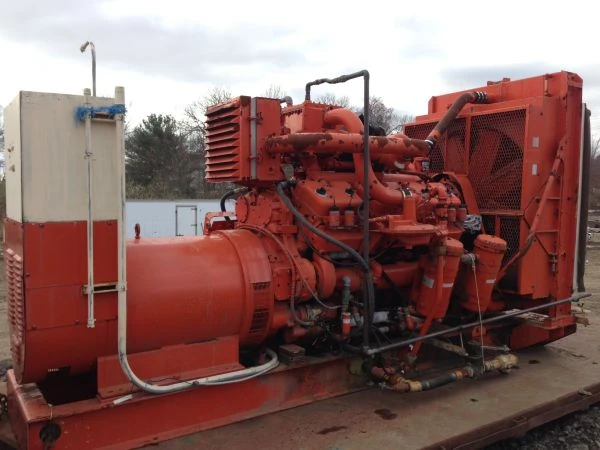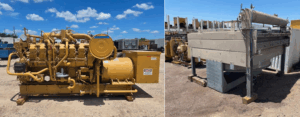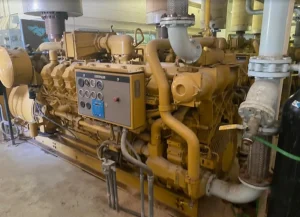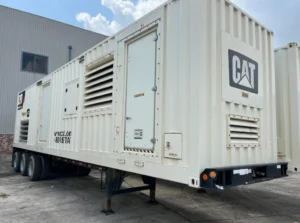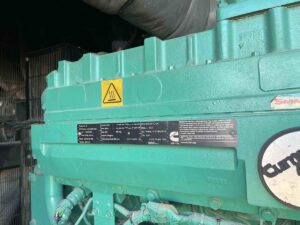
Natural gas generators produce electricity by burning pipeline natural gas or LNG instead of diesel, eliminating on-site fuel storage, reducing NOx emissions by 25–40% versus diesel equivalents (per EPA stationary source emissions data), and cutting fuel costs by 30–50% for facilities with utility gas access. This guide covers every major natural gas generator platform available today — from 75kW Caterpillar G3306 units to 2,000kW Waukesha industrial sets — including specifications, pricing, ideal applications, and what to look for when buying used.
Natural gas generators have taken significant market share from diesel in data centers, hospitals, wastewater treatment facilities, and co-generation plants over the past decade. Understanding when natural gas is the right choice — and when it isn’t — starts with the fuel supply, the application, and the regulatory environment.
Natural Gas vs. Diesel: When Each Wins
Natural gas generators are the correct choice when three conditions align: reliable pipeline gas access at adequate pressure (typically 5–7 psi minimum for generator supply), a facility that runs the generator frequently (prime power, co-gen, or regular exercising), and an application where diesel fuel storage creates logistical, environmental, or permitting complications.
Diesel holds the advantage in applications requiring absolute fuel security independent of utility infrastructure — military installations, remote sites without gas service, and locations where pipeline reliability is uncertain. A diesel generator with a 2,000-gallon sub-base tank operates completely independently of any utility. A natural gas generator tied to a utility gas main shares a single point of failure with the grid event that may have triggered the outage.
For most urban commercial and industrial facilities with reliable gas utility service, natural gas wins on operating cost, emissions compliance, and fuel management simplicity. For remote or mission-critical standby applications, diesel remains the safer choice.
Caterpillar Natural Gas Generator Platform
Natural Gas Generators for Sale ·
Waukesha Generators ·
CAT Gas Generators
Caterpillar produces the most extensive natural gas generator lineup in the industrial market — spanning the G3306 (75kW) through the G3520 (2,000kW) on spark-ignited gas platforms, plus the newer CG137 and CG170 continuous gas engine series designed specifically for prime power and co-generation applications.
The G3512 is the workhorse of the Caterpillar natural gas line. At 550kW to 1,000kW depending on configuration, aspiration, and fuel quality, the G3512 appears in more data centers, hospitals, and industrial facilities than any other Caterpillar gas generator. Its lean-burn combustion technology — the Electronic Ignition System (EIS) and Electronic Modular Control Panel (EMCP) — delivers 36–38% electrical efficiency in prime power service, competitive with diesel equivalents consuming more expensive fuel.
The G3516 extends the platform to 800kW–1,000kW in standard configuration and up to 1,600kW in high-output versions. G3516 units are the most common large-format natural gas generator in data center backup power applications and wastewater treatment plants requiring continuous duty. View our Cat G3516 800kW inventory →
The CG137-12 represents Caterpillar’s current-generation continuous duty gas engine, producing 400kW at exceptional thermal efficiency. Its Miller Cycle combustion with cooled external EGR meets Tier 4 emissions levels on natural gas without aftertreatment complexity. View our CG137-12 400kW inventory →
Waukesha Natural Gas Generators
Waukesha (now INNIO Waukesha) produces natural gas generators that dominate the 500kW–5,000kW prime power market in North America — particularly in oil and gas, co-generation, and continuous duty industrial applications. The VHP (Very High Performance) series is the Waukesha flagship: the VHP7042GSI produces 1,100kW on natural gas with exceptional thermal efficiency at continuous duty load factors that would stress competing platforms.
Waukesha’s key differentiation from Caterpillar is fuel flexibility. Waukesha gas engines operate on pipeline natural gas, wellhead gas with variable BTU content, landfill gas, digester gas, and propane without engine replacement — only fuel system recalibration. For oil and gas production facilities running on associated gas, Waukesha VHP units are the dominant technology because no other platform handles the variable composition of wellhead gas with the same reliability.
The trade-off: Waukesha engines have a smaller parts and service network than Caterpillar or Cummins. Outside of the oil patch and industrial co-gen market, finding qualified Waukesha service technicians requires planning. For facilities with dedicated maintenance staff, this is manageable. For facilities relying on third-party service, Caterpillar’s dealer network depth is a meaningful advantage. View our Waukesha VHP7042GSI 1100kW →
Cummins and Jenbacher Natural Gas Options
Cummins GTA855 and QSV91G natural gas generators serve the 180kW–2,000kW market with the same parts availability advantage that makes Cummins diesel generators dominant in the used market. The GTA855 is particularly common in the 150–200kW range — a cost-effective natural gas option for smaller commercial facilities and agricultural applications.
Jenbacher (GE Vernova) gas engines represent the premium European alternative — exceptional efficiency at 42–45% electrical efficiency on pipeline gas, but engineered specifically for prime power and co-generation applications rather than standby service. Jenbacher units appear primarily in wastewater treatment, landfill gas, and industrial process heat-and-power applications. They are rarely the correct choice for emergency standby.
Buying a Used Natural Gas Generator
Used natural gas generators require additional due diligence beyond what diesel units demand. Gas engine condition is strongly influenced by fuel quality history — an engine that has run on clean pipeline gas its entire life is a fundamentally different purchase than one that ran on landfill gas or variable-quality wellhead gas. Always request fuel type history before inspection.
Valve and seat condition is the primary mechanical concern on gas engines. Natural gas combustion is hotter than diesel combustion, and exhaust valve seat recession occurs at predictable intervals on most platforms. Ask for valve inspection records. On Caterpillar G3512 and G3516 units, valve work at 8,000–12,000-hour intervals is expected maintenance — not a red flag — but ensure it has been completed at the correct intervals.
Ignition system condition matters more on gas units than any diesel equivalent. The Electronic Ignition System (EIS) on Caterpillar gas generators and equivalent systems on Waukesha and Cummins control combustion timing, knock detection, and air-fuel ratio. Inspect spark plug condition and ignition module logs before purchase. A history of knock events indicates either fuel quality issues, timing problems, or detonation damage that may not be visible externally.
Power Generation Enterprises inspects all natural gas generators at our Santa Clarita facility before offering them for sale. Each unit undergoes engine oil analysis, compression testing, ignition system inspection, and a documented load test. Call +1 (818) 484-8550 for current natural gas inventory availability.
Dual-Fuel Generators: Natural Gas and Diesel Combined
Dual-fuel generators operate primarily on natural gas while maintaining the ability to switch to diesel — either automatically during gas supply interruptions or manually for extended outages. They eliminate the gas-supply dependency that makes pure natural gas unsuitable for mission-critical standby applications in earthquake zones, severe weather regions, or locations with older gas distribution infrastructure.
Most dual-fuel systems are diesel-primary with gas supplementation: the engine starts on diesel and gradually substitutes natural gas to reduce diesel consumption at load. True bi-fuel systems capable of running on 100% of either fuel independently are available but more mechanically complex and expensive. For facilities that need gas economics during normal operation and diesel security during extended emergencies — hospitals, data centers, and critical municipal facilities — dual-fuel is the correct architecture.
Key dual-fuel applications: hospitals in earthquake zones requiring full fuel independence; data centers with 72-hour autonomy mandates who want gas economics during monthly test runs; municipal wastewater facilities running biogas co-generation with diesel backup. Power Generation Enterprises can source dual-fuel conversion kits for major platforms and has dual-fuel units in inventory periodically — call +1 (818) 484-8550 for current availability.
Natural Gas Generator Pricing
Used natural gas generators sell at a significant premium over equivalent diesel units in the 200kW–1,000kW range because of lower supply — fewer natural gas units are produced and fewer reach the used market annually. The table below reflects current market pricing for inspected units in serviceable condition. Pricing varies with hours, configuration, enclosure type, and regional market conditions.
Related Guides
- Diesel Generators for Sale: Complete Buyer Guide 2026 — Diesel vs. natural gas total cost of ownership, inspection checklist, and brand comparison
- Industrial Generator Pricing Guide 2026 — Natural gas generator pricing by model and power class in context of the full industrial market
- Caterpillar Generator Guide: All Models and Pricing 2026 — Complete CAT G-Series natural gas generator specifications, model history, and current pricing