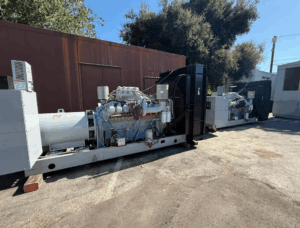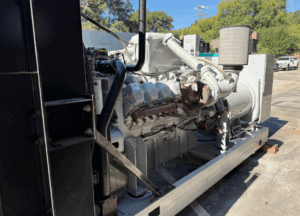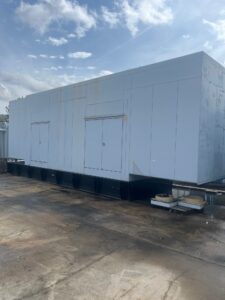
MTU, Caterpillar, and Cummins collectively power the majority of industrial diesel generators above 500kW installed in North America. Choosing between them requires understanding what each platform optimizes for — because none is objectively superior across all criteria. The correct choice depends on your facility’s priorities: fuel cost sensitivity, parts and service access, resale value, or emissions compliance requirements. Power Generation Enterprises carries all three brands in active inventory at our Santa Clarita, California facility — this comparison reflects firsthand knowledge of each platform from buying, inspecting, and selling thousands of units across all three brands over 25+ years.
Engine Technology Compared
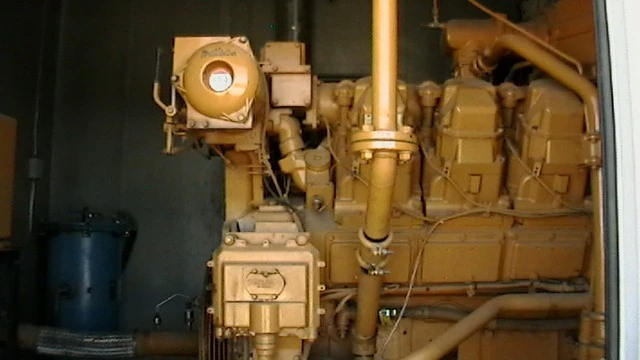
Caterpillar 3500 Series: American-designed, manufactured in Mossville, Illinois. The 3512 and 3516 use a V-configuration with unit injectors — each cylinder has its own mechanical injection pump integrated into the engine block. ACERT combustion technology achieves Tier 3 and Tier 4 compliance through in-cylinder combustion control with minimal aftertreatment dependency. Mechanically robust and well-understood by North American technicians.
MTU Series 2000 and 4000: German-designed by MTU (Rolls-Royce Power Systems) in Friedrichshafen, manufactured to German industrial tolerances. MTU engines use common rail fuel injection at pressures up to 1,800 bar — significantly higher than Caterpillar’s unit injector system — enabling finer fuel atomization and more precise combustion control. The result is superior fuel efficiency but greater sensitivity to fuel quality and higher repair cost when injection system components fail. MTU’s 4000 Series covers the 1,000–3,500kW range where only Caterpillar’s 3516C HD competes directly.
Cummins QSK Series: American-designed in Columbus, Indiana. The QSK45, QSK60, and QSK78 use X-configuration and inline architectures. Cummins XPI (Cummins Integrated Pressure-Modulated Injection) common rail system operates at pressures comparable to MTU’s system. The QSK60 — Cummins’ most widely deployed large industrial generator engine at 1,500–2,000kW — is the most direct competitor to the CAT 3516 in the large commercial generator market.
Fuel Efficiency: MTU Wins, But By How Much?
MTU Generators for Sale ·
Caterpillar Generators for Sale ·
Cummins Generators for Sale
At equivalent power output and load factor, MTU Series 2000 and 4000 generators consume 5–10% less diesel than comparable Caterpillar 3500 Series or Cummins QSK units. This is real and measurable.
At full load, a 1,000kW generator running 4,000 hours per year at $3.50/gallon diesel: CAT 3512 consumes approximately 76 gallons/hour = $1,064,000 in fuel over 4,000 hours. An MTU Series 2000 at the same output consumes approximately 69 gallons/hour = $966,000 over the same period. The difference: $98,000 in fuel cost over four years — a meaningful offset to MTU’s typically higher purchase price for facilities running generators at high duty cycles.
For emergency standby applications running fewer than 200 hours per year, the fuel efficiency advantage produces less than $5,000 per year difference at the same power class. In standby applications, the MTU premium is harder to justify on operational economics alone.
Reliability and Uptime Data
All three platforms achieve exceptional reliability in properly maintained installations. Industry data from large generator fleet operators (data center REITs, hospital systems, utility companies) consistently shows unplanned failure rates below 1% annually for all three brands when maintained according to manufacturer specifications. The practical reliability distinction is servicing response time when something does go wrong — and here, Caterpillar’s dealer network is unmatched in North America.
Parts Availability and Dealer Networks
Caterpillar: Over 2,000 dealer locations worldwide; approximately 200 in the US. Emergency parts delivery within 24 hours is routine anywhere in North America. For facilities where generator downtime risk is highest, this network depth is a genuine operational advantage — not just a marketing point.
Cummins: Approximately 1,600 dealer and distributor locations in North America. Cummins parts pricing typically runs 10–20% below CAT for equivalent components. Cummins QuickServe online parts system allows emergency parts identification and ordering 24/7.
MTU: Approximately 200 authorized dealers in North America — less than one-tenth of CAT’s coverage. In secondary markets and remote locations, a generator fault can mean 2–5 day waits for a qualified technician and specialized parts. For facilities in secondary markets or without dedicated in-house maintenance staff, MTU’s dealer network depth is a material operational risk.
Head-to-Head Specs: 1,000kW Class Comparison
The comparison table below puts the CAT 3512B, Cummins QSK45, and MTU 16V2000 side by side at equivalent power output — the most relevant head-to-head for the 800kW–1,200kW industrial generator market.
Total Cost of Ownership Over 10 Years
Assumptions: 500 hours/year operation, $3.50/gallon diesel, manufacturer-recommended maintenance intervals, emergency standby application at 1,000kW.
CAT 3512B: Purchase $120,000 + Fuel (500 hrs × 54 gal/hr × $3.50 × 10 yrs) = $945,000 + Maintenance $65,000 = Total $1,130,000. Residual value: $70,000–$90,000.
Cummins QSK45: Purchase $98,000 + Fuel (500 hrs × 51 gal/hr × $3.50 × 10 yrs) = $892,500 + Maintenance $58,000 = Total $1,048,500. Residual value: $50,000–$65,000.
MTU 16V2000: Purchase $135,000 + Fuel (500 hrs × 49 gal/hr × $3.50 × 10 yrs) = $857,500 + Maintenance $72,000 = Total $1,064,500. Residual value: $42,000–$58,000.
Result: Cummins produces the lowest 10-year TCO in low-duty standby applications. MTU saves fuel but the higher purchase price and maintenance cost offset the fuel savings at 500 hours/year. Caterpillar is highest TCO but delivers the most liquid resale value.
Bottom Line: Which Brand Is Right for Your Application?
After 25+ years of buying, inspecting, and selling all three platforms, here is the unvarnished guidance Power Generation Enterprises gives every buyer who asks:
- Choose Caterpillar if: you are in a secondary market or rural location where dealer response time is critical; your facility depends on third-party service without in-house generator expertise; you need maximum resale value at end of ownership; or your application is emergency standby with fewer than 500 hours of annual runtime where fuel savings don’t compound into meaningful dollars.
- Choose Cummins if: you want the best 10-year total cost of ownership in a low-to-medium duty standby application; your team has Cummins engine familiarity; or you need the most competitive first cost at the 500kW–1,500kW range without sacrificing reliability or parts access.
- Choose MTU if: you operate a high-duty-cycle application (2,000+ hours/year) where 5–10% fuel efficiency translates into real operational savings; your facility is in a major metropolitan area with authorized MTU dealer access; and you have in-house technical staff comfortable with high-pressure common rail systems and German engineering tolerances.
The worst outcome is choosing MTU for its fuel efficiency in a standby application that runs 100 hours per year in a market without a nearby MTU dealer. The fuel savings will never materialize; the service disadvantage will. Match the platform to the application and the service environment — not to what looks best on a spec sheet.
Power Generation Enterprises carries all three brands. Caterpillar inventory, Cummins inventory, and MTU/Detroit inventory are all available for current pricing and availability. Call +1 (818) 484-8550 to discuss which platform best matches your application.
Related Guides
- Caterpillar Generator Guide: All Models, Specs and Pricing 2026 — Complete CAT product family reference: C-Series, 3500 Series, XQ, and G-Series with specifications and current pricing
- Diesel Generators for Sale: Complete Buyer Guide 2026 — How to evaluate and inspect used diesel generators across all three brands before purchase
- Industrial Generator Pricing Guide 2026 — Full pricing breakdown for Caterpillar, Cummins, MTU, Kohler, and Detroit Diesel by power class