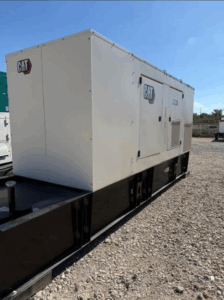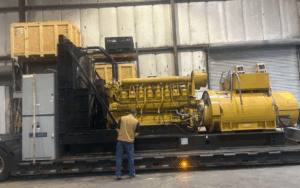
PGE has two identical Detroit Diesel / MTU 1000DSEC diesel generator sets in stock right now — GS4844-2 (399 hours) and GS4844-1 (417 hours). Both are rated 1000kW standby, 1250 KVA, 480V, 3-phase, 60Hz, 1800 RPM. Tier 2 emissions. Weatherproof sound-attenuated enclosures with engine-driven radiators, analog control panels, 1600A main breakers, HotStart systems, Sens EnerGenius battery chargers, and base fuel tanks. The MTU 16V2000 engine inside these units is the same platform that powers military vehicles, marine vessels, and data centers worldwide. Two matched units at this hour range almost never surface at the same time. Priced at $149,000 each. View the GS4844-2 listing or view the GS4844-1 listing, or call PGE at (818) 484-8550.
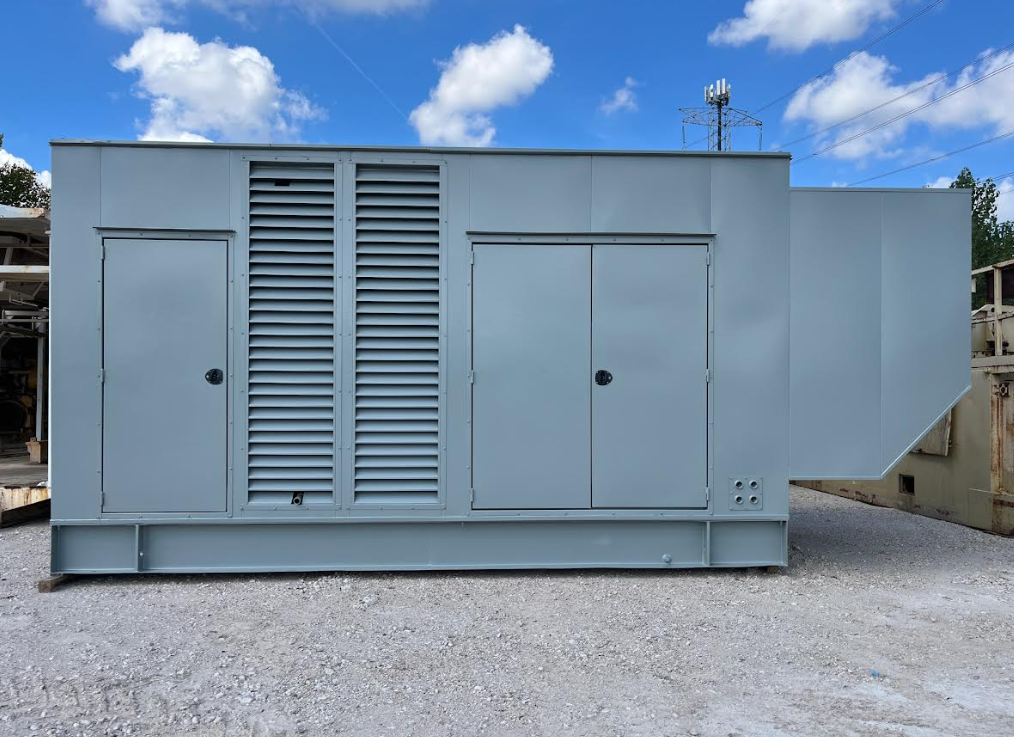
PGE has two Detroit Diesel / MTU 1000DSEC diesel generator sets sitting in our Santa Clarita yard right now. They are identical units from the same original installation, and that matters for buyers in ways we will get to below.
GS4844-2 has approximately 399 hours on the meter. GS4844-1 has approximately 417 hours. Both are rated 1000kW standby, 1250 KVA, 480V, 3-phase, 60Hz, 1800 RPM. Both carry EPA Tier 2 emissions certification. Both came out of standby service where they ran monthly exercise cycles and occasional utility outage events. Under 420 hours on a 1000kW MTU genset means these engines have consumed roughly 1.5% of their useful life before major overhaul.
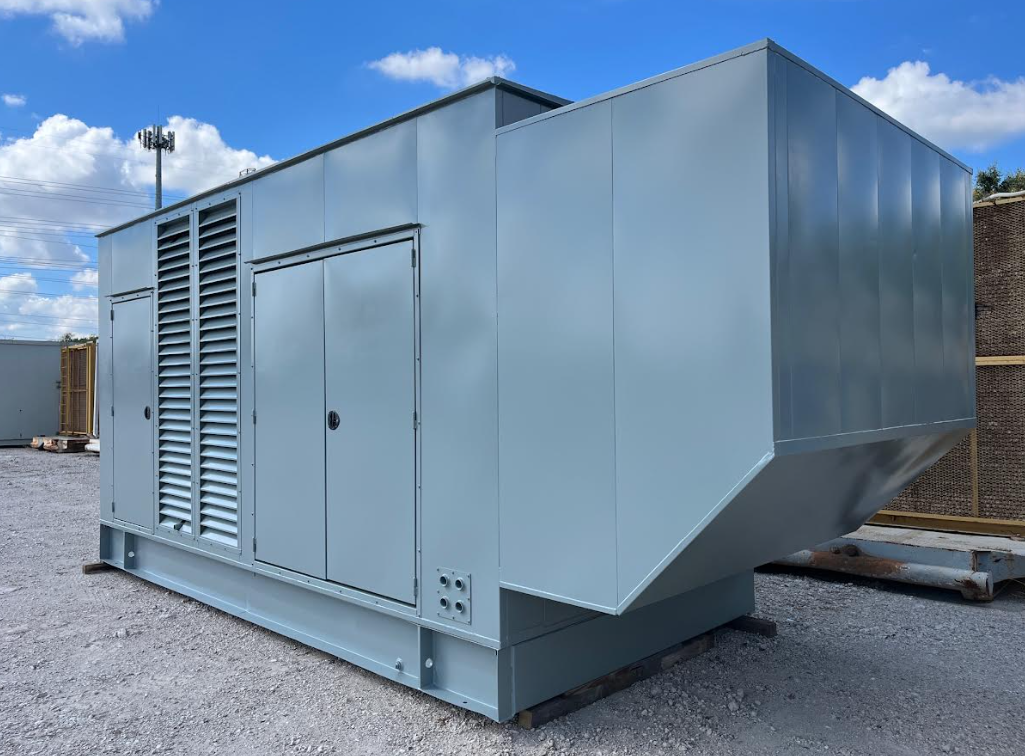
Here is what each package includes: the MTU 16V2000 G86S V16 diesel engine, 31.9 liters of displacement, turbocharged and intercooled. Engine-driven radiator rated for 122F / 50C ambient. Analog control panel with full engine and generator instrumentation. 1600-amp main circuit breaker with LSI trip and shunt trip. HotStart engine block heater for cold-weather readiness. Sens EnerGenius 24V battery charger maintaining starter battery condition during standby. Base-mounted fuel tank for extended runtime without external fuel supply. The entire package sits inside a weatherproof sound-attenuated enclosure suitable for outdoor installation with no additional shelter required.
Priced at $149,000 each. For reference, a new MTU 1000kW diesel genset package from an authorized distributor lists between $350,000 and $450,000 with a 16-24 week lead time. At $149,000 per unit, you are getting a proven MTU platform with sub-420 hours at roughly 35-40 cents on the dollar versus new. View the complete photo galleries and specifications: GS4844-2 listing | GS4844-1 listing. Or call PGE at (818) 484-8550 to schedule an inspection at our yard.
If you have searched for “Detroit Diesel generator” and “MTU generator” and wondered why the same unit shows up under both names, you are not alone. The brand history is tangled, and it confuses buyers constantly. Here is the short version.
Detroit Diesel Corporation built engines in Detroit, Michigan starting in the 1930s. The 2-stroke 71 Series, the V92, the Series 60 highway truck engine, the V149 for large industrial applications. In 2000, DaimlerChrysler (which had acquired Detroit Diesel in 1988) merged the off-highway engine division with MTU Friedrichshafen, the German engine manufacturer based in southern Germany. MTU had been building high-speed diesel engines since the 1960s, primarily for military vehicles, marine vessels, and locomotives. The combined entity operated as MTU Detroit Diesel.
In 2005, the off-highway business was sold to the Swedish investment firm EQT and reorganized under the holding company Tognum, with MTU Friedrichshafen as the core company. In 2008, the former Katolight, Detroit Diesel, Spectrum, and MTU generator brands were consolidated under the MTU Onsite Energy brand name. Then in 2011, Rolls-Royce Holdings and Daimler AG jointly acquired Tognum. By 2014, Tognum became Rolls-Royce Power Systems AG, and the generator products were branded under the mtu name (lowercase, as Rolls-Royce prefers it).
What this means for a buyer looking at units like GS4844-2 and GS4844-1: the “Detroit Diesel / MTU” designation on the nameplate reflects the transition period. The engine inside is an MTU 16V2000 designed in Friedrichshafen, Germany. The genset packaging (enclosure, control panel, switchgear, cooling system integration) was done under the Detroit Diesel Spectrum brand name at the North American facility. Parts availability runs through the Rolls-Royce Power Systems / mtu dealer network, which absorbed the former Detroit Diesel industrial parts supply chain. You can call an mtu distributor, reference the engine serial number, and get parts. The “Detroit Diesel” name on the unit does not create orphan equipment. The supply chain is active and well-stocked. PGE deals with MTU/Rolls-Royce distributors regularly for parts on units exactly like these. Visit our Detroit Diesel brand page for our full inventory under this nameplate.
The engine inside both of these 1000DSEC units is the MTU 16V2000, specifically the G86S variant configured for 60Hz standby power generation at 1800 RPM. This is a 16-cylinder V-configuration engine with 31.9 liters (1,944 cubic inches) of displacement from a 130mm bore and 150mm stroke. It is turbocharged and intercooled with an electronic unit pump fuel injection system.
The Series 2000 is MTU’s workhorse platform for the 500-1250kW generator market. It also powers the Leopard 2 main battle tank (in the 12V2000 variant at 1,500 HP), fast patrol boats, luxury yachts, and mine haul trucks. MTU designed this engine family for extreme reliability in harsh operating environments. The block is a deep-skirt cast iron design with cross-bolted main bearing caps, wet cylinder liners for easy replacement at overhaul, and a gear-driven valve train with no timing belt or chain to worry about.
Fuel efficiency on the 16V2000 at 1000kW is consistently 5-8% better than comparable Caterpillar 3512 or Cummins QST30 engines in the same power class. German manufacturing tolerances on the fuel injection system and combustion chamber geometry produce cleaner, more complete combustion. That translates directly to lower fuel cost per kWh and longer intervals between oil changes, because less unburned fuel dilutes the crankcase oil. At standby loads of 50-100 hours per year, the fuel savings are marginal. At prime or continuous ratings running 4,000+ hours annually, MTU fuel efficiency adds up to tens of thousands of dollars.
Overhaul intervals on the 16V2000 in standby generator service are 24,000 hours to top-end and 48,000 hours to major overhaul, per MTU’s maintenance schedule for standby-rated units with load factors under 30%. For units like GS4844-2 at 399 hours, the first top-end inspection is roughly 23,600 hours away. At typical standby utilization of 50-200 hours per year, that is 118 to 472 years. The engine will outlast the building it protects.
PGE sells more 1000kW generators than any other single power level. It is the inflection point where commercial standby power gets serious, and here is why.
Most commercial buildings run on 2000A, 480V, 3-phase electrical services. A 2000A service at 480V delivers approximately 1,330 kVA, or roughly 1,064 kW at a typical 0.8 power factor. A 1000kW generator covers about 94% of a fully loaded 2000A service. In practice, standby loads after non-essential load shedding run 70-85% of service capacity, putting actual demand right in the 750-900kW range that a 1000kW generator handles with margin.
That math makes 1000kW the standard specification for hospitals and medical centers (Joint Commission requires emergency power for life safety systems and critical care), Class A office towers and commercial high-rises, university campus central plants, manufacturing facilities up to about 150,000 square feet, grocery distribution centers and cold storage warehouses, and municipal water treatment and pumping stations. The MTU 1000DSEC at 1000kW, 1250 KVA, 480V slots directly into these applications. The 1250 KVA rating at 0.8 power factor gives you 1000kW of real power with the reactive power margin that inductive loads (motors, compressors, elevator drives) demand during starting surges.
| Unit / SKU | Make / Engine | kW / Voltage | Hours / Tier | Price |
|---|---|---|---|---|
| MTU 1000DSEC (GS4844-2) | Detroit Diesel / MTU 16V2000 | 1000kW / 480V | 399 hrs / Tier 2 | $149,000 — featured unit, matched pair available |
| MTU 1000DSEC (GS4844-1) | Detroit Diesel / MTU 16V2000 | 1000kW / 480V | 417 hrs / Tier 2 | $149,000 — identical matched unit |
| MTU 900DSEC (GS4824) | MTU 16V2000 | 900kW / 480V | Call / Tier 2 | $120,000 — same engine platform, 900kW rating |
| CAT 3412C (GS4841) | Caterpillar 3412C | 800kW / 480V | Call / N/A | $135,000 — enclosed CAT option at 800kW |
| Cummins QST30 (GS4872) | Cummins QST30 V12 | 1000kW / 480V | Call / Tier 2 | Call — direct Cummins competitor at 1000kW |
| Cummins QSK50 (GS4868) | Cummins QSK50 | 1250kW / 480V | Call / Tier 2 | $295,000 — step up to 1250kW if 1000kW is not enough |
At 1000kW, three engine platforms dominate the market. The MTU 16V2000 in units like GS4844-2. The Cummins QST30 (a 30-liter V12). And the Caterpillar C32 (a 32-liter V12). Each has strengths and trade-offs, and which one you should buy depends on your priorities. PGE published a full comparison at MTU vs Caterpillar vs Cummins: Industrial Generator Comparison 2026, but here is the 1000kW-specific breakdown.
Fuel efficiency. MTU wins. The 16V2000 burns 5-8% less diesel per kWh than the QST30 or C32 at equivalent load factors. Over 1,000 hours at 75% load, that gap equals roughly 3,000-5,000 gallons of fuel. At $4/gallon, that is $12,000-$20,000 in savings. For a standby unit running 100 hours a year, the fuel advantage is real but small in absolute dollars. For a prime-rated unit running 4,000+ hours, the MTU pays for itself on fuel alone.
Parts availability and dealer network. Caterpillar wins. CAT has the densest dealer network in North America with parts warehoused at every branch. Cummins is a close second with their distributor network and Onan/Power Solutions dealers. MTU (now through Rolls-Royce Power Systems) has a thinner North American dealer network. Parts are available but may take 24-48 hours to arrive at remote locations where a CAT dealer could have them on the shelf. For facilities near major metro areas, the difference is negligible. For a mine in rural Nevada, it matters.
Engine complexity. The Cummins QST30 and CAT C32 are both V12 engines with 12 cylinders, 12 injectors, and 12 cylinder liners to service at overhaul. The MTU 16V2000 is a V16 with 16 of each. More cylinders means more parts at overhaul but also means each cylinder works less hard for the same total output. The lower per-cylinder loading on the MTU contributes to its longer overhaul intervals. It is a trade-off: slightly higher overhaul parts cost versus significantly longer intervals between overhauls.
Used market pricing. Caterpillar and Cummins generators command a 15-25% premium over equivalent MTU units on the used market. Brand recognition and dealer network drive that premium. A used Cummins QST30 1000kW with similar hours trades for $159,000-$175,000 (PGE has GS4872 at call-for-price). A CAT C32-based 1000kW with comparable hours sits in the $165,000-$195,000 range. The MTU 1000DSEC at $149,000 with 399 hours is the best value per dollar in the 1000kW class right now. You get a superior engine platform at a lower acquisition cost because the MTU nameplate does not carry the same secondary-market premium as CAT or Cummins. That is an opportunity, not a problem.
If parts network proximity is your deciding factor and you are in a remote location, look at PGE’s Cummins QST30 1000kW inventory or CAT 3512 generators for sale. If you are in a metro area and want the best engine in the class at the lowest price point, the MTU 1000DSEC units are the clear play.
PGE has two identical 1000DSEC units in stock simultaneously. That almost never happens in the used generator market, and it opens options that a single unit cannot.
N+1 redundancy. Install both generators at a single facility with paralleling switchgear. One unit carries the load during a utility outage. The second unit stands by as a backup to the backup. If the primary generator trips on a fault or needs emergency maintenance during an extended outage, the second unit picks up the load with no gap in power. Hospitals, data centers, financial trading floors, and pharmaceutical manufacturing operations require this level of redundancy. Two identical MTU 1000DSEC units at $149,000 each give you 2MW of installed standby capacity with full N+1 protection for $298,000 total. Try pricing that with new equipment.
2MW parallel operation. Configure both units on a paralleling bus to deliver 2000kW from two 1000kW sources instead of one 2000kW unit. Benefits: you can run a single generator at 75-100% load for optimal fuel efficiency during lighter demand, then bring the second unit online when load exceeds 1000kW. Two 1000kW units on a paralleling bus provide better fuel economy across a wide load range than a single 2000kW engine loafing at 40% load. PGE wrote about the economics of this approach in our Cummins QSK60 guide comparing single large engines versus parallel smaller units.
Multi-site deployment. Buy both units, send one to your East Coast facility and one to your West Coast facility. Identical generators at multiple sites mean your maintenance team trains on one platform, stocks one set of spare parts, and uses interchangeable procedures. A hospital system with campuses in two cities. A data center operator with colocation sites in different metros. A university with a main campus and a satellite campus. The operational simplicity of running identical equipment at multiple locations reduces maintenance cost and training overhead. GS4844-1 and GS4844-2 are the same genset down to the part numbers.
Matched pairs with sub-420 hours do not last in PGE’s inventory. If you need one or both of these units, call (818) 484-8550 now and put a deposit down before they are separated to different buyers.
Used MTU generators in the 1000kW class trade between $75,000 for high-hour units (15,000+ hours, approaching overhaul) and $175,000 for low-hour enclosed units with full documentation. The Detroit Diesel / MTU nameplate trades at a discount to equivalent Caterpillar and Cummins units, which works in the buyer’s favor. The GS4844-2 at $149,000 with 399 hours sits in the upper-middle of the used MTU range, which reflects the extremely low hours and complete, turnkey package.
When inspecting a used MTU 16V2000, here is what matters most. First, pull the oil analysis history. MTU engines run tight tolerances. Elevated iron, copper, or silicon in the oil analysis trends signal wear on specific components. Iron means liner or ring wear. Copper means bearing wear. Silicon means an air filtration breach. If the seller has oil analysis reports from every oil change interval, that is a good sign. If there are none, budget for an oil sample and lab analysis ($50-$100) before committing.
Second, check the turbocharger. The 16V2000 runs a single large turbocharger or twin turbos depending on the variant. Grab the compressor wheel and push it laterally. Any perceptible radial play beyond 0.003 inches means the turbo bearings are worn and replacement is coming. A new turbo for this platform runs $4,000-$8,000. On a 399-hour or 417-hour unit, turbo play should be essentially zero.
Third, verify the cooling system. Engine-driven radiator units like the GS4844-1 are self-contained, but the radiator core is the most exposed component on the package. Look for fin damage, corrosion on the tube faces, and coolant weeping at the tank-to-core joints. Coolant should test at the correct glycol concentration (50/50 in most climates) and the pH should be above 8.0. Acidic coolant eats aluminum components from the inside out.
Fourth, run the unit under load. Any reputable seller load-tests before sale. PGE load-banks every generator at our Santa Clarita facility. You want to see the unit start, stabilize at operating temperature, accept 25%, 50%, 75%, and 100% load steps, and hold rated voltage and frequency within specification. Watch exhaust color under load: clean gray is normal, black smoke at rated load means the injectors need attention. On units this fresh, the test should be clean across all load steps. Call (818) 484-8550 to schedule a witnessed load test on either GS4844-2 or GS4844-1.
PGE carries deep inventory across the 800-1250kW range from every major manufacturer. Below is a snapshot of what we have available right now, including the MTU 1000DSEC units featured in this post.
If you need more power, PGE stocks 1250kW units from Cummins and Spectrum/MTU, including a Cummins QSK50 at 1250kW for $295,000 and a Spectrum Detroit Diesel/MTU containerized 1250kW for $175,000. For significantly more power, see PGE’s guides on the Cummins QSK60 at 2000kW and the Kohler 2000REOZMD at 2000kW (which uses an MTU 16V4000 engine, by the way).
If you have a Detroit Diesel, MTU, or any 800-1250kW generator you want to sell, PGE buys industrial generators outright. No consignment, no auction fees. We make a direct offer and wire funds. Visit our We Buy Industrial Generators page or go to Sell Your Equipment and submit your unit details. Or call (818) 484-8550 and tell us what you have.
The GS4844-2 and GS4844-1 are the featured units here because finding two identical sub-420-hour MTU 1000kW generators is genuinely rare. The matched pair opens N+1, paralleling, and multi-site options that no single unit can offer. At $149,000 per unit on the MTU 16V2000 platform, these are the best value in the 1000kW diesel generator market. Call (818) 484-8550 before they are gone.
Not exactly, but close enough that it matters for parts and support. Detroit Diesel’s off-highway engine division merged with MTU Friedrichshafen in 2000. The combined entity went through several ownership changes and is now part of Rolls-Royce Power Systems, operating under the mtu brand. The MTU 1000DSEC units at PGE carry the “Detroit Diesel / MTU” nameplate because they were built during the transition period. The engine is an MTU 16V2000 designed in Germany. Parts and service flow through the mtu / Rolls-Royce dealer network. The Detroit Diesel name on the unit does not mean orphan equipment. Call (818) 484-8550 for specifics on parts sourcing.
In standby service with load factors under 30%, MTU specifies 24,000 hours to top-end inspection and 48,000 hours to major overhaul. At typical standby utilization of 50-200 hours per year, that is 120-480 years to the first top-end. The GS4844-2 at 399 hours and GS4844-1 at 417 hours have consumed about 1.5% of their life before the first major maintenance event. For prime or continuous-duty applications running 4,000+ hours per year, adjust intervals to 12,000 hours top-end and 24,000 hours major overhaul. MTU’s maintenance schedule is published in the operator’s manual that ships with each unit.
The MTU 16V2000 burns 5-8% less fuel per kWh than the Cummins QST30 at equivalent loads. The MTU has a V16 configuration versus the QST30’s V12, meaning each cylinder works less hard and overhaul intervals are longer. The trade-off is parts network: Cummins has a denser North American dealer network than MTU/Rolls-Royce. On the used market, the MTU trades at a 15-25% discount to equivalent Cummins units, making units like the GS4844-2 at $149,000 a better value per dollar. PGE stocks both platforms. See our Cummins QST30 1000kW inventory or the full MTU vs CAT vs Cummins comparison.
Yes. Two identical MTU 1000DSEC generators on a paralleling bus deliver 2000kW of combined output. You need paralleling switchgear with automatic synchronization, load sharing controls, and protective relaying. Budget $35,000-$75,000 for the switchgear, depending on complexity. The advantage of paralleling two 1000kW units over buying a single 2000kW generator: better fuel efficiency across variable loads (run one unit at 75-100% instead of one large unit at 40%), built-in redundancy (lose one generator, the other still carries 1000kW), and lower acquisition cost ($298,000 for two MTU 1000kW units versus $350,000+ for a single used 2000kW). Call (818) 484-8550 to discuss paralleling configurations.
A new MTU 1000kW diesel generator set from an authorized distributor lists between $350,000 and $450,000 with a 16-24 week lead time from the factory. The GS4844-2 at $149,000 with 399 hours represents 35-40 cents on the dollar versus new, and it is available for immediate shipment from PGE’s Santa Clarita yard. The MTU 16V2000 engine in this unit has consumed roughly 1.5% of its useful life. You are paying less than half of new-equipment cost for a unit that is functionally new. PGE load-tests, services, and inspects every unit before sale.
Yes. PGE buys Detroit Diesel, MTU, and Rolls-Royce-branded generators in any condition, any power rating, running or not. We buy outright with no consignment and no auction fees. We make a direct offer and wire funds on closing. Visit our We Buy Industrial Generators page, go to Sell Your Equipment, or call (818) 484-8550 and tell us what you have. PGE has particular interest in MTU Series 2000 and Series 4000 units because demand for these platforms remains strong.
PGE has two identical Detroit Diesel / MTU 1000DSEC diesel generator sets at our Santa Clarita, CA facility. GS4844-2 with 399 hours and GS4844-1 with 417 hours. Both rated 1000kW, 1250 KVA, 480V, Tier 2, weatherproof enclosed with HotStart, battery charger, base fuel tank, and 1600A main breaker. $149,000 each. Matched pairs at this hour range do not last. View the listings, or call PGE at (818) 484-8550 to schedule an inspection, request oil analysis reports, or arrange a load test. We ship nationwide.