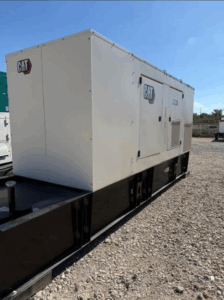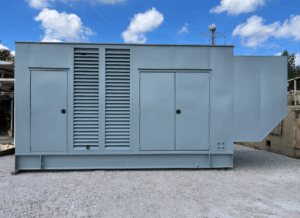
PGE has a Caterpillar 3516DITA 1850kW high voltage diesel generator set in stock — SKU GS4851. Pre-owned with approximately 480 hours since new. Rated 1850kW standby, 2312 KVA, 7200/12470V, 3-phase, 60Hz, 1800 RPM. Open skid mounted with engine-driven radiator, shipped-loose control panel, and jacket water heater. Approximately 23’L x 12’2″H x 8’7″W, ~40,000 lbs. This is a medium voltage unit configured for 12.47kV distribution — ideal for data centers, utility peaking, mining operations, and large industrial facilities with existing MV switchgear. Priced at $175,000. View the full GS4851 listing with photos and specs, or call PGE at (818) 484-8550.
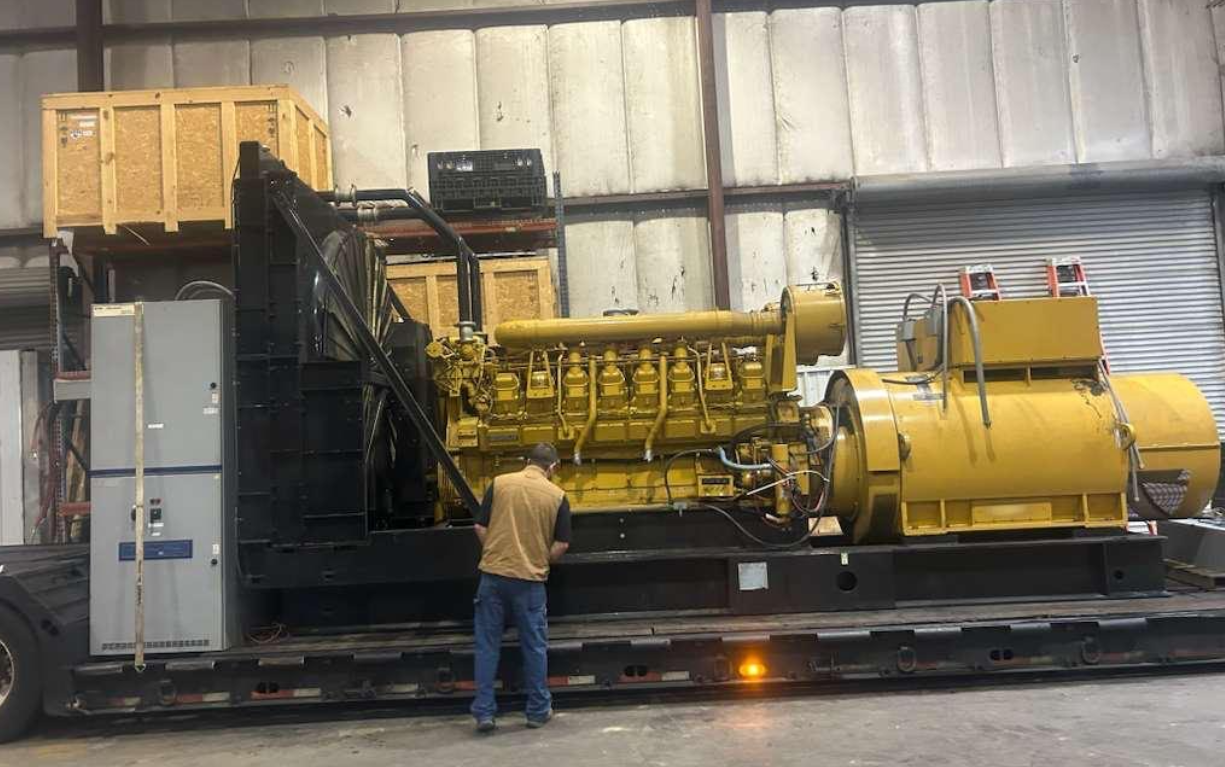
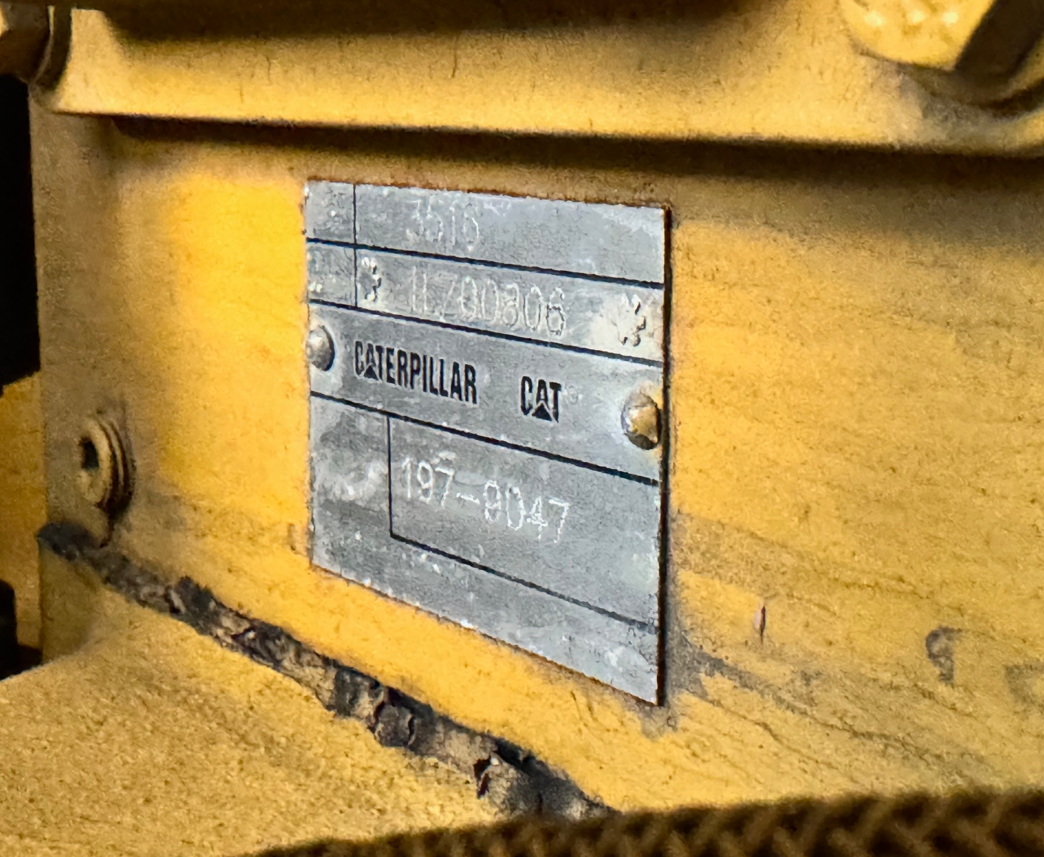
The unit sitting in PGE’s Santa Clarita yard right now — SKU GS4851 — is a Caterpillar 3516DITA diesel generator set rated at 1850kW standby, 60Hz, 7200/12470V, 1800 RPM. It has approximately 480 hours since new. For a 3516 platform engine rated at 20,000+ hours to major overhaul, 480 hours is barely past the break-in period. This engine has consumed roughly 2.4% of its useful life.
Here is what the package includes: the CAT 3516DITA V16 diesel engine driving a medium voltage generator end rated at 2312 KVA / 7200/12470V / 3-phase / 60Hz / 1800 RPM. Open skid mounted — no enclosure. Engine-driven radiator for cooling. Shipped-loose control panel (meaning the control panel was removed for transport and ships separately on a pallet). Jacket water heater to keep the engine block warm for fast starts. Overall dimensions are 23 feet long, 12’2″ tall, 8’7″ wide. Weight is approximately 40,000 lbs.
The critical detail on this unit is the voltage: 7200/12470V. That is 12.47kV line-to-line, 7.2kV line-to-neutral. This is not a standard 480V generator that you wire into a building panel. This is a medium voltage machine designed to connect directly to utility-class switchgear, step-up substations, or a facility’s MV distribution bus. The buyer who needs this unit already knows they need it. View all photos and specs on the GS4851 listing.
Priced at $175,000. For reference, a new CAT 3516-series generator package at this power level lists north of $800,000 with a 6-12 month lead time from the factory. A used 3516DITA with 480 hours at this price point represents a substantial acquisition opportunity for any facility that can use 12.47kV output. Call PGE at (818) 484-8550 or view the listing directly.
Most industrial generators produce 480V. That covers the vast majority of commercial and industrial standby applications: hospitals, manufacturing plants, data centers under 5MW, office buildings. So why does a generator like GS4851 exist at 12,470V?
The answer is physics and economics. At 480V, delivering 1850kW requires approximately 2,225 amps of current. That current needs massive copper conductors — typically 4000A-rated bus duct or multiple parallel sets of 500 MCM cables. Run those cables more than 200 feet and voltage drop becomes a real engineering problem. The I²R losses in the conductors waste fuel and generate heat. The cable trays, conduit, and bus duct cost a fortune to install.
At 12,470V, that same 1850kW only requires about 86 amps. The cables are dramatically smaller — a single set of #1 AWG conductors can handle the load. You can run power a mile with negligible voltage drop. The switchgear is more compact per kVA. The infrastructure cost for distributing medium voltage power across a large campus or between buildings drops by 60-80% compared to 480V distribution at the same wattage.
Facilities that need 12.47kV generators fall into specific categories. Data center campuses above 5MW where multiple generators parallel onto a medium voltage bus, then step down to 480V at each server hall through unit substations. Utility peaking plants where the generator connects directly to the distribution grid through a recloser or breaker. Mining operations with long cable runs to remote load centers — haul truck charging stations, dragline feeds, processing plant motors. Large industrial campuses — refineries, chemical plants, steel mills — with existing 12.47kV or 13.8kV distribution infrastructure. Municipal water and wastewater facilities with large MV motor loads (pump stations with 4160V or higher motors). In every case, the facility already has medium voltage switchgear and distribution. A 12.47kV generator plugs into that existing infrastructure without step-up transformers.
If your facility runs on 480V, this is not the unit for you. Look at PGE’s CAT 3512 inventory or the 480V 3516 options below. But if you have a medium voltage bus and you need a CAT 3516 to tie into it, the GS4851 at $175,000 is the unit.
The designation “3516DITA” tells you exactly what this engine is. 3516 = Caterpillar’s V16 diesel platform, 78.1 liters (4,765 cubic inches) of displacement from a 170mm bore and 215mm stroke. The “DITA” suffix means Direct Injection, Turbocharged, Aftercooled. This is the original mechanical fuel injection version of the 3516 family — no electronic fuel system, no HEUI injectors. Fuel delivery is handled by mechanically actuated unit injectors governed by a mechanical rack. The turbocharger feeds compressed air through an air-to-water aftercooler to increase charge air density and power output.
Caterpillar produced four major variants of the 3516 platform. The original 3516 (mechanical) and the 3516DITA are essentially the same generation — both use mechanical fuel injection and produce 1750-2000kW depending on rating and application. The 3516B introduced electronic fuel injection with the ADEM III controller, improving fuel efficiency by 3-5% and adding digital monitoring. The 3516C / 3516C HD pushed output to 2500kW+ with the ADEM A4 controller, higher boost pressures, and redesigned pistons.
The 3516DITA’s mechanical simplicity is its defining advantage. No ECM to fail. No harness issues. No software updates. The governor is mechanical. The fuel system is mechanical. The engine will start and run with nothing more than fuel, coolant, oil, and battery power to the starter. For remote sites, mining operations, or facilities in developing regions where electronic diagnostic tools and CAT technicians are not readily available, the DITA variant is the preferred platform. It is the reason GS4851 uses this specific engine variant — mechanical reliability in applications where uptime matters more than the last 3% of fuel efficiency.
At 1850kW standby, the 3516DITA sits between the 3512 family (which tops out around 1500kW in the C HD variant) and the 3516C (2000-2500kW). PGE wrote a detailed breakdown of the CAT 3512 platform here. If 1850kW is more than you need, the 3512 is a smaller, lighter, less expensive option — but it does not come in medium voltage from the factory. If you need 2000kW+ at 480V, the 3516B or 3516C is the move. PGE has those too — see the comparison table below.
| Unit / SKU | Engine | kW / Voltage | Config / Tier | Price / Notes |
|---|---|---|---|---|
| CAT 3516DITA (GS4851) | CAT 3516DITA V16 | 1850kW / 12470V | Open Skid / N/A | $175,000 — 480 hrs, 12.47kV MV output, mechanical DITA, featured unit |
| Cummins QSK60 DQKAB (GS4845) | Cummins QSK60 | 2000kW / 12470V | Sound Attenuated / Tier 2 | $295,000 — enclosed 2000kW at 12.47kV, direct MV competitor |
| CAT 3516C (GS4826) | CAT 3516C | 2000kW / 4160V | Containerized / Tier 2 | Call — containerized 3516C at 4160V, MV with different bus voltage |
| 2013 CAT 3516C (GS4863) | CAT 3516C | 2500kW / 480V | Weather Enclosed / Tier 2 | Call — 2500kW enclosed, standard 480V if MV is not required |
| CAT 3516B (GS4790) | CAT 3516B | 2000kW / 480V | Open Skid / N/A | Call — electronic 3516B at 480V, open skid like GS4851 |
| Cummins QSK60 DQKAB (GS4864) | Cummins QSK60 | 2000kW / 480V | Weather Enclosed / Tier 2 | $565,000 — 2000kW enclosed at 480V, paired units available |
A 12,470V generator is a specialty product. The pool of buyers is smaller than the 480V market, but the buyers are sophisticated and know exactly what voltage they need before they start shopping. Here is who buys a unit like GS4851.
Data center operators at scale. Hyperscale and colocation data centers above 10MW routinely use 12.47kV or 13.8kV medium voltage generator plants. Multiple generators parallel onto a MV bus through medium voltage paralleling switchgear, and unit substations step power down to 480V at each server hall. At this scale, running 480V from the generator plant to the IT load is not feasible — the cable cost alone would exceed the generator cost. The generators feed an MV bus, and the bus feeds step-down transformers distributed throughout the campus. A 3516DITA at 12.47kV drops directly onto that MV bus with compatible switchgear.
Utility peaking and distributed generation. Municipal utilities and co-ops use medium voltage generators as peaking units during high-demand periods. The generator connects to the utility’s 12.47kV distribution feeder through a recloser or circuit breaker. The output is already at distribution voltage — no step-up transformer required. For temporary utility peaking applications, a used 3516DITA at $175,000 is orders of magnitude cheaper than a new gas turbine peaking plant. PGE ships units like GS4851 to utilities and IPPs (independent power producers) across the U.S.
Mining operations. Open-pit and underground mines distribute power at medium voltage because the cable runs from the substation to the load centers can be thousands of feet. Haul truck charging stations, electric shovels, crushing plants, conveyor drives — all of these loads sit at the end of long MV feeders. A 12.47kV generator at the mine’s main substation integrates directly into the existing distribution without adding transformers or dealing with voltage drop on extended 480V runs.
Large industrial campuses. Refineries, chemical plants, paper mills, and steel mills with 12.47kV or 4160V distribution systems. PGE also stocks medium voltage units at 4160V — including the GS4826 CAT 3516C at 2000kW/4160V and a Cummins QSK60 DQKAB at 2000kW/12470V (GS4845). The voltage has to match the existing bus. If you need 4160V instead of 12.47kV, call (818) 484-8550 and we will walk you through options.
Buying a used medium voltage generator adds inspection steps that do not apply to a standard 480V unit. The engine side is the same — oil analysis, turbo play, coolant condition, fuel system health. But the generator end and the associated electrical infrastructure require specific attention.
Insulation resistance testing (megger test). This is non-negotiable on any medium voltage generator. You need a megohmmeter rated for at least 5kV DC test voltage. Apply test voltage between each phase winding and ground, and between phase-to-phase. At 12.47kV operating voltage, minimum acceptable insulation resistance is 100 megohms at operating temperature. Below that, the stator winding is degraded and the generator is a candidate for a rewind — which runs $40,000-$80,000 on a machine this size. On a 480-hour unit like GS4851, insulation resistance should be well above 1,000 megohms. PGE can provide megger test results — call (818) 484-8550.
Surge arrester and PT/CT condition. Medium voltage generators use surge arresters (lightning/switching surge protection) and instrument transformers — potential transformers (PTs) and current transformers (CTs) — for metering and protective relaying. Verify all surge arresters are intact and have not been cracked or thermally damaged. Confirm PTs and CTs are correctly rated for 7200/12470V and that their accuracy class matches the protective relay requirements. Failed instrument transformers can cause nuisance trips or, worse, fail to trip when they should.
Switchgear compatibility. Before you buy any medium voltage generator, confirm your facility’s switchgear is rated for the generator’s output voltage and fault current contribution. A 3516DITA at 12.47kV has a subtransient reactance that determines its maximum fault current contribution. Your switchgear bus bracing must handle the combined fault current of the generator plus any utility or other sources. An engineer needs to run a short-circuit study before the unit is energized. This is not a plug-and-play installation.
Winding temperature detectors (RTDs or thermocouples). Medium voltage stator windings embed temperature sensors to protect against overheating. Verify all RTDs read correctly and that the temperature monitoring circuit in the control panel is functional. A dead RTD on an MV generator means you lose thermal protection on that phase — and a winding failure at 12.47kV is catastrophic. On the GS4851 control panel, PGE can demonstrate RTD functionality during your inspection.
The used CAT 3516 market covers a wide range. Original 3516 and 3516DITA units with 10,000+ hours trade between $35,000 and $75,000. Low-hour 3516DITA units in the 500-2,000 hour range sell for $100,000 to $200,000 depending on voltage and configuration. The 3516B commands $125,000 to $250,000 in similar condition. The 3516C and 3516C HD — the newest and most powerful variants — range from $200,000 for high-hour open units to $450,000+ for low-hour enclosed packages.
Medium voltage configuration affects pricing in both directions. On the sell side, MV units take longer to move because the buyer pool is smaller. A 480V 3516 at 2000kW will sell faster than a 12.47kV unit because more facilities operate at 480V. On the buy side, that smaller market means better deals for the buyer who actually needs MV. The GS4851 at $175,000 is priced below where a comparable 480V unit with 480 hours would trade — precisely because it is a high voltage unit and the seller knows the audience is narrower.
For comparison, PGE also stocks a Cummins QSK60 DQKAB at 2000kW/12470V (GS4845) priced at $295,000. That unit is a newer platform with sound-attenuated enclosure and base fuel tank. If you need the enclosure and the extra 150kW, the QSK60 is the alternative. If you have a building or enclosure pad and 1850kW is sufficient, the 3516DITA at $175,000 saves you $120,000 and gives you the CAT platform’s aftermarket parts availability. Read PGE’s full comparison of containerized vs. enclosed vs. open skid generators to decide if the open skid configuration works for your site.
PGE carries a deep inventory of generators in the 1500-2000kW range from Caterpillar, Cummins, Kohler, and MTU. At this power level, the CAT 3516 and Cummins QSK60 dominate the market. Below is a snapshot of what we have available right now, including the GS4851 featured in this post.
For a full walkthrough of the Cummins QSK60 platform, read PGE’s QSK60 generator guide. For the Kohler 2000kW REOZMD, see our Kohler 2000REOZMD guide. If you need less power, PGE has written detailed guides on the Cummins QSK50 at 1250kW and the Cummins QST30 at 1000kW.
If you have a CAT 3516, a Cummins QSK60, or any 1500-2000kW generator you want to sell, PGE buys industrial generators outright. No consignment, no auction fees — we make a direct offer and wire funds. Visit our We Buy Industrial Generators page or go to Sell Your Equipment and submit your unit details. Or call (818) 484-8550 and tell us what you have.
The CAT 3516DITA 1850kW GS4851 is the featured unit here because there are very few low-hour medium voltage 3516 generators on the secondary market at any given time. At 480 hours, $175,000, and the 3516DITA’s mechanical simplicity, this unit fits a specific buyer perfectly. If you have a 12.47kV bus and need 1850kW of standby or prime power on a CAT platform, browse PGE’s full Caterpillar inventory or call (818) 484-8550 to discuss this unit directly.
Not directly. A 12,470V generator like the GS4851 produces medium voltage output that requires a step-down transformer to convert to 480V. Adding a transformer is technically feasible but adds $15,000-$40,000 to the project cost and defeats the purpose of buying a medium voltage unit. If your facility operates at 480V, PGE stocks CAT 3516B and 3516C generators at 480V — see the comparison table above or call (818) 484-8550 for 480V options.
Both are medium voltage, but they serve different distribution systems. 4160V is common in older industrial plants, oil refineries, and facilities with large MV motors (compressors, pumps, blowers). 12,470V (12.47kV) is the standard U.S. utility distribution voltage and is used in data centers, utility peaking plants, and newer industrial facilities designed around the utility voltage class. The GS4851 is 12470V. PGE also stocks 4160V units including the GS4826 CAT 3516C at 4160V. Call (818) 484-8550 to discuss which voltage fits your bus.
The 3516DITA is the mechanical fuel injection variant — Direct Injection, Turbocharged, Aftercooled. No ECM, no electronic fuel system, no software dependencies. The 3516B added electronic fuel injection (ADEM III controller), improving fuel efficiency 3-5%. The 3516C and 3516C HD use the ADEM A4 controller, push output to 2000-2500kW, and meet Tier 2/Tier 4 emissions. The DITA is simpler to maintain and repair in the field, which is why it remains popular for remote sites and mining. PGE stocks all variants — view the 3516DITA GS4851 or call (818) 484-8550 for 3516B/3516C availability.
You need 15kV-class metal-clad switchgear with vacuum circuit breakers rated for the generator’s fault current contribution plus any other sources on the bus. The switchgear must include protective relaying (87G differential, 51V voltage-restrained overcurrent, 40 loss of excitation, 32 reverse power, and 59G ground fault protection at minimum). Common switchgear manufacturers for this application include Eaton, Schneider Electric, ABB, and Siemens. The short-circuit study must be completed before ordering switchgear. PGE can provide the generator reactance data for GS4851 — call (818) 484-8550.
Extremely low. Caterpillar rates the 3516 platform for 20,000-30,000 hours to major overhaul depending on loading and maintenance program. A unit with 480 hours has used roughly 2% of its useful life. In standby service running 100-200 hours per year, this engine will run for over a century before the first major overhaul. PGE’s GS4851 at 480 hours is essentially a new engine in a used package at a fraction of new-equipment cost. Call (818) 484-8550 for the full maintenance history.
Yes. PGE load tests every generator at our Santa Clarita, CA facility (26764 Oak Ave, Santa Clarita, CA 91351). Medium voltage units require load bank equipment rated for the output voltage. We verify output at 25%, 50%, 75%, and 100% load steps, monitor winding temperatures, confirm voltage regulation and frequency stability, and check all protective relay setpoints. On the GS4851, we document megger test results, AVR performance, and load-step response. Buyers can attend in person or request a video. Call (818) 484-8550 to schedule.
The Caterpillar 3516DITA 1850kW diesel generator set — SKU GS4851 — is at PGE’s Santa Clarita facility with approximately 480 hours, 12470V medium voltage output, open skid mount, engine-driven radiator, and jacket water heater. Priced at $175,000. Low-hour medium voltage 3516 generators rarely surface on the secondary market, and this one is priced well below comparable 480V units with similar hours. View the full listing with all photos, specifications, and dimensions, or call PGE at (818) 484-8550 to schedule an inspection, request megger test data, or arrange a load test.