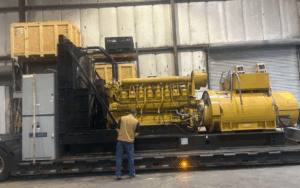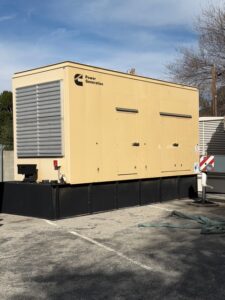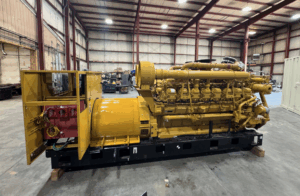
PGE has a Cummins QST30-G5 NR2 1000kW Tier 2 diesel generator set in stock — SKU GS4731. Pre-owned with approximately 449 hours since new, rated 1000kW standby / 900kW prime, 1250 KVA, 480V/3-phase/60Hz, 1800 RPM. Weatherproof sound-attenuated enclosure, PowerCommand digital control panel, 1600A main breaker, 2400-gallon UL-listed base fuel tank, engine-driven radiator. EPA Tier 2 compliant. Located at our Santa Clarita, CA yard and ready to ship. Priced at $225,000. View the full GS4731 listing with photos and specs, or call PGE at (818) 484-8550.
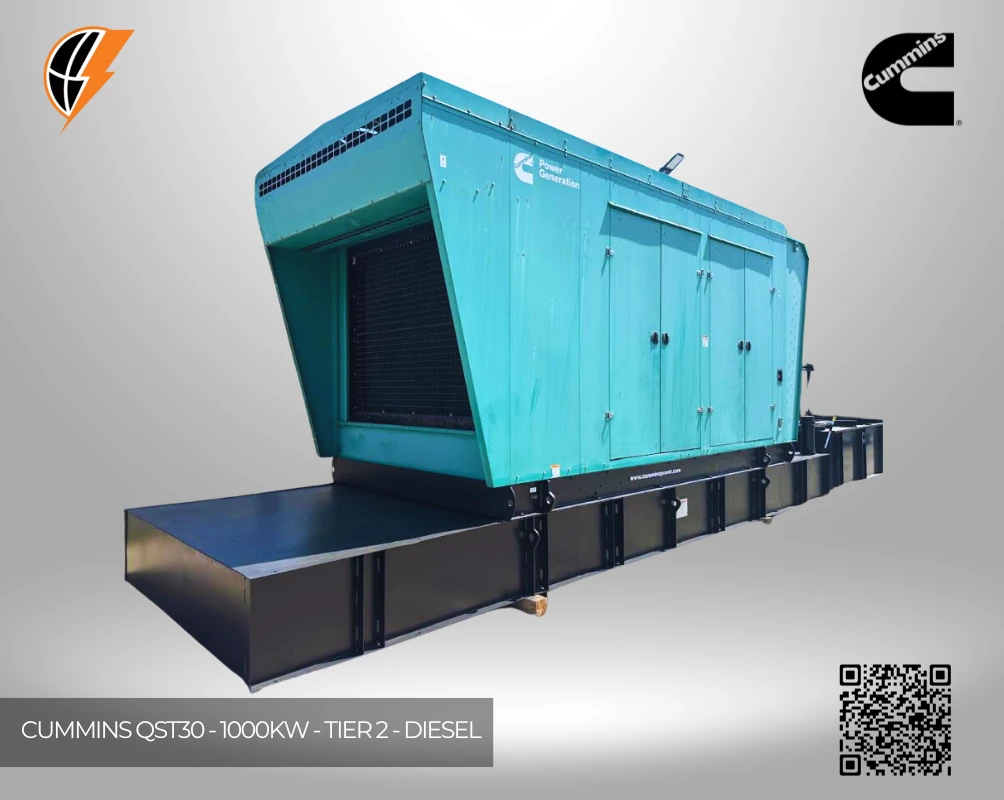
The unit on our lot right now — SKU GS4731 — is a Cummins QST30-G5 NR2 diesel generator set rated at 1000kW standby / 900kW prime. It has approximately 449 hours since new. That is low for a QST30. Standby units in commercial service might accumulate 50-100 hours per year on exercise and the occasional transfer event. 449 hours means this engine has barely started its useful life.
Here is what the package includes: a weatherproof, sound-attenuated enclosure measuring 27’8″ long by 8’2″ wide by 11’10” tall, weighing 31,000 lbs. Inside that enclosure sits the QST30-G5 NR2 engine driving a generator end rated at 1250 KVA / 480V / 3-phase / 60Hz / 1800 RPM. The package includes a PowerCommand digital control panel, a 1600-amp main breaker, an engine-driven radiator, and a 2400-gallon UL-listed sub-base fuel tank. At full load the QST30-G5 consumes roughly 72 gallons per hour, so that 2400-gallon tank gives you over 33 hours of continuous runtime at 100% standby load. At 75% load — which is where most standby generators spend their emergency hours — consumption drops to about 54 GPH, extending runtime past 44 hours. That is enough fuel autonomy for most emergency scenarios without a refueling truck.
This unit is EPA Tier 2 compliant, located in Newhall, CA (our Santa Clarita yard), and priced at $225,000. View the full GS4731 listing with all photos and specifications here.
The “30” in QST30 stands for the engine displacement: 30.5 liters (1,860 cubic inches). It is a 50-degree V12 with a cast iron block and head, 140mm bore, 165.1mm stroke, and a 14.7:1 compression ratio. Turbocharged and low-temperature aftercooled. The G5 variant is the generator drive version, and the NR2 designation means it meets EPA Tier 2 non-road emissions standards.
Cummins designed the QST30 as the bridge between the smaller QSX15 (a straight-six making 500kW) and the much larger QSK50 (a V16 making 1250kW). At 1000kW standby, the QST30 occupies the most requested power class in the industrial generator market. Data centers, hospitals, water treatment plants, manufacturing facilities, large commercial buildings — the 1000kW node is where most mission-critical standby loads land. Too much power is wasted money. Too little means you are undersized for the load and risking a blackout on the loads you were supposed to protect.
The QST30-G5 NR2 produces 1,112 kWm (1,490 bhp) at the crankshaft at 1800 RPM. The oil capacity is 154 liters (162.8 quarts), and oil change intervals run to 500 hours or 12 months, whichever comes first. Life to major overhaul is rated at 20,000 hours by Cummins. In standby service running 100-200 hours per year, that is a century of engine life before you need to think about a major teardown. Even in prime service running 4,000 hours annually, you get five years between major overhauls.
The engine powers a range of Cummins factory-packaged generator sets. The DQFAD is the enclosed 1000kW standby/900kW prime 60Hz package — which is what GS4731 essentially is. The DQFAC covers the 60Hz prime-rated packages, and the DFHA/DFHB designations cover the 750-800kW configurations of the same engine.
If you are shopping for a 1000kW diesel generator, the conversation always comes down to two engines: the Cummins QST30 and the Caterpillar C32. They compete head-to-head at this power class and have for decades.
The CAT C32 displaces 32.1 liters from a V12 configuration — slightly larger than the QST30’s 30.5 liters. The C32 has a 145mm bore and 162mm stroke with a 15.0:1 compression ratio. At 1000kW standby, both engines are loafing. Neither is at the ragged edge of its mechanical limits, which is good for longevity.
Where they diverge is in parts cost, controller ecosystem, and resale value. CAT generators consistently hold higher resale values due to the Caterpillar brand premium and the larger CAT dealer network. That is good if you are selling, but it means you pay more to buy one. A used C32 1000kW unit in comparable condition to GS4731 typically lists $20,000-$40,000 higher than the Cummins equivalent. The Cummins PowerCommand controller is arguably more intuitive than CAT’s EMCP system, and Cummins parts are generally 10-15% cheaper on consumables like filters, injectors, and turbocharger kits.
PGE stocks both. We have CAT C32 units including the GS4805 (new surplus C32, 1000kW Tier 4) and the GS4848 CAT XQ1140 rental grade. Browse our full CAT generator inventory here. But if total cost of ownership matters more than badge, the QST30 wins.
PGE also sells Cummins QSK50 (1250kW) and QSK60 (2000kW) generators. We wrote a full guide on the QSK60 and a detailed walkthrough of the QSK50 DQGAA package. Those are excellent platforms. But if your load analysis says 1000kW, do not buy a 1250kW or 2000kW generator just because someone told you to “leave headroom.”
Generator engines are most efficient and most durable when loaded between 50% and 80% of their rated capacity. A 1000kW generator running a 700kW load operates at 70% — right in the sweet spot. A 1250kW QSK50 carrying the same 700kW load operates at 56%, which is acceptable but less efficient. A 2000kW QSK60 at 700kW operates at 35% — below the minimum recommended loading for long-term engine health. Light loading causes wet stacking, carbon buildup, and accelerated wear on the liner seals.
The QSK50 at 1250kW costs $40,000-$80,000 more than a comparable QST30 at 1000kW. The QSK60 at 2000kW is in a different galaxy — $300,000-$600,000 depending on hours and configuration. If you only need 1000kW, the QST30 GS4731 at $225,000 is the right-sized solution. You get a Cummins V12 with a 20,000-hour overhaul life, a sound-attenuated enclosure, a 2400-gallon tank, and 449 hours on the clock. That is the machine for the job.

| Unit / SKU | Engine | kW / Voltage | Enclosure / Tier | Price / Notes |
|---|---|---|---|---|
| Cummins QST30 (GS4731) | QST30-G5 NR2 | 1000kW / 480V | Weather Enclosed / Tier 2 | $225,000 — 449 hrs, 2400-gal tank, sound attenuated, featured unit |
| Cummins DQFAD (GS4756) | QST30-G5 | 1000kW / 480V | Weather Enclosed / Tier 2 | $210,000 — enclosed DQFAD package, Tier 2 compliant |
| Cummins DQFAD (GS4833) | QST30 | 1000kW / 480V | Open Skid / Tier 2 | $159,000 — open skid, best value QST30 at 1000kW |
| MTU 1000DSEC (GS4844-1) | MTU 16V2000 | 1000kW / 480V | Weather Enclosed / Tier 2 | $149,000 — lowest-priced enclosed 1000kW in stock |
| NEW Cummins QST30 (GS4829) | QST30 | 1000kW / 480V | Open Skid / Tier 4 Final | $275,000 — brand new, full Cummins warranty, Tier 4 compliant |
| CAT 3412C (GS4841) | CAT 3412C | 800kW / 480V | Weather Enclosed / Tier 2 | $135,000 — step down to 800kW on the proven CAT 3412 platform |
The used Cummins QST30 1000kW market has tightened over the past two years. New DQFAD packages from Cummins list around $350,000. Used Tier 2 units in sound-attenuated enclosures with under 1,000 hours are trading between $175,000 and $250,000 depending on fuel tank size, controller generation, and overall condition. Open-skid units without enclosures trade between $130,000 and $175,000. Tier 4 Final units command a premium — expect $250,000-$300,000 for low-hour enclosed packages.
PGE’s GS4731 at $225,000 sits in the middle of the enclosed Tier 2 range, which reflects the 449 hours, the 2400-gallon tank, and the complete weatherproof enclosure. Compare that to our open-skid GS4833 at $159,000 — same QST30 engine, same kW, but no enclosure. The difference between those two prices is essentially what you pay for a factory sound-attenuated enclosure with integrated fuel storage. If you already have a generator building or enclosure pad, the open-skid unit saves you $66,000.
When inspecting a used QST30, pull the PowerCommand controller history first. The controller logs fault codes, load history, and alarm events going back to commissioning. Repeated high-coolant-temp or low-oil-pressure alarms mean the unit was abused or neglected. Clean logs with routine maintenance codes tell you the unit was professionally maintained. PGE pulls controller data on every unit we inventory. Call (818) 484-8550 and ask for the controller report on GS4731.
Beyond the controller, the critical inspection points on a QST30 are: turbocharger shaft play (grab the compressor wheel and check for radial movement — more than 0.005″ is a rebuild), coolant condition (check for oil contamination indicating a head gasket or aftercooler core issue), lube oil analysis (send a sample to a lab for metals, silicon, and fuel dilution), and the fuel injection system. The QST30-G5 uses electronic unit injectors controlled by the ECM. Injector failures on the QST30 are uncommon before 8,000-10,000 hours, but verify the ECM is communicating correctly with all 12 cylinders by running a cylinder cutout test during the load test.
One thing specific to the QST30 that catches some buyers: the ECM on older units (pre-2005) uses a GCS controller from Cummins Power Generation that is not compatible with the newer InSite diagnostic software. If you are buying a unit from that era, confirm the seller can pull diagnostics with InPower Pro v7.6 or the appropriate legacy tool. On newer units like GS4731, this is not an issue — the PowerCommand system uses current-generation diagnostic protocols.
The QST30 maintenance schedule is straightforward. Oil and filter changes every 500 hours or 12 months. Fuel filters every 500 hours. Coolant analysis annually, full coolant change every 3,000 hours or 3 years. Valve adjustment at 3,000 hours. Air filter replacement as indicated by the restriction gauge. The turbocharger gets inspected at every oil change and typically requires rebuild or replacement around 12,000-15,000 hours.
Major overhaul — which means in-frame with new pistons, liners, rings, bearings, head gaskets, and injectors — runs $40,000-$60,000 on a QST30 depending on your shop rate and whether you rebuild or replace the turbo and aftercooler at the same time. That sounds expensive until you consider the engine is rated to 20,000 hours between overhauls and produces 1000kW. On a per-kW, per-hour basis, the QST30 overhaul cost is competitive with anything in its class.
For comparison, a CAT C32 major overhaul runs $45,000-$70,000, and the MTU 16V2000 (which powers MTU/Detroit 1000kW packages) runs $50,000-$75,000. Cummins parts availability is the best of the three — QST30 parts ship from multiple Cummins distributors across the U.S., and the engine shares many consumables with other QS-series platforms. You will never wait three weeks for a filter or a gasket set.
On a 449-hour unit like GS4731, you are looking at roughly 19,500 hours of service life before the first major overhaul event. In standby service at 150 hours per year, that is 130 years. The engine will outlive the building it protects.
PGE currently stocks over 40 Cummins QST30-powered generators ranging from 750kW to 1000kW in open, enclosed, mobile, and containerized configurations. At the 1000kW node specifically, we carry QST30 units alongside CAT C32s, MTU 16V2000s, and Kohler 1000kW platforms. Here is a snapshot of what is available right now.
If you have a QST30 or any 800-1000kW generator you want to sell, PGE buys industrial generators outright. No consignment, no auction — we make an offer and wire funds. Visit our We Buy Industrial Generators page or go directly to Sell Your Equipment and submit your unit details. Or just call (818) 484-8550 and tell us what you have.
The GS4731 Cummins QST30 1000kW is the featured unit here because it represents the best combination of low hours, complete packaging, and fair pricing in our QST30 inventory. But if you need a different configuration — open skid, Tier 4, containerized, 750kW, 800kW — call us. We almost certainly have it or can source it within days. Browse our full Cummins inventory here.
Cummins rates the QST30 for up to 20,000 hours before major overhaul. In standby service running 100-200 hours per year, the engine can operate for decades without a teardown. PGE’s GS4731 has approximately 449 hours — less than 3% of its overhaul life consumed. Call PGE at (818) 484-8550 for the complete maintenance history and controller data.
The Cummins QST30-G5 NR2 at 1000kW standby consumes approximately 72 gallons per hour at 100% load, 54 GPH at 75% load, 36 GPH at 50% load, and 19 GPH at 25% load. The GS4731 includes a 2400-gallon sub-base fuel tank providing over 33 hours of runtime at full standby load and 44+ hours at 75% load. Call PGE at (818) 484-8550 for detailed runtime calculations for your specific load profile.
Both are V12 engines in the 30-32 liter range, both rated to 1000kW standby. The CAT C32 holds slightly higher resale value due to the Caterpillar brand premium, but the Cummins QST30 has lower parts costs (10-15% cheaper on consumables), better parts availability through the Cummins distribution network, and a more user-friendly PowerCommand controller. A used C32 in comparable condition typically lists $20,000-$40,000 higher than a QST30. PGE stocks both — view the QST30 GS4731 or browse our CAT inventory. Call (818) 484-8550 for a direct comparison.
Yes. PGE load tests every generator at our Santa Clarita, CA facility (26764 Oak Ave, Santa Clarita, CA 91351) before shipping. On the GS4731 QST30, we verify output at 25%, 50%, 75%, and 100% load steps, check all fluid levels and pressures, confirm controller operation, and document the results. Buyers can attend the load test in person or request a video walkthrough. Call (818) 484-8550 to schedule.
Tier 2 generators are legal for emergency standby use in most California jurisdictions, but some local AQMD districts impose additional restrictions such as limited annual runtime hours or require CARB certification. SCAQMD (South Coast Air Quality Management District), which covers the Los Angeles basin including PGE’s location in Santa Clarita, generally permits Tier 2 standby generators with proper permitting. PGE navigates California air quality permitting regularly and can advise on your specific location. If Tier 4 is required, we stock the brand-new GS4829 Tier 4 Final QST30. Call (818) 484-8550.
PGE currently stocks over 40 QST30-powered generators ranging from 750kW to 1000kW. At 1000kW, we have the GS4756 enclosed DQFAD at $210,000, the GS4833 open skid at $159,000, and the brand-new GS4829 Tier 4 at $275,000. We also carry 750kW and 800kW QST30 configurations. Browse our full Cummins inventory or call (818) 484-8550 and tell us your kW requirement, enclosure preference, and emissions tier.
The Cummins QST30-G5 NR2 1000kW Tier 2 diesel generator set — SKU GS4731 — is at PGE’s Santa Clarita facility with 449 hours, a weatherproof sound-attenuated enclosure, PowerCommand controls, a 1600A main breaker, and a 2400-gallon UL-listed base fuel tank. Priced at $225,000. Low-hour enclosed QST30 1000kW units move fast on the secondary market. View the full listing with all 35 photos and complete specifications, or call PGE at (818) 484-8550 to schedule an inspection, request the controller history, or arrange a load test.