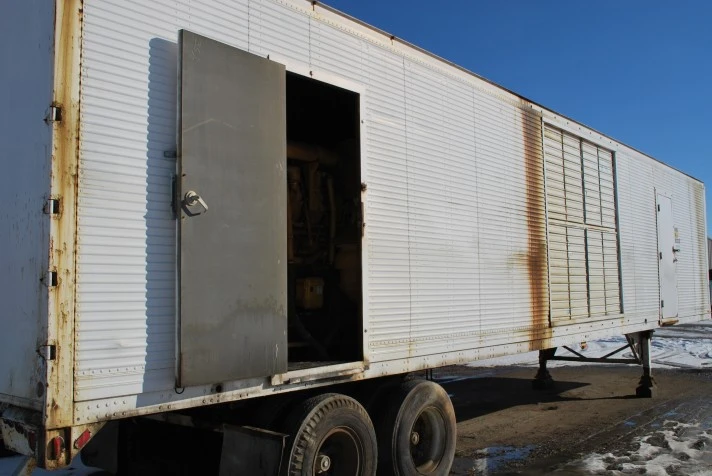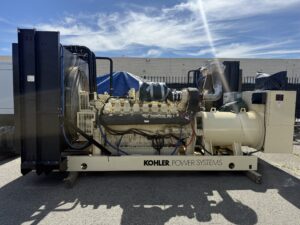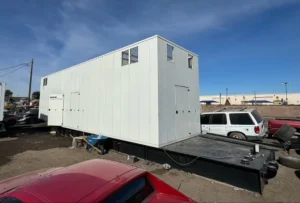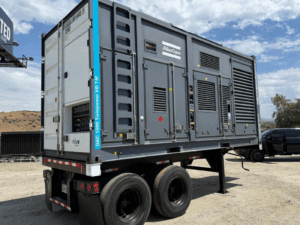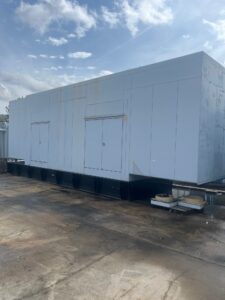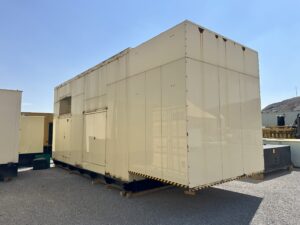
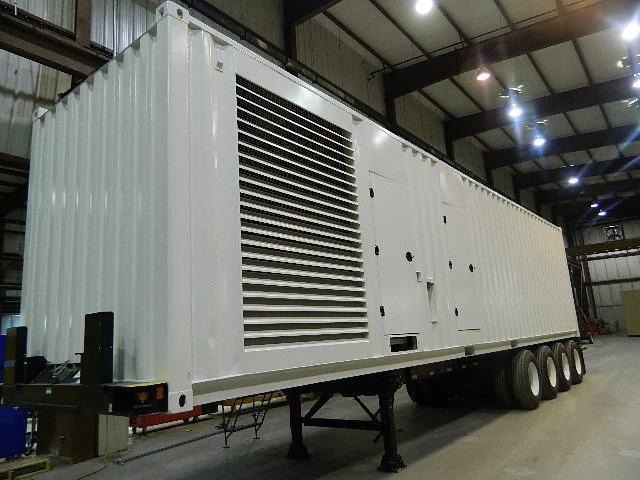
Commercial generators are purpose-built diesel or natural gas generator sets rated for emergency standby, continuous prime power, or co-generation service in commercial and institutional applications — hospitals, data centers, office complexes, manufacturing facilities, and retail operations where a power outage translates directly into lost revenue, patient safety risk, or regulatory non-compliance. Commercial-grade generators differ from consumer standby units in three fundamental ways: they are designed for immediate automatic transfer, continuous duty cycles, and service life measured in decades rather than years.
Selecting the correct commercial generator requires matching the unit’s rated capacity, fuel type, enclosure specification, and emissions compliance to your facility’s specific demands. Undersizing creates overload failures during actual emergencies; oversizing wastes capital and produces wet stacking problems.
What Is a Commercial Generator?
A commercial generator is an industrial-grade diesel or natural gas generator set rated for emergency standby, continuous prime power, or co-generation service in commercial and institutional applications. Commercial generators typically produce 100kW to 2,500kW and include automatic start systems, automatic transfer switch compatibility, and enclosure options for outdoor installation.
Commercial units use industrial diesel engines — Caterpillar, Cummins, MTU, Kohler, or Detroit Diesel — with service intervals measured in hundreds of hours, not years. Their automatic transfer switches operate in seconds. Their control systems log every start event, fault code, and operating parameter for maintenance tracking.
Commercial Generator Sizing Guide
Size a commercial standby generator at 1.25x the facility’s measured peak demand to accommodate motor starting inrush current and growth capacity. Key sizing benchmarks by application:
Office buildings: 5–10 watts per square foot for critical loads (HVAC, lighting, elevators, IT). A 50,000 sq ft office building with 50% critical load coverage needs 125–250kW.
Data centers / server rooms: Size to full UPS load plus cooling. A 500kW UPS system with 150kW of cooling requires a 750–800kW generator minimum. Modern hyperscale data centers use multiple 2,000–2,500kW units in N+1 redundancy configurations.
Hospitals / healthcare facilities: NFPA 110 Level 1 requirements mandate generator capacity for all essential electrical system loads. Typical community hospitals require 500kW–2,000kW. The Joint Commission requires weekly exercise and annual full-load testing.
Retail / grocery / cold storage: Prioritize refrigeration, lighting, and POS systems. A 50,000 sq ft grocery store typically needs 200–400kW for critical loads.
Manufacturing: Highly variable by process. Motor starting current for large equipment can be 6–8x running current — size accordingly. A load study is essential before specification.
Best Brands for Commercial Applications
Caterpillar: The most widely specified commercial generator brand in the US. Unmatched dealer network, parts availability, and resale value. The CAT C32 (1,000kW), 3512 (800–1,000kW), and 3516 (1,200–1,825kW) are the most common large commercial units.
Cummins: Strong in the 200kW–1,500kW commercial range. The QSK60 (1,500–2,000kW) is the dominant large-format commercial generator outside of CAT’s 3516. Excellent parts network and competitive pricing versus CAT. Browse Cummins commercial generators →
Kohler: Dominant in the 100kW–750kW commercial standby segment, particularly in healthcare and light commercial. The KD Series with MTU engine technology powers the largest units. Browse Kohler commercial generators →
MTU (Rolls-Royce Power Systems): German-engineered premium platform — 5–10% better fuel efficiency than CAT or Cummins at equivalent loads. Smaller US dealer network than CAT or Cummins, but premium performance for facilities where efficiency is a priority.
Standby vs. Prime Power Commercial Units
Standby rated: Designed to run up to 200 hours per year at full load, for emergency use only. Standby ratings are 10–15% higher than prime power ratings on the same engine. Emergency standby units in California require AQMD permits but have no operational hour restrictions.
Prime power rated: Designed for unlimited continuous operation as the primary power source. Prime power ratings are conservative — the engine can sustain that output indefinitely without reducing service life. Required for applications where the generator runs as the primary power source.
Commercial Generator Installation
Commercial generator installation involves five distinct cost components beyond the generator itself:
- Concrete foundation: $3,000–$15,000
- Fuel storage (2,000-gallon sub-base tank): $8,000–$20,000 installed
- Exhaust system with silencer: $5,000–$25,000
- Automatic transfer switch (ATS): $4,000–$35,000
- Electrical interconnection and commissioning: $8,000–$45,000
Total installation cost typically adds 25–50% to the generator purchase price.
Commercial Generator Maintenance
Standard commercial maintenance intervals: Monthly — visual inspection, fluid levels, battery test, brief no-load exercise. Quarterly — oil and filter change, coolant system inspection, fuel check. Annual — full service including valve inspection (gas units), cooling system service, exhaust inspection, ATS functional test, and NFPA 110-required load bank test. Annual maintenance costs average $2,500–$8,000 per unit depending on size.
Related Guides
- Diesel Generators for Sale: Complete Buyer Guide 2026 — How diesel generators work, how to size correctly, and what to inspect before purchase
- Natural Gas Generators: Complete Buyer’s Guide 2026 — When natural gas makes more sense than diesel for commercial facilities with pipeline access
- Industrial Generator Pricing Guide 2026 — Commercial generator pricing by brand and power class, including installation cost benchmarks