Load bank testing is one of the most critical maintenance procedures for standby and prime power generators. A properly executed load bank test verifies that your generator can handle its rated capacity, prevents wet stacking damage, and ensures compliance with NFPA 110 and JCAHO requirements. Power Generation Enterprises (PGE) sells load banks ranging from 300KW to 2000KW from brands like Avtron, Simplex, and LoadTec. Call us at (818) 484-8550 for availability and pricing.
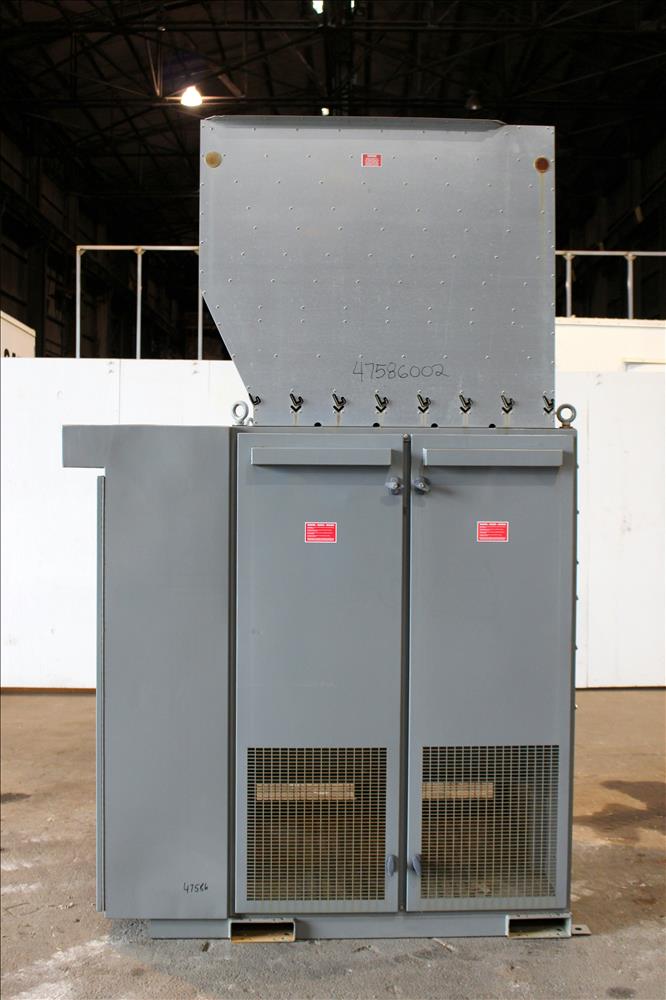
We load test every generator before it leaves our yard. Not a 30-minute idle test — a real stepped load test at 25%, 50%, 75%, and 100% of rated output. A load bank test is the only way to know a generator will actually deliver its rated power when you need it. The load bank converts electrical output into heat through resistive elements while we monitor voltage, frequency, oil pressure, coolant temp, and exhaust conditions at each step.
Here is the thing most people do not realize: a generator that starts and runs at idle proves almost nothing. We have seen units that purred like a kitten at no-load but fell on their face at 75%. The governor hunts, the voltage sags, the exhaust goes black. The only way to find that out before an actual emergency is a load bank test.
For a lot of facilities, this is not optional. Hospitals, data centers, high-rise buildings, and any building with emergency power under NFPA 110 — your fire marshal and your insurance company both want to see documented load test results. We sell the equipment to do it yourself, and every generator we ship comes with a test report.
This is the bread and butter of generator testing. A resistive load bank is essentially a giant set of heating elements — think industrial space heater on steroids. You connect it to the generator output, dial up the load in steps (usually 50KW or 100KW increments), and the load bank converts all that electrical output into heat. Simple, effective, and what NFPA 110 calls for in most routine maintenance testing.
Most of the load banks we stock are resistive units. The Avtron LPV700 700KW and Simplex MARS-500 are our most popular sellers — contractors and facility managers buy them for routine monthly testing.
Real buildings do not present a purely resistive load. Motors, transformers, HVAC compressors, elevators — all of that creates a lagging power factor, typically around 0.8. A reactive load bank adds inductive load to simulate those real-world conditions. It forces the alternator voltage regulator and excitation system to work harder than a pure resistive test.
We usually recommend reactive testing during commissioning or if you are troubleshooting voltage regulation issues. For routine monthly testing, resistive is fine.
A combined test uses both resistive and reactive load banks at the same time, creating a load profile at about 0.8 power factor — which is how most generators are actually rated. This is the most thorough test you can run because it exercises everything: engine, alternator, voltage regulator, governor, and cooling system under conditions identical to a real outage. We recommend combined testing for commissioning new installations and for annual performance verification on large standby systems.
You can smell wet stacking before you see it. That black, oily film around the exhaust stack and turbo outlet? That is unburned fuel and carbon deposits from running under light loads. When a diesel generator sits at idle or runs below 30% of rated capacity — which is what most standby generators do during monthly “tests” — the combustion chamber never gets hot enough to burn fuel completely.
Over time, the deposits build up in the exhaust system, turbo, and cylinder walls. Power output drops. Fuel consumption goes up. Eventually the engine cannot make rated power even if you ask it to. We have bought generators at auction that were listed as “low hours, runs great” but could not hold 60% load because they had been wet-stacked for a decade.
The fix is simple: run the generator at 75-100% load for 2-4 hours. A load bank test burns off the carbon deposits and restores performance. Do it regularly and wet stacking never becomes a problem in the first place.
Every new generator installation should get a full load bank test before you sign off on it. The commissioning test proves the generator, transfer switch, distribution equipment, and controls all work together as a system. It also gives you baseline numbers — voltage regulation, frequency stability, fuel burn rate, operating temps — that you can compare against in future tests.
If you have emergency power, your authority having jurisdiction (AHJ) wants documented proof that it works. NFPA 110, the Joint Commission (JCAHO) for hospitals, and most insurance carriers require specific load testing protocols. A generator without test documentation is a generator that does not exist, as far as your inspector is concerned.
Here is what NFPA 110 (2022 edition) actually requires for Level 1 and Level 2 emergency power supply systems:
The practical reality: most standby generators in office buildings and small hospitals never see 30% load during monthly tests because the building load is a fraction of the generator rating. That means the annual load bank test is not optional — it is a code requirement. We sell load banks specifically for this reason, and we can help you figure out what size you need. Call (818) 484-8550.
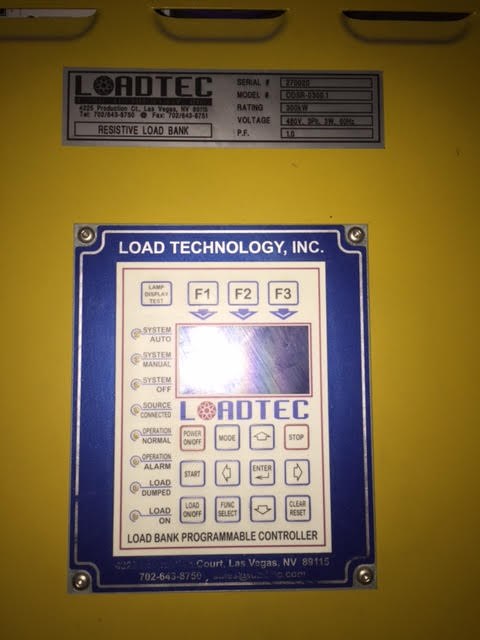
| Model | Capacity | Type | Voltage | Application |
|---|---|---|---|---|
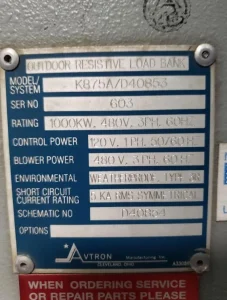
| Avtron K875A | 1000KW | Resistive | 480V | Large generators, commissioning |
| Avtron LPV700 | 700KW | Resistive | 480V | Mid-range generators, portable testing |
| LOADTEC OSW4v-1500.1 | 1500KW | Resistive | 480V | Large generator testing, industrial |
| Simplex Saturn | 2000KW | Resistive | 480V | Extra-large generators, data centers |
| Simplex MARS-500 | 500KW | Resistive | 480V | Commercial generators, routine testing |
| Avtron 750KW | 750KW | Resistive | 480V | Mid-range to large generators |
We have done thousands of these. Here is the procedure we follow and what we tell our customers to do:
Before you start: Check engine oil level, coolant level, and fuel level. Inspect belts, hoses, and connections. Make sure the load bank is positioned where exhaust air can flow freely — not recirculating into the generator radiator intake. Connect your cables (more on sizing below) and verify all connections are tight.
Step 1 — Warm up at 25% load (30 minutes). Start the generator, let it stabilize, then apply 25% of rated load. Monitor coolant temp — you want to see it climb to normal operating range (180-200F on most diesel engines). Watch oil pressure. This step is about bringing everything up to temperature gradually. Do not slam a cold engine to full load.
Step 2 — Step to 50% load (30 minutes). Increase to 50% and hold. Voltage should be within +/- 2% of nominal (480V +/- 10V). Frequency should hold at 60Hz +/- 0.5Hz. If you see voltage sag or frequency droop beyond those limits, you have a governor or voltage regulator issue to address.
Step 3 — Step to 75% load (30 minutes). This is where problems show up. Exhaust gas temperature should rise proportionally. If you see black smoke at 75%, the engine may need injector service, turbo inspection, or valve adjustment. Coolant temp should stabilize — if it keeps climbing past 210F, the cooling system cannot reject enough heat and you have a radiator, thermostat, or fan issue.
Step 4 — Step to 100% load (30-60 minutes). Full rated output. Everything should hold steady. This is the test that proves the generator can deliver what it says on the nameplate. If voltage, frequency, temperatures, and pressures are all stable at 100% for 30 minutes, the unit passes.
Cool down: Step the load back down to 50%, then 25%, then remove load entirely. Let the engine idle for 5 minutes before shutdown. Never shut down a hot, loaded diesel engine — the turbo needs cool-down time.
Simple rule: buy a load bank rated to at least 80% of your largest generator. NFPA 110 only requires 30%, but 30% barely proves anything. We tell our customers to test at 100% if possible, 80% minimum.
Here is what we stock and what each one is best for:
Cable sizing matters. For a 1000KW, 480V load bank, you are pulling about 1,200 amps. That requires 4 sets of 500MCM cables minimum for a 100-foot run. We have seen facilities try to use undersized cables and wonder why the load bank only draws 60% power. The voltage drop in the cables eats the rest. Ask us about cable requirements when you buy a load bank — we will spec it out for you.
The rental market for load banks is active, especially in the 500-1000KW range. A 750KW resistive load bank typically rents for $1,500-$3,000 per week plus delivery. If you test once a year, renting makes sense.
But if you test more than twice a year — which NFPA 110 effectively requires for most standby installations — buying pays for itself fast. A used Avtron 750KW in good condition runs $12,000-$18,000 from us. Two annual rentals at $2,500 each plus delivery runs $6,000-$8,000 per year. In two years, you have paid for a load bank you own.
For hospitals and data centers that test monthly, the math is even more obvious. And owning your own load bank means you test on your schedule, not when the rental company has availability.
We stock load banks from 300KW to 2000KW at our Santa Clarita facility. Call (818) 484-8550 and we can help you figure out the right size for your generator fleet.
Load bank testing is a procedure where an artificial electrical load is applied to a generator using specialized equipment called a load bank. The test verifies that the generator can produce its full rated power output and that all engine and alternator systems function correctly under demand. A load bank converts electrical energy into heat through resistive elements, allowing technicians to precisely control the load level, typically testing at 25%, 50%, 75%, and 100% of capacity. PGE sells load banks from 300KW to 2000KW for facilities that need to perform regular testing. Call (818) 484-8550 for equipment availability.
NFPA 110 requires monthly testing of emergency generators for a minimum of 30 minutes under load. If the generator cannot achieve at least 30% of its nameplate kW rating during monthly tests using building load alone, a load bank must be used. Additionally, an annual load test is required: 30 minutes at 50% load followed by 60 minutes at 75% load. Hospitals under Joint Commission accreditation must also conduct a four-hour triennial test. Generators that consistently run under light loads should be load tested more frequently to prevent wet stacking. Contact PGE at (818) 484-8550 for load bank equipment to keep your facility compliant.
Your load bank should be rated at or above your generator nameplate kW output. For a 500KW generator, you need at least a 500KW load bank. If you test multiple generators of different sizes, size the load bank for your largest unit. A larger load bank can always be operated at partial capacity for smaller generators. PGE stocks load banks from 500KW to 2000KW including the Simplex MARS-500, Avtron LPV700 (700KW), Avtron K875A (1000KW), LOADTEC 1500KW, and Simplex Saturn (2000KW). Call (818) 484-8550 for help selecting the right unit for your fleet.
Wet stacking occurs when a diesel generator operates below approximately 30% of its rated capacity for extended periods. At low loads, combustion temperatures are insufficient for complete fuel burn, causing unburned fuel, carbon, and soot to accumulate in the exhaust system, turbocharger, and cylinder walls. Symptoms include black exhaust smoke, oil leaks at exhaust joints, and reduced power output. Load bank testing at 75-100% capacity for 2-4 hours raises exhaust temperatures high enough to burn off these deposits, restoring engine performance. Regular load testing prevents wet stacking from developing. PGE can supply the right load bank for your maintenance program. Call (818) 484-8550.
Yes. Power Generation Enterprises sells quality load banks from leading manufacturers including Avtron, Simplex, LoadTec, and Load Banks Direct. Our current inventory includes units ranging from 500KW to 2000KW, suitable for testing commercial and industrial generators. Available models include the Avtron K875A (1000KW), Avtron LPV700 (700KW), LOADTEC OSW4v-1500.1 (1500KW), Simplex Saturn (2000KW), Simplex MARS-500 (500KW), and Avtron 750KW. All units are inspected and tested before shipment from our Santa Clarita, California facility. Call (818) 484-8550 for current pricing, availability, and shipping quotes.
Resistive load bank testing applies a purely resistive (unity power factor) load that converts generator output directly into heat. It tests the engine at rated horsepower and verifies basic alternator output. Reactive load bank testing adds inductive or capacitive elements to create a lagging power factor (typically 0.8), simulating real-world conditions with motors and transformers. Combined resistive/reactive testing is the most thorough because it exercises the alternator voltage regulator and excitation system under realistic conditions. Most routine NFPA 110 testing uses resistive load banks. PGE carries resistive load banks from 500KW to 2000KW. Call (818) 484-8550 to discuss your testing needs.
Power Generation Enterprises stocks load banks from 500KW to 2000KW by Avtron, Simplex, and LoadTec. Browse our current inventory of tested and inspected load banks ready for immediate shipment from Santa Clarita, California.