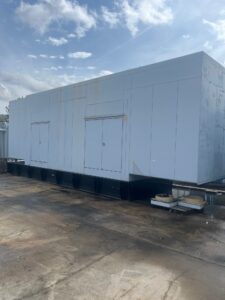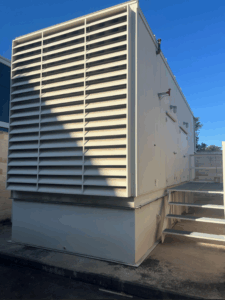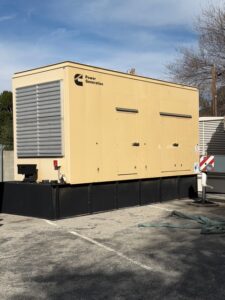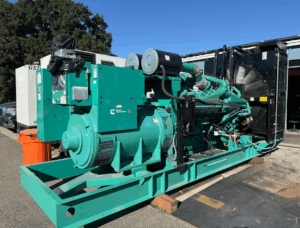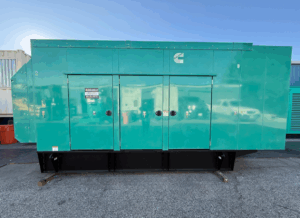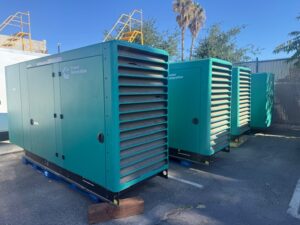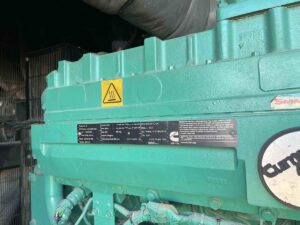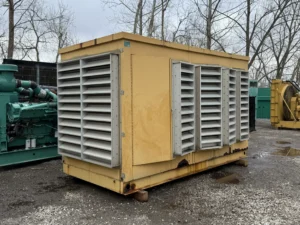
The Cummins QSK60 is the workhorse of the 2000kW generator market, built around a 60-liter V16 diesel engine that’s been in continuous production since the late 1990s. Used units in good condition typically trade between $85,000 and $250,000 depending on hours, tier rating, and enclosure configuration. PGE currently stocks multiple DQKAB 2000kW Tier 2 units ready to ship from Santa Clarita, CA. Call (818) 484-8550 for current pricing and load bank test reports.
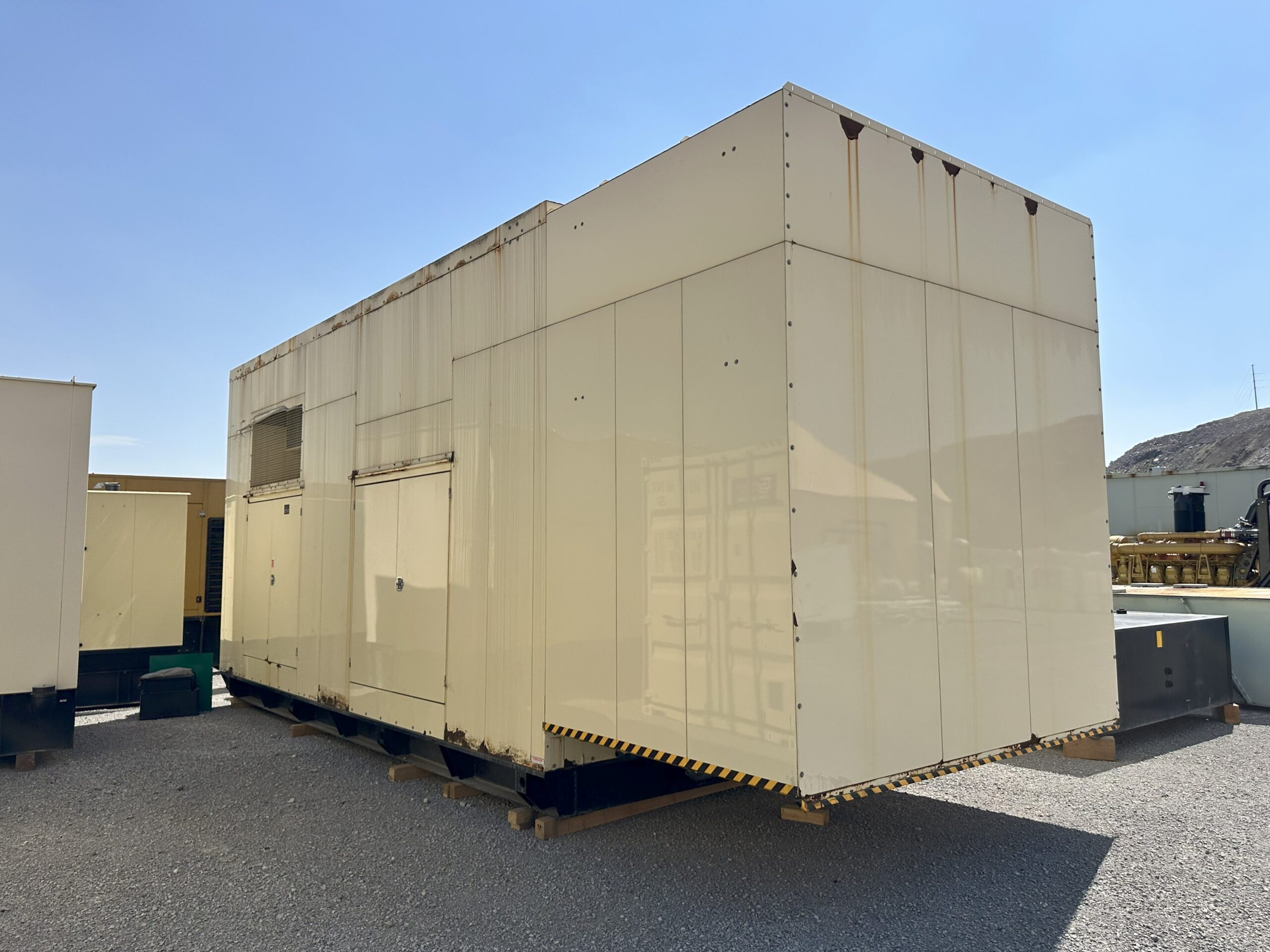
There’s a reason the Cummins QSK60 shows up on almost every data center bid spec and hospital standby power plan above 1500kW. It’s not because Cummins has better marketing than Caterpillar or MTU. It’s because the QSK60 platform has been running in the field for over 25 years, parts are available from Cummins distributors on six continents, and the engine has a track record at high-output ratings that facility managers actually trust with their critical loads.
We move more QSK60-powered generators through our Santa Clarita yard than any other single engine platform. Cummins generators in the 2000kW class account for a significant share of every data center decommissioning project we handle, and the DQKAB package specifically is the unit we see most often when a Tier 1 data center operator decides to offload surplus standby power. That volume tells you something about market adoption that no spec sheet can.
The QSK60 also benefits from something the competing platforms struggle with at this power level: genuine simplicity of the dealer network. If you’re installing a 2000kW standby unit at a water treatment plant in rural Oklahoma or a mining operation in northern Nevada, the nearest Cummins dealer is almost certainly closer than the nearest CAT or MTU dealer with 2MW-class experience. That matters when you need injector service at 2 AM during a grid outage.
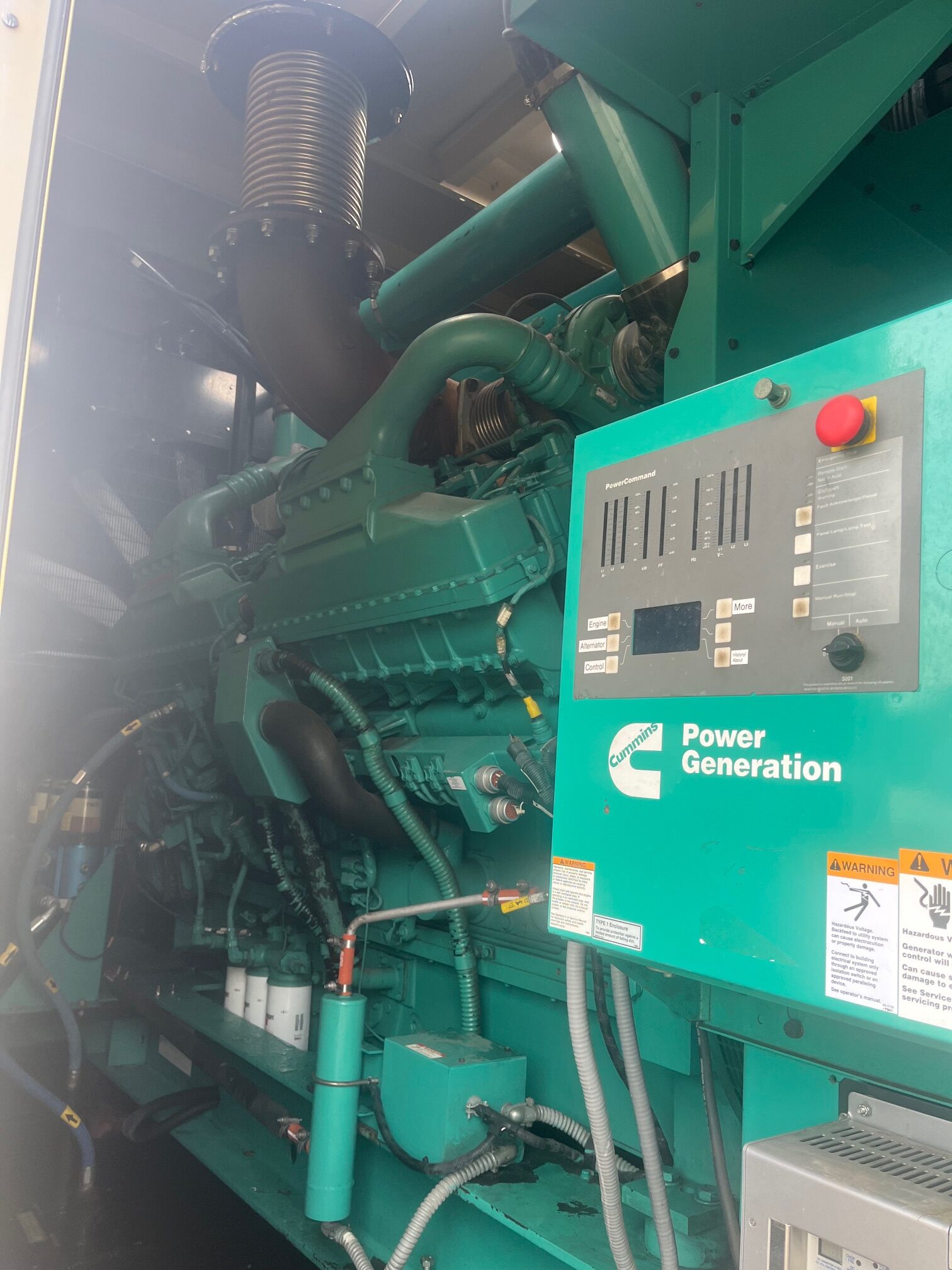
The QSK60-G engine at the heart of these generators is a 60-liter, V16 turbocharged diesel. Cummins designed it specifically for power generation duty cycles, though variants exist for marine and locomotive applications. The -G designation confirms the generator-drive configuration, which runs at 1800 RPM for 60Hz applications and 1500 RPM for 50Hz markets.
Where buyers sometimes get confused is in the genset package designations. The engine is the QSK60. The complete generator set — engine, alternator, control system, base frame, and sometimes an enclosure — gets a separate Cummins Power Generation model number. Here’s what you’ll see most often:
The DQKAB is the 2000kW standby / 1800kW prime-rated package. This is far and away the most common configuration in the North American market. When someone says “QSK60 generator” without any other qualifier, they’re almost always talking about a DQKAB. Our current inventory includes multiple DQKAB units (Stock #GS4864 and #GS4845), all Tier 2 rated.
The DQKAC pushes the same QSK60 engine to its 2250kW standby rating. You see these in facilities that need maximum output per footprint, like dense urban data centers where adding another generator isn’t an option due to permitting or space constraints. The DQKAC runs the engine harder, which means slightly shorter overhaul intervals if the unit actually sees load above 2000kW regularly.
The DQGAB is the 1750kW configuration, which might seem like a step backward until you realize it’s often specified for prime-rated applications where the generator runs continuously rather than just during outages. Oil and gas operations, remote mining camps, and island microgrids frequently spec the DQGAB for its more conservative power-to-displacement ratio.
All three packages are available in Tier 2 and Tier 4 Final emissions configurations. Tier 4 Final adds aftertreatment — selective catalytic reduction (SCR) and diesel particulate filtration — which increases the unit’s footprint, weight, and maintenance complexity. For standby-only applications in most jurisdictions, Tier 2 units remain fully legal and significantly less expensive on the used market.
The overall weight of a QSK60 genset runs approximately 15,000 to 20,000 lbs depending on whether it’s an open-frame unit or a weather-protective or sound-attenuated enclosure. Rigging a DQKAB into a rooftop installation or through a mechanical room door is a project in itself, and any buyer should confirm the unit’s actual shipping weight and dimensions before committing.
Every buyer evaluating a QSK60 is also looking at the Caterpillar 3516. It’s unavoidable. Both engines compete directly at the 2000kW+ power level, and both have massive install bases. We’ve sold hundreds of each platform, so here’s an honest take rather than a brand loyalty pitch.
The CAT 3516B at 2000kW standby and the Cummins DQKAB 2000kW are functionally equivalent for most standby power applications. Both will start reliably, pick up load within 10 seconds, and run for the duration of an outage without drama — assuming proper maintenance. The differences show up at the margins.
Cummins wins on parts cost and availability for most buyers. The QSK60’s fuel system components, specifically the Cummins PT fuel system on older units and the common-rail system on newer production, tend to be less expensive to service than CAT’s equivalent. Cummins also has a broader independent parts aftermarket, which means you’re not locked into OEM pricing the way CAT owners sometimes are.
CAT wins on residual value in certain markets, particularly oil and gas, where Caterpillar’s brand carries institutional weight that translates to higher resale prices. If you’re buying a generator purely as a financial asset that you plan to redeploy or resell within five years, the 3516 may hold its value slightly better in some sectors.
For a detailed breakdown across all three major OEMs, we put together a head-to-head comparison of Cummins, Caterpillar, and MTU platforms that covers everything from initial acquisition cost to long-term total cost of ownership.
The one area where the QSK60 has a clear technical advantage is at the top of the power range. The DQKAC pushes 2250kW standby from the same engine block, while CAT needs to move up to the 3516C or the newer C175 platform to exceed 2000kW. If your load study shows you need more than 2000kW from a single unit, the QSK60 gives you headroom without changing platforms.
| Model / Package | kW Rating (Standby / Prime) | Engine | Approx. Weight | Used Market Price Range |
|---|---|---|---|---|
| Cummins DQKAB | 2000kW / 1800kW | QSK60-G V16, 60L Diesel | ~17,500 lbs | $100,000 - $250,000 |
| Cummins DQKAC | 2250kW / 2000kW | QSK60-G V16, 60L Diesel | ~18,000 lbs | $120,000 - $280,000 |
| Cummins DQGAB | 1750kW / 1500kW | QSK60-G V16, 60L Diesel | ~17,000 lbs | $90,000 - $220,000 |
| CAT 3516B | 2000kW / 1825kW | CAT 3516B V16, 78.1L Diesel | ~19,500 lbs | $110,000 - $260,000 |
| CAT 3516C | 2500kW / 2250kW | CAT 3516C V16, 78.1L Diesel | ~21,000 lbs | $150,000 - $320,000 |
| Cummins DQGAA (QSK50) | 1250kW / 1100kW | QSK50-G V16, 50L Diesel | ~14,000 lbs | $70,000 - $160,000 |
The used market for QSK60 generators is one of the more transparent segments in the industrial power space, mostly because there are so many units available. Data center decommissioning projects alone have put thousands of low-hour DQKAB units onto the secondary market over the past decade, and that supply keeps prices reasonable relative to new-build cost.
A new Cummins DQKAB 2000kW genset with a Level 2 sound-attenuated enclosure lists north of $500,000 from an authorized distributor, and that’s before site engineering, rigging, and commissioning. The used market offers dramatically better economics for buyers who don’t need a factory warranty.
For a used DQKAB Tier 2 unit with fewer than 500 hours, expect to pay $150,000 to $250,000 depending on enclosure type, control panel generation (older PowerCommand 1.1 vs. newer 3.3 or ATS integration), and whether the unit comes with a current load bank test report. These are typically data center pulls — units that sat on a concrete pad for 10 to 15 years, started once a week for exercise, and never saw a real outage beyond annual testing. Mechanically, they’re barely broken in.
Units in the 500 to 2,000 hour range trade between $100,000 and $180,000. This is the sweet spot for value-conscious buyers. The engine has proven itself, any infant-mortality issues are long past, and there’s still enormous life remaining before a major overhaul. Many of these come from oil and gas decommissioning projects where the gensets ran as prime power during drilling or fracking operations.
Above 2,000 hours but below 10,000, pricing drops to $85,000 to $140,000, and the buyer needs to scrutinize maintenance records more carefully. A QSK60 with 8,000 hours and complete Cummins dealer service records is a better buy than a 3,000-hour unit with no documentation. Hours alone don’t tell the story.
Units over 10,000 hours still have a market, particularly for export or for buyers with in-house Cummins service capability, but pricing gets very deal-specific. Call us at (818) 484-8550 if you’re evaluating a high-hour unit and want an honest assessment of remaining value.
The single most important document when buying a used QSK60 is a recent load bank test report at full rated output. Not a “exercise run at 30% load for 15 minutes” report — an actual progressive load test to 100% for a sustained period. If the seller can’t produce one, either negotiate the cost of load bank testing into the deal or walk away. We load bank every unit that comes through our yard before listing it on our diesel generators for sale page.
Oil analysis history matters more than a single oil sample at time of sale. A seller can change the oil before listing the unit and a single clean sample tells you very little. What you want is a pattern: consistent oil analysis at regular intervals showing stable wear metals. A spike in copper or lead at 6,000 hours that the previous owner ignored is a red flag that a single fresh sample would mask entirely.
Coolant condition is the sleeper issue on QSK60 units. The V16 configuration has long coolant passages, and if the previous owner used incorrect supplemental coolant additives or neglected coolant testing, internal corrosion can compromise the block and heads in ways that aren’t visible externally. Ask for coolant analysis records. If they don’t exist, budget for a full cooling system flush and inspection before putting the unit into service.
Skip obsessing over cosmetic condition. A QSK60 that lived outdoors in West Texas for eight years will look rougher than one that sat inside a climate-controlled data center — but the West Texas unit may have better mechanical records and a more experienced maintenance history. Faded paint and surface corrosion on the enclosure don’t affect the engine’s ability to make 2000kW.
The QSK60 doesn’t have a reputation-killing weak point the way some platforms do. There’s no single component that fails so routinely it becomes the engine’s identity. That said, every engine platform has patterns, and here’s what we see across the QSK60 units that come through PGE.
Fuel injectors are the most common service item beyond standard filters and fluids. The QSK60 uses individual unit injectors (on pre-common-rail models) that should be tested and recalibrated or replaced around the 12,000 to 15,000 hour mark, depending on fuel quality. A full set of 16 injectors isn’t cheap, so factor this into your acquisition cost if you’re buying a unit approaching that interval.
Turbocharger actuators on dual-turbo configurations can develop issues, particularly on units that spend most of their life at low load during weekly exercise cycles. The actuators don’t get the thermal cycling they need to stay free, and can stick or respond sluggishly when the unit is suddenly called on to ramp to full load during an actual outage. This is more of a maintenance discipline issue than a design flaw — regular full-load testing prevents it.
The PowerCommand control panel, regardless of version, is generally robust. The most common issue is battery charger failure or battery degradation, which isn’t a Cummins-specific problem. It’s a “someone installed cheap batteries six years ago and never tested them” problem. Every QSK60 installation should have a battery monitoring system and a maintenance schedule that includes quarterly battery testing.
Major overhaul intervals for the QSK60 run 20,000 to 30,000 hours for standby-rated applications. For a generator that runs 200 hours per year in a typical standby role, that’s 100+ years of theoretical engine life. The reality is that most QSK60 generators are retired from service long before they reach mechanical end-of-life, replaced because the facility upgraded, closed, or consolidated to a different power architecture. That’s precisely why the used market is so well supplied.
Right now in our Santa Clarita yard, we have multiple Cummins QSK60-powered generators available for immediate sale and shipment. Stock #GS4864 includes two Cummins DQKAB 2000kW Tier 2 units, and Stock #GS4845 is another DQKAB 2000kW Tier 2. For buyers who need a slightly different power level, we also carry Cummins QSK50-powered units like the DQGAA 1250kW (Stock #GS4868 and #GS4860), and smaller Cummins platforms like the DFEK QSX15 500KW (Stock #GS4853-1) and the C150 150kW natural gas unit (Stock #GS4861, three available).
Browse our full Cummins inventory or call (818) 484-8550 to discuss what’s in stock and what’s arriving this month.
We’re also active buyers of QSK60 generators. If you’re decommissioning a data center, shutting down a drilling operation, or upgrading to newer Tier 4 units, we buy industrial generators nationwide. We handle logistics, rigging, and transportation — you get a fair offer based on actual market conditions, not a lowball number designed to leave margin for three middlemen. Visit our sell your equipment page or email [email protected] for a quote within 24 hours.
Both use the same Cummins QSK60-G engine. The DQKAB is rated 2000kW standby and 1800kW prime, while the DQKAC pushes to 2250kW standby and 2000kW prime. The DQKAC achieves its higher output through engine calibration changes and potentially upgraded cooling system components, not a different engine block. For most standby applications, the DQKAB provides plenty of headroom. The DQKAC makes sense when your load study shows you need more than 1800kW continuously or when you want to maximize output from a single unit to avoid adding another genset to the paralleling bus. Call us at (818) 484-8550 if you’re not sure which rating fits your project.
It depends entirely on the maintenance history and application. We’ve sold QSK60 units with 15,000 hours of well-documented prime power service that were in better mechanical condition than 2,000-hour standby units with no records. That said, for a buyer who doesn’t want to think about major overhaul planning, staying under 5,000 hours for standby-rated applications gives you decades of remaining life. Above 10,000 hours, you should budget for injector replacement and potentially a top-end inspection within the first few years of ownership. PGE can walk you through the specifics of any unit’s hour profile — give us a call.
For emergency standby applications, Tier 2 diesel generators remain legal in most U.S. jurisdictions under EPA regulations. However, state and local air quality districts can impose stricter rules. California’s SCAQMD and BAAQMD districts, parts of the Northeast, and some Colorado counties have additional requirements for Tier 2 standby units, including operating hour limits and enhanced permitting. Tier 2 units are generally unrestricted for export. PGE ships Tier 2 Cummins generators internationally on a regular basis. Contact us at (818) 484-8550 to discuss your specific installation location.
Functionally, both are excellent platforms for data center standby at the 2000kW level. The QSK60 typically has a lower total cost of ownership due to better parts availability through Cummins’ independent aftermarket and a wider dealer network for service. The CAT 3516 tends to hold slightly higher residual value in certain resale markets. For most data center operators buying on the used market, the QSK60 offers better economics. PGE stocks both platforms and can provide honest pricing comparisons — we don’t have brand loyalty, we have inventory.
For a standby-rated QSK60 running 100-200 hours per year, expect annual maintenance costs of $3,000-$6,000 covering oil and filter changes, coolant testing, battery testing, fuel polishing, and an annual load bank test. This assumes you’re using a qualified Cummins technician or a third-party service provider with QSK60 experience. The number goes up if you’re running prime-rated hours or if the unit needs injector work. The biggest maintenance cost isn’t the routine stuff — it’s the load bank test, which runs $2,000-$4,000 per event depending on your location.
Yes. A QSK60 genset at 17,000-20,000 lbs requires a flatbed or step-deck trailer and typically a crane or forklift with at least 10-ton capacity for loading and offloading. PGE coordinates nationwide shipping from our Santa Clarita, CA facility and can also arrange international freight. We handle the logistics so you’re not calling trucking companies and rigging outfits separately. Call (818) 484-8550 or email [email protected] for a delivered quote to your site.
PGE has Cummins QSK60-powered DQKAB 2000kW generators in stock and ready to ship from Santa Clarita, CA. We also buy QSK60 units nationwide from data centers, oil and gas operations, and any other facility decommissioning surplus power assets. Call (818) 484-8550 for current pricing or a purchase offer.