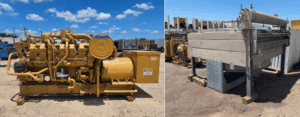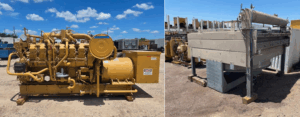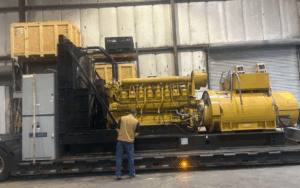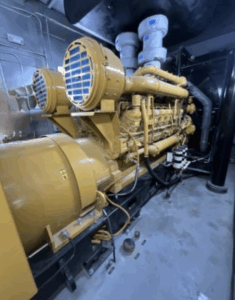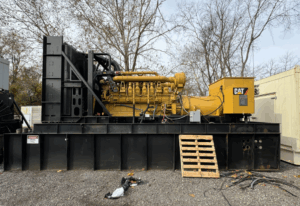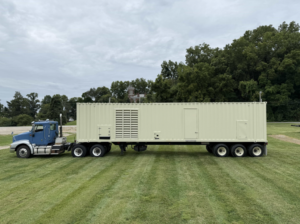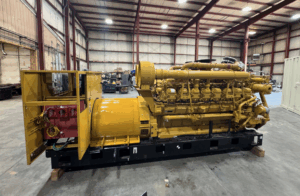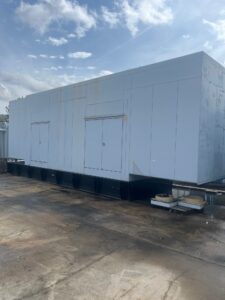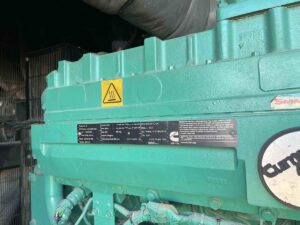
PGE stocks CAT 3512 generators in our Santa Clarita yard, including natural gas G3512 units available now. Used 3512 pricing runs $45,000 for original mechanical units up to $250,000+ for low-hour 3512C HDs. We’ll walk you through what’s on the market, what the serial number tells you, what breaks at what hours, and what to budget beyond the sticker price. Call us at (818) 484-8550 or browse our current CAT inventory to see what’s in stock today.
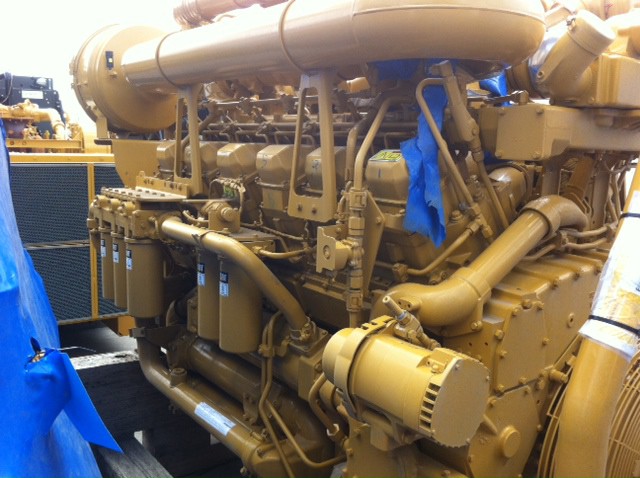
Right now on MachineryTrader there are about 71 CAT 3512 listings nationwide. Prices range from $29,000 for a clapped-out original 3512 with 25,000+ hours to $445,000 for a low-hour 3512C HD package on a trailer with switchgear. That spread tells you something important: “CAT 3512” covers a lot of ground, and if you don’t know which variant you’re looking at, you can overpay by six figures or end up with a unit that needs an immediate overhaul.
Most of what’s available in the secondary market falls into a few buckets. You’ll see a glut of original mechanical 3512s pulled from pipeline and oilfield service — these ran hard, got basic maintenance, and are priced to move. You’ll see 3512Bs from standby data center and hospital applications that might have 200 hours on them but are 15 years old, and sellers price them like they’re new. And you’ll see 3512Cs coming off lease from rental fleets, often in the 5,000-10,000 hour sweet spot where the engine still has real life left if the maintenance was done right.
The natural gas G3512 market is thinner. Fewer units out there, and demand from CHP and cogeneration applications keeps prices firm. We’ve got two G3512 units in our yard right now — stock numbers GS4835-1 (a 550kW G3512 LE) and GS4835 (a standard G3512 at 550kW). If you’re looking at natural gas for a combined heat and power setup or for emissions compliance in a non-attainment area, those are worth a call.
Before you spend a dollar, you need to know exactly what you’re buying. The model designation on the data plate only tells you part of the story. The serial number prefix tells you the rest.
Here’s the short version:
24Z or 65Z prefix — You’re looking at an original mechanical 3512. Rack-and-pinion fuel system, no ECM. These are straightforward engines. Easy to work on in the field, but they’re old at this point and parts availability is getting tighter for some mechanical-specific components.
6GW, 6NZ, or NSC prefix — This is a 3512B with electronic fuel injection. The big upgrade here is the ADEM III ECM, which gives you better fuel control, diagnostic capability, and load response. For standby applications, the 3512B is a huge step up from the original.
BDW prefix — Current-production 3512C. This is what CAT dealers are quoting on new genset packages. Improved combustion, better fuel economy, and Tier 2 emissions compliance without aftertreatment on most configurations.
4KC prefix — G3512 natural gas. Completely different fuel system, different heads, different pistons. Don’t let anyone tell you it’s “just a 3512 converted to gas.” It’s a purpose-built gas engine and the parts are not interchangeable with the diesel variants.
We go much deeper on all the model differences, power ratings, and emissions tiers in our CAT 3512 Spec Guide. If you want the full technical breakdown before you buy, start there.
Let’s put real numbers on the table, because “it depends” isn’t useful when you’re trying to build a budget.
Original 3512 (mechanical): $45,000 to $85,000. At the low end, you’re buying a unit that probably needs a top-end or in-frame. At the high end, you’ll find units with recent overhauls and documentation to prove it. The sweet spot here is around $55,000-$65,000 for a unit with 12,000-18,000 hours that has had a top-end done in the last 3,000-5,000 hours.
3512B (electronic): $65,000 to $135,000. The premium over the original is justified by the electronic fuel system alone. Diagnostic capability, better fuel economy, and improved transient response. At the top of this range you’ll find standby units with under 500 hours — but verify the exercise schedule and check for wet stacking if the previous owner ran the unit lightly.
3512C: $95,000 to $185,000. This is the current-production diesel variant. Units coming off three-to-five-year rental fleet contracts are your best value here, typically in the 3,000-6,000 hour range. Make sure Tier 2 compliance matters for your application — if it doesn’t, a well-maintained 3512B at $70,000 less does the same job.
3512C HD: $120,000 to $250,000. The HD designation means heavier-duty components — better bearings, improved cooling, stronger block. These were built for continuous and prime-rated applications, and they command a premium because of it. If you’re running prime power 24/7, the HD is the only 3512 variant worth considering.
G3512 (natural gas): $55,000 to $150,000. Thinner market, which means less negotiating leverage but also less competition when a good unit comes up. Most G3512s on the secondary market came from CHP or landfill gas applications. Check the gas train components carefully — regulators, mixers, and gas valves add up fast if they need replacement.
New 3512C from a CAT dealer: Expect $250,000 to $400,000+ for a complete genset package with switchgear. Lead times are running 16-24 weeks depending on configuration. That’s the number that makes the used market look very attractive.
For comparison, a new Cummins QSK38-powered unit in similar output range will come in slightly lower on the initial purchase, though the installed cost difference narrows once you factor in fuel system and cooling package. We cover that matchup in our CAT vs. Cummins vs. MTU comparison.
| Model | kW Range | Typical Hours Available | Used Price Range | Best For |
|---|---|---|---|---|
| 3512 (Original) | 725-1,000 kW | 12,000-28,000 hrs | $45,000-$85,000 | Budget standby, field operations where simplicity matters |
| 3512B | 890-1,360 kW | 200-20,000 hrs | $65,000-$135,000 | Standby applications needing electronic fuel control and diagnostics |
| 3512C | 1,100-1,500 kW | 1,000-12,000 hrs | $95,000-$185,000 | Prime power and standby where Tier 2 compliance is required |
| 3512C HD | 1,250-1,500 kW | 2,000-15,000 hrs | $120,000-$250,000 | Continuous-duty and prime-rated 24/7 applications |
| G3512 | 400-600 kW | 3,000-25,000 hrs | $55,000-$150,000 | CHP, cogeneration, landfill gas, emissions-restricted sites |
| CAT 3516B | 1,750-2,500 kW | 500-20,000 hrs | $95,000-$350,000 | Heavy industrial, data center, and utility standby above 1,500 kW |
This is the section that will save you money. Every used 3512 sits somewhere on a predictable maintenance curve, and knowing where a unit falls on that curve is more important than the asking price.
0 to 5,000 hours: You shouldn’t see much here beyond normal consumables. Belt replacements, hose clamp tightening, thermostat checks. If a unit with under 5,000 hours is showing coolant leaks or unusual oil consumption, something went wrong during commissioning or the unit was abused early. Walk away or price in a deeper inspection.
5,000 to 10,000 hours: This is where the first real maintenance items show up. Water pump seals start to weep. Turbocharger shaft play develops — you can feel it with a dial indicator during inspection. Injectors begin to degrade, which shows up as increased fuel consumption and rougher idle before it shows up as a hard fault. A good seller will have injector flow test data from this interval.
10,000 to 15,000 hours: This is top-end overhaul territory on a 3512, and it’s the most important thing to verify on any unit you’re considering. Head gaskets, valve recession, and injector failure all converge in this window. A unit that had a proper top-end done at 12,000 hours with documentation is worth significantly more than a unit at 11,000 hours that hasn’t had one. The top-end resets the clock on the cylinder heads, and it’s a $15,000-$25,000 job depending on what the heads need.
15,000 to 20,000 hours: If the top-end wasn’t done, you’ll see it now. Power loss under load, elevated blowby readings, and oil consumption that climbs every service interval. If you’re buying a unit in this range and the seller can’t produce top-end overhaul records, assume you’re doing one immediately and price accordingly.
20,000 to 25,000 hours: Cylinder liner wear becomes measurable, main bearing clearances open up, and oil pressure starts to drop at operating temperature. Even with a prior top-end, you’re approaching in-frame overhaul territory.
25,000 to 30,000 hours: In-frame overhaul is due. Full stop. Liners, pistons, rings, bearings, seals — the engine needs to come apart. At $30,000-$35,000 for parts and labor, this is a significant capital event. But a properly done in-frame on a 3512 resets you for another 15,000-20,000 hours of reliable service. It’s often the smarter buy compared to a newer unit at twice the price.
The takeaway: ask for service records before you ask for a price. A 3512 at 14,000 hours with a documented top-end at 12,000 is a better buy than a 3512 at 8,000 hours with no records. Hours aren’t everything — maintenance history is.
Buying a used generator is not just the purchase price. Here’s what the major maintenance items actually cost on a 3512, so you can build a realistic total cost of ownership.
Fuel injectors: $540 to $1,400 each depending on variant and whether you’re buying new or reman. The 3512 has 12 injectors. A full set runs $6,500 to $16,800. On a 3512B or 3512C, injector replacement at the 10,000-hour mark is essentially mandatory.
Turbochargers: The 3512 runs twin turbos. A remanufactured turbo runs $1,980 to $3,300 each, plus a $1,330 core charge per unit. If the cores are damaged, that charge doesn’t come back. Budget $6,600-$9,260 for a twin turbo replacement, or more if the cores are shot.
Top-end overhaul: $15,000 to $25,000 with parts and labor. This covers head removal, valve work, head gasket replacement, injector replacement, and reassembly. The range depends on whether the heads need machining or just new valves and seats.
In-frame overhaul: $30,000 to $35,000 with parts and labor. This is the big one. Liners, pistons, rings, rod and main bearings, all gaskets and seals, and full reassembly with new fluids. Some shops will quote lower by cutting corners on bearings or reusing liners — don’t let them.
These numbers should factor directly into your purchase decision. A 3512B at $75,000 with 14,000 hours and no top-end history means you’re really looking at $90,000-$100,000 all-in. A 3512B at $95,000 with a documented top-end at 12,000 hours might actually be the cheaper path.
The 3512 fits a specific power band — roughly 700kW to 1,500kW depending on variant, rating, and fuel type. If your load calculation lands outside that range, the smarter move is to go up or down within the CAT 3500 family rather than trying to make a 3512 work at the edge of its rating.
Need less power (500-1,035kW): The CAT 3508 is a V-8 using the same cylinder architecture as the 3512. Same bore, same stroke, same parts commonality — just four fewer cylinders. Used 3508 packages run $35,000 to $85,000, and they’re plentiful on the secondary market from pipeline and oilfield service. We typically have multiple 3508 units in the 750-1,035kW range in stock. The maintenance costs scale proportionally — fewer cylinders means fewer injectors, one turbo instead of two, and less oil capacity.
Need more power (1,200-2,750kW): The CAT 3516 is the V-16 big brother. Same cylinder platform again, which means your maintenance team doesn’t need to learn a new engine. Used 3516 packages run $75,000 to $350,000 depending on variant and hours. Right now we have the GS4851 — a 3516DITA rated at 1,850kW in high voltage configuration, a 2013 CAT 3516C at 2,500kW (GS4863), a 2007 3516C HD at 2,500kW (GS4863-1), and a containerized 3516C at 2,000kW (GS4826) with Tier 2 compliance.
If your load sits right at the boundary — say 1,100kW to 1,300kW — talk to us before you decide. A 3512C HD at 1,500kW prime might be right-sized, or a 3516 derated for standby might give you more headroom for future load growth. That’s a conversation worth having before you commit.
We maintain rotating CAT 3500-series inventory at our Santa Clarita yard. Units get inspected, documented, and listed with real specs and photos — not stock images and vague descriptions. Our current 3512-family listings include two G3512 natural gas units: the GS4835-1 G3512 LE at 550kW and the GS4835 G3512 at 550kW.
Inventory turns over. If you’re reading this and those specific units are sold, call us at (818) 484-8550 anyway. We track availability across our dealer network and can usually source a specific 3512 variant within a week or two.
And if you’re upgrading or replacing an existing genset, we buy equipment too. Whether it’s a 3512 you’ve outgrown or a different platform entirely, get a quote through our Sell Your Equipment page or call us direct. We pay fair market, and we handle freight from anywhere in the continental U.S.
Browse our full CAT generator inventory here, or dive into the CAT 3512 specification guide for the complete technical reference before you buy.
For standby applications, yes — and it’s not close. The electronic fuel system on the 3512B (ADEM III ECM) gives you faster load response, better fuel economy, remote diagnostics, and programmable fault protection that the mechanical 3512 simply can’t match. The premium is typically $20,000-$50,000 over a comparable original 3512, and you’ll recover a portion of that in fuel savings and reduced troubleshooting time over the life of the unit. The only scenario where the original makes sense is remote field operations where you need a mechanic with a wrench to fix it, not a laptop.
Plan for 15-30% of the purchase price in first-year costs. On a $100,000 3512B, that means $15,000-$30,000 for: load bank testing and commissioning ($2,000-$5,000), initial fluid and filter service ($1,500-$3,000), any deferred maintenance items ($5,000-$15,000), rigging and freight to your site ($3,000-$8,000 depending on distance), and concrete pad or enclosure work if needed. If the unit is approaching top-end overhaul territory (10,000-15,000 hours), add $15,000-$25,000 to that budget.
Three things to check: hours since last overhaul (ask for records), oil analysis trends (rising iron, copper, and silicon indicate internal wear), and a blowby measurement (crankcase pressure test). If the unit is over 10,000 hours with no documented top-end, assume you’re doing one. Over 25,000 hours, assume an in-frame. A reputable seller will have recent oil analysis available. If they don’t have oil analysis data, factor the cost of the appropriate overhaul into your offer price — $15,000-$25,000 for a top-end, $30,000-$35,000 for an in-frame.
A new 3512C genset package from a CAT dealer runs $250,000 to $400,000+ depending on configuration, and lead times are 16-24 weeks. A used 3512C with 3,000-6,000 hours from a rental fleet return will run $95,000-$150,000 and be available now. That’s a $150,000+ savings for a unit that’s barely broken in. The trade-off is warranty coverage — new units come with CAT’s factory warranty, while used units are sold as-is unless the seller offers their own coverage. For most commercial and industrial buyers, the math favors used, especially if you have a maintenance plan in place.
No, and don’t let anyone tell you otherwise. The G3512 is a purpose-built natural gas engine with different pistons, cylinder heads, fuel system, and ignition system. A diesel 3512 and a G3512 share the same block architecture, but the internal components are not interchangeable. If you need natural gas, buy a G3512 from the start. We have two in stock — GS4835-1 and GS4835 — both rated at 550kW.
Yes. We buy CAT 3500-series generators in any condition — running, non-running, complete packages, or bare engines. If you’re upgrading to a larger unit, decommissioning a facility, or just have a 3512 sitting idle, get a quote through our Sell Your Equipment page or call (818) 484-8550. We handle freight and logistics from anywhere in the lower 48 and pay fair market value based on condition, hours, and configuration.
PGE maintains rotating CAT 3500-series inventory at our Santa Clarita yard and sources specific configurations through our dealer network nationwide. Whether you need a 3512, 3516, or G3512 natural gas unit, call us at (818) 484-8550 to discuss what’s available right now, or browse our full Caterpillar inventory online.