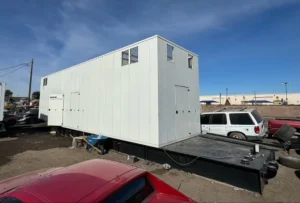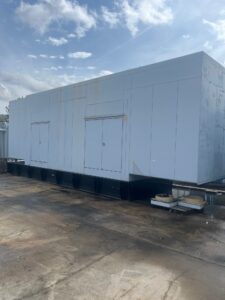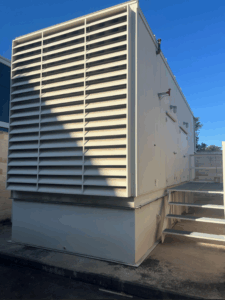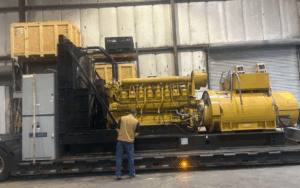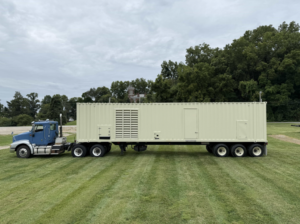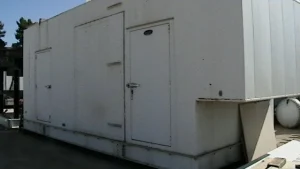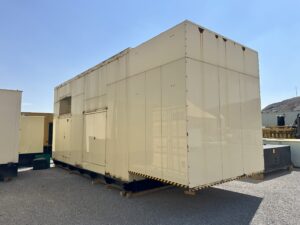
A 3000kW generator sits at the upper edge of what a single diesel engine can produce. In practice, the used market for single-engine 3MW units is thin — most large facilities at this power level run paralleled smaller platforms instead. The three single-engine platforms worth knowing are the CAT 3516B HD (84.5L V16), the MTU 20V4000 G83 (the engine inside the Kohler 3000REOZMD), and the Cummins QSK78 V18. Used pricing runs $850K–$1.5M depending on hours and configuration; new units land between $2.5M and $4M. We stock 2000kW-class units and parallel-ready platforms today. Call us at (818) 484-8550 and we can discuss sourcing a 3000kW unit or building you a paralleled solution.
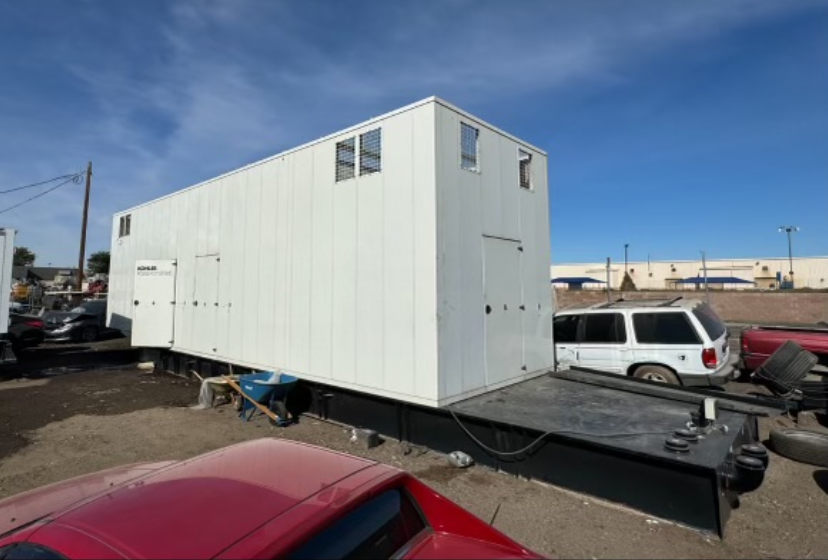
Let’s start with the math, because buyers at this size are usually engineers and they want the numbers.
3000kW prime power at 0.8 power factor gives you 3,750 kVA. At 480V three-phase, that’s 4,510 amps on the generator output terminals. Most facilities at this power level step up to medium voltage — at 4,160V you’re at around 520 amps; at 12,470V you’re pulling roughly 174 amps. The voltage choice drives your switchgear spec, your transformer sizing, and ultimately your total installed cost. We’ll come back to that.
So what actually needs 3MW of backup or prime power?
A 100-bed acute care hospital with full life safety, HVAC, surgical suites, and dietary systems can push 2,200–2,800kW of connected critical load. A single 3000kW unit covers that with enough headroom for expansion. That said, most hospital campus builds we’ve quoted for that load profile don’t run a single 3MW machine — they run two or three 1000kW–1500kW units in parallel because the code mandates redundancy anyway, and a single-engine failure on a solo 3MW unit means the building goes dark.
A small-to-mid Tier III data center hall is another legitimate 3MW customer. If your IT load is 1,000–1,200kW and you’re engineering N+1 redundancy, you need your generator plant to cover at least 2,000–2,400kW of UPS input simultaneously. Bump that up for cooling overhead and your number lands squarely in the 2,500–3,000kW generator spec. Again, most data center operators we talk to at this scale split it across multiple units — but single-engine configurations exist and do get spec’d, particularly for mid-size colocation facilities without the physical footprint for a multi-unit pad.
Oil and gas is the other real market at this size. Running three or four frac pump motors simultaneously, with variable frequency drives, on a remote pad with no utility connection — that’s where 3MW prime power actually makes sense as a single-engine deployment. The logistics of getting multiple units to a remote location and paralleling them in the field sometimes makes one big engine the smarter operational choice.
Mid-scale industrial: a copper smelter reverberatory furnace line, a large aggregate crushing and screening operation, a steel billet reheat furnace — these facilities draw 1,500–3,000kW of continuous process load and often have a single-engine standby spec that matches. We’ve moved large-frame units into refinery substations and paper mill applications where the process engineer was very deliberate about not wanting a paralleled switchgear scheme.
What 3MW does not cover, to be honest: a full-scale hyperscale data center (those need 10MW–100MW plants), a large smelting complex, or most utility-scale applications. If you’re shopping in this range, you probably already know your load. But it’s worth saying out loud: buyers who come to us with a “3000kW” requirement often find that 2× 1500kW or 3× 1000kW serves them better after we walk through the failure mode analysis together.
This is the decision that defines the project, and it’s worth more than a paragraph.
The case for a single 3000kW engine comes down to simplicity. One engine, one alternator, one set of controls, one maintenance contract, one fuel system, one exhaust stack. The paralleling switchgear for three 1000kW units runs $150,000–$250,000 installed. A single 3MW unit doesn’t need any of it. If your facility has a defined single critical load — one data hall, one hospital building, one process line — and you have a separate utility feed as your N+1, a single large-frame generator is a legitimate and sometimes cheaper total installed cost solution.
The case for paralleling is almost always redundancy. Four 1000kW units in an N+1 configuration means any single unit fails and you stay at full critical load. You also get load-following efficiency: at 40% load (1,200kW out of 3,000kW total capacity), you can run two units at 60% load each rather than one large unit throttling down to 40% load — diesel efficiency curves punish you hard below 50% load. Fuel consumption at part-load on a 3MW single engine running at 30% is noticeably worse than two 1500kW units each running at 60%.
The math on paralleling versus single-engine isn’t always what buyers expect. Let’s run it straight:
Single 3000kW unit (used, mid-hours): $1,100,000 unit cost + $60,000 pad/foundation + $80,000 medium-voltage switchgear + $40,000 installation labor = approximately $1.28M total installed.
2× 1500kW units (used, similar hours): $700,000–$800,000 for both units + $60,000 for two pads + $180,000 paralleling switchgear and controls + $70,000 installation labor = approximately $1.1M–$1.11M total installed.
The numbers are actually closer than most people think. The paralleling switchgear premium is real, but two used 1500kW units cost less than one used 3000kW unit because the 3MW supply on the used market is much thinner — limited supply means sellers hold price.
One more variable: lead time. We can source a used 1500kW Cummins QSK60 or CAT 3512B with reasonable hours in two to three weeks. A used single-engine 3000kW unit — CAT 3516B HD with low hours, correct voltage, functional controls — takes two to four weeks minimum because there are fewer of them. If your project timeline is tight, paralleling gives you more sourcing flexibility.
The decision is a 30-year infrastructure choice, not a price decision. Think about how your load will grow over a decade, how your maintenance program is staffed, and whether your critical systems can tolerate a single point of failure. That last question usually answers the rest.
If you ask an engineer which single diesel platform has delivered the most 3000kW prime power hours in industrial history, the answer is the CAT 3516B HD. It is not a glamorous answer, but it is the correct one.
The 3516B HD is a 16-cylinder, 60-degree V configuration engine displacing 84.5 liters — the same basic architecture that CAT has refined since the 3500 series launched in the 1980s. The HD (Heavy Duty) designation is the load variant rated for 3000kW prime / 3250kW standby at 1800 RPM, 60 Hz. Standard 3516B (non-HD) peaks lower; make sure the model code explicitly says HD or you’re looking at a different rating. The 3516C HD followed with Tier 2 emissions compliance, upgraded fuel injection, and revised turbochargers — same block family, cleaner burn, similar maintenance intervals.
Key specs on the 3516B HD:
The EMCP 4 control system is genuinely good. It handles paralleling functions, load sharing, data logging, and remote monitoring without requiring a separate paralleling module for basic N+1 applications. If you’re buying a used 3516B HD, confirm the EMCP version — upgrading from EMCP 2 to EMCP 4 is possible but adds cost.
Maintenance intervals on the 3516B HD follow CAT’s S·O·S (Scheduled Oil Sampling) program. Oil changes at every 500 hours, major overhaul at 20,000–30,000 hours depending on application and load profile. CAT’s dealer network for 3516 parts is the deepest in the industry. That matters when you’re running a unit in a location where downtime costs $10,000 per hour. Parts availability for 3516B HD blocks, turbochargers, injectors, and heads is excellent — new, rebuilt, and aftermarket.
What to watch on a used 3516B HD: liner pitting is a known issue on units that have sat with low-sulfur fuel and inadequate DCA (diesel coolant additive) maintenance. Pull the hoods and look for coolant staining at the liner O-rings. Turbocharger bearing wear shows up in oil analysis as elevated iron and aluminum — ask for the last three S·O·S reports. Injector condition is the other watch item; injector replacement on a 16-cylinder engine runs $18,000–$25,000 in parts alone.
The 3516C HD is a worthwhile upgrade over the B variant if you’re comparing used units at similar hours. The C’s common-rail fuel system improves fuel economy at part load by 3–5% and the emissions profile is cleaner. The trade-off is slightly higher fuel system complexity — common-rail injector failures are more expensive than the mechanical injectors on the B.
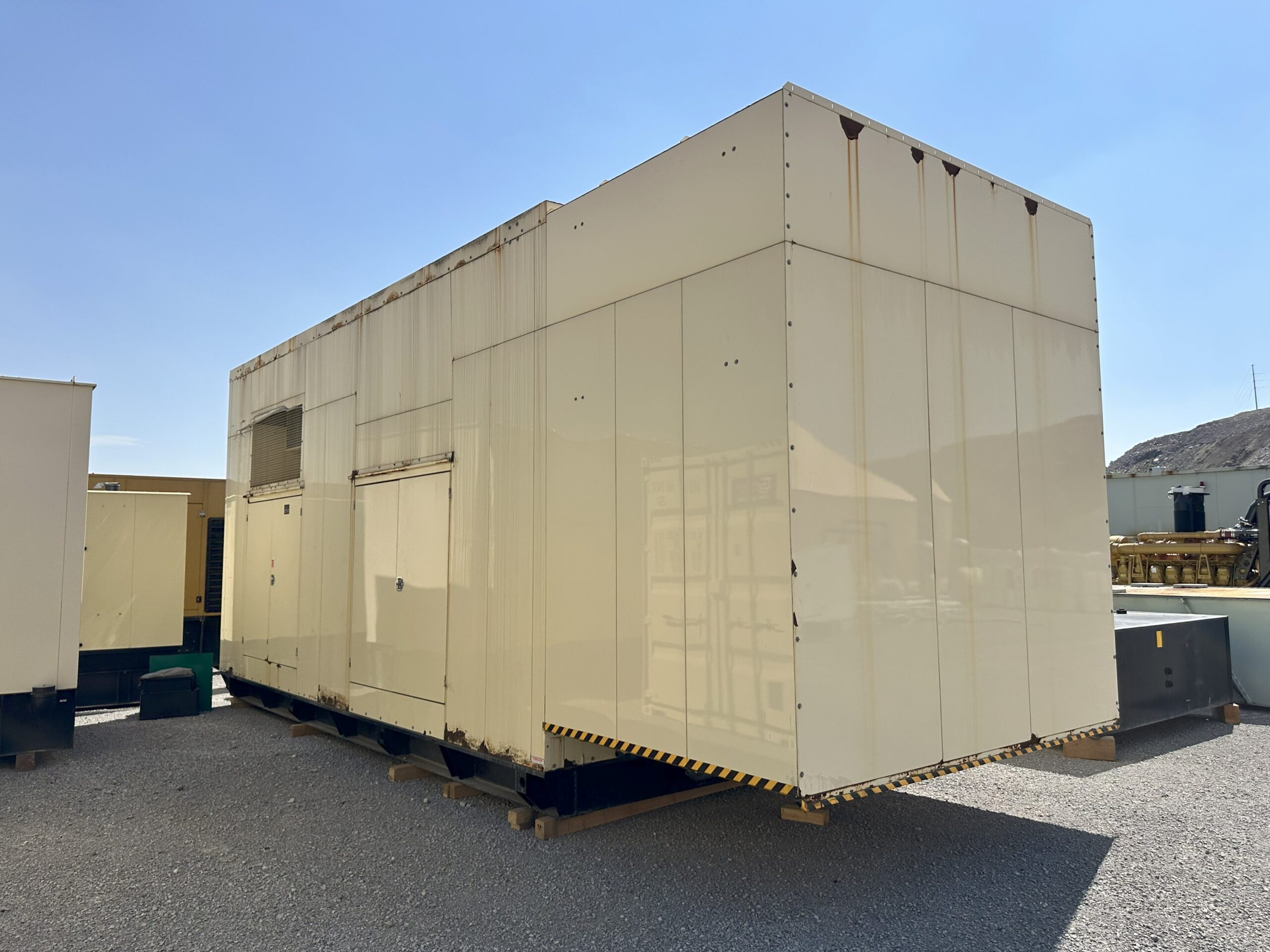
Enclosure footprint for a CAT 3516B HD generator set in a sound-attenuated steel enclosure: approximately 30 feet long by 9 feet wide by 11 feet tall. Plan for a 6-inch reinforced concrete pad with adequate rebar spacing for 70,000 lbs, and 18–24 inches of clearance on all sides for maintenance access. The exhaust stack runs 16–20 inches diameter at this displacement; your muffler and rain cap selection matters for back-pressure.
We’ve quoted the 3516B HD platform to more buyers in the 2000kW–3000kW range than any other single engine. It is not the only option, but if someone asks us for the reliable, well-supported, long-track-record choice at 3MW, this is the one.
MTU’s 4000 series engines are the other platform where single-engine 3000kW is realistic. The specific engine you’ll encounter at this power level is the 20V4000 G83 — a 20-cylinder, 95-liter V configuration running at 1800 RPM for 60 Hz North American applications. MTU designates the G84 for the EU 50 Hz variant.
The relationship between MTU and Kohler at this power level mirrors what you see at 2000kW: MTU makes the engine, Rolls-Royce Power Systems owns MTU, and Kohler packages the complete generator set. The Kohler 3000REOZMD is effectively the North American market name for a 20V4000 G83-powered generating set with Kohler’s PowerSync controls and alternator package. The “REO” nomenclature in Kohler’s large-frame line always signals an MTU engine under the hood.
The 20V4000 G83 specs:
The 20V4000 family is the engine inside a significant portion of the world’s rail locomotive fleet — the MTU 4000 series powers Siemens Charger locomotives, among others — so the engineering pedigree at sustained high load is real. The diesel generator variant is a purpose-built power generation derivative of that core architecture.
Where the MTU/Kohler platform earns its premium: noise. The 20V4000 G83 in a Kohler sound-attenuated enclosure typically achieves 72–75 dB(A) at 7 meters, which is lower than comparable CAT configurations. If your generator plant is near a property line or a noise-sensitive facility, that 3–5 dB difference is meaningful. Hospitals and data centers in urban locations frequently spec Kohler for exactly this reason.
The knock on the MTU/Kohler path is parts cost and dealer network depth. MTU authorized dealers are fewer than CAT dealers, and major components — turbochargers, fuel injection pumps, cylinder heads — cost more. The 20V4000’s 20-cylinder configuration means 20 fuel injectors, 20 sets of valve components, and 20 pistons. Budget accordingly for major overhauls. A top-end overhaul on a 20V4000 G83 runs $85,000–$130,000 in parts depending on what gets replaced.
Used Kohler 3000REOZMD units on the market are rare. We’ve seen fewer than 10 legitimate units come across the used market in the past five years with documented hours under 10,000 and verifiable service records. When they appear, they command a premium — expect $1.2M–$1.5M for a low-hour unit in good mechanical condition. That’s not price gouging; it’s simple supply and demand on a thin market.
One detail that comes up on inspections: Kohler’s PowerSync controls on the 3000REOZMD use a proprietary architecture that communicates with the MTU ECM. Third-party control retrofits are possible but expensive. If you’re buying a used unit with controls issues, budget for a Kohler controls refresh — $25,000–$45,000 — rather than assuming you can substitute generic paralleling gear.
| Platform | Engine | Displacement | kW Rating | Best For |
|---|---|---|---|---|
| CAT 3516B HD | V16 Diesel | 84.5L | 3000kW prime / 3250kW standby | Industrial prime power, wide parts availability, 25+ year track record; best choice when CAT dealer support is local |
| CAT 3516C HD | V16 Diesel (common rail) | 84.5L | 3000kW prime / 3300kW standby | Tier 2 emissions, improved fuel economy at part load vs B; preferred when fuel efficiency matters or Tier 2 required |
| MTU 20V4000 G83 / Kohler 3000REOZMD | V20 Diesel | 95L | 3000kW prime / 3375kW standby | Lowest noise profile at the 3MW level; urban/campus installs; premium parts cost; used units rare |
| Cummins QSK78 | V18 Diesel | 78L | 2800–3000kW prime / 3200kW standby | Best Tier 4F emissions path; newest engine in class; virtually no used market yet; buy new or not at all |
| Paralleled 2× 1500kW | Various (QSK60, 3512B, etc.) | Varies | 3000kW total / N+1 at 1500kW | Best redundancy; more sourcing flexibility; higher switchgear cost; preferred for data centers and hospitals with N+1 requirements |
Cummins’ path to 3000kW runs through the QSK78, a 78-liter V18 engine that represents the top of the QSK diesel generator line. If you’re already familiar with the QSK60 — the 60-liter V16 that peaks around 2000kW prime in generator application — the QSK78 is the logical next step upward in the same product family.
The QSK78 specs:
The QSK78 is newer to the market than the CAT 3516 or MTU 20V4000. Cummins introduced the QSK78 for generator applications in 2019–2020, which means the used market for this engine is nearly nonexistent. You will not find a low-hour QSK78 generator set at a used price — if one appears for sale, question the provenance. This is an engine you buy new or you don’t buy at this power level.
Cummins also makes the QSV91, a 91-liter natural gas V18 variant. If your application has access to reliable pipeline gas or LNG and you’re considering gas prime power at 3MW, the QSV91 is worth a conversation. Fuel cost economics on a 3MW natural gas engine versus diesel over a 10-year prime power application can favor gas by $200,000–$400,000 depending on local fuel prices. The trade-off is lower energy density (gas has roughly 70% of diesel’s BTU per volume at equivalent pressures), slightly lower power density, and more complex fuel infrastructure.
Cummins’ dealer network is strong in North America — second only to CAT in parts availability and technician coverage for large-frame engines. If you’re in a location where CAT dealer coverage is thin, Cummins often has better local service support.
One note for buyers used to QSK60 platforms: the QSK78 is physically larger and heavier. The set footprint and weight land in the same range as the CAT 3516B HD. Don’t assume your existing 2000kW pad will accommodate an upgrade to QSK78-powered equipment without an engineering review.
Pricing reality at 3MW
The used market for 3000kW single-engine generator sets is thin, and price reflects that. Here’s what we’ve actually seen:
Used CAT 3516B HD: $850,000 on the low end for a unit with 15,000–20,000 hours and deferred maintenance that needs turbo work and injectors. A clean unit with 5,000–8,000 hours and a documented service record runs $1,050,000–$1,200,000. Units with recent major overhauls and under 3,000 post-overhaul hours can approach $1,300,000.
Used CAT 3516C HD: Similar hour-for-hour pricing to the B, sometimes a slight premium for the cleaner fuel system. $950,000–$1,250,000 depending on condition.
Used Kohler 3000REOZMD / MTU 20V4000 G83: $1,200,000–$1,500,000 for low-hour units when they surface. High-hour or poor-condition units rarely trade at this level because the parts cost for a full refurbishment doesn’t justify a low purchase price.
New 3000kW generator set: $2,500,000–$4,000,000 depending on engine platform, emissions tier, enclosure specification, and voltage configuration. Tier 4F with SCR adds $180,000–$300,000 to the package cost. Medium-voltage (4,160V or 12,470V) configurations add another $80,000–$150,000 in alternator and termination costs.
These numbers do not include: shipping (a 70,000-lb unit on a lowboy from a Texas dealer to California runs $12,000–$18,000), pad and foundation work ($30,000–$80,000 depending on soil conditions and rebar spec), switchgear, fuel tank, exhaust system, or startup commissioning.
Voltage configurations
At 3MW, voltage selection is a real decision, not a default. Most installations we see fall into one of three configurations:
480V — used in facilities where the generator feeds an existing 480V distribution bus directly. Lower voltage means very high current (4,510 amps at full load), which requires large cable runs and heavy buss work. Common in industrial plants that already have 480V infrastructure.
4,160V — the most common medium-voltage choice for large industrial and some data center applications. A 3000kW generator at 4,160V runs 416 amps at full load — manageable with standard medium-voltage cable and switchgear. Requires a facility-side transformer to step down to 480V for utilization equipment.
12,470V — higher voltage distribution, often seen in utility-adjacent applications, large campus designs, and oil and gas facilities. 174 amps at full load. Distribution losses over long cable runs are lower. Requires 12kV-class switchgear.
The voltage you spec must match your facility’s distribution infrastructure or your transformer/switchgear budget goes up fast. We’ve talked to buyers who spec’d a 480V unit because they’re used to 480V equipment, then discovered their facility’s 3MW service entrance is a 4,160V bus. That’s a $60,000–$120,000 transformer addition that should have been in the project budget from day one.
What to inspect before buying
At this power level, a 3MW load test is not optional — it’s the price of admission. Loading a 3MW generator to 100% requires a 3MW load bank. Portable resistive load banks in that range are not cheap to mobilize: expect $15,000–$25,000 to rent, transport, and operate a 3MW load bank for a one-day test at a remote facility. If the seller won’t support a full-power load test, that’s a red flag worth taking seriously.
Beyond the load test, the inspection checklist at this size:
Oil and coolant analysis — ask for the last three laboratory oil analysis reports (S·O·S for CAT, Fleetguard for Cummins). Elevated iron indicates cylinder wear or liner pitting. Elevated aluminum points to turbocharger bearing wear. Coolant analysis should show no combustion gases (which would indicate a head gasket issue) and proper DCA levels.
Turbocharger condition — at 84.5L or 95L displacement, each turbo moves enormous volumes of air. Shaft play on a turbo bearing at this size translates to catastrophic failure risk under load. Check shaft axial and radial play with a dial indicator, or have a qualified technician do it during the inspection.
Aftercooler condition — the aftercoolers (charge air coolers) on large-frame diesels are failure points that get overlooked. Clogged or corroded aftercooler cores reduce charge air density, drop output, and increase exhaust temperatures. Pull the inspection covers and look.
EMCP/controls functionality — test every alarm and protective relay function on the control panel. Verify alternator metering accuracy. On units with older EMCP 2 or 3 panels, budget for a controls upgrade if you’re integrating into a modern BAS or paralleling switchgear.
Alternator insulation — test with a megohmmeter (megger test) at 1,000V. Insulation resistance on a healthy large-frame alternator should be 100 megohms or higher. Readings below 10 megohms indicate moisture or insulation degradation. Below 1 megohm, the alternator needs rewinding.
One final note on inspections: do not buy a 3MW generator set sight-unseen based on photos and a seller’s hour reading. We’ve seen odometer rollbacks on hour meters, units that were “rebuilt” with used parts that have hidden wear, and configurations that don’t match what’s on the nameplate. At $1M or more, an independent inspection with a qualified diesel technician is worth the $2,000–$4,000 it costs.
We’ll be direct: we don’t typically stock single-engine 3000kW units on our lot in Santa Clarita. The used market for those units is thin enough that stocking them speculatively doesn’t make sense — when they surface, they move fast.
What we do stock right now in the 2000kW class and above:
GS4806 — Kohler 2000REOZMD — the 2000kW Kohler powered by the MTU 16V4000 G23, the smaller sibling of the 20V4000 G83. If you know the Kohler 3000REOZMD, this is the same basic MTU architecture at two-thirds the displacement. Clean unit with documented service history.
GS4864 and GS4845 — Cummins QSK60-powered units — both in the 2000kW range, QSK60 V16 engines. The QSK60 platform has the best parts availability in the QSK line and technician familiarity is high. These are solid platforms for facilities that need proven large-frame Cummins coverage.
GS4826 — CAT 3516C — a 3516C HD-rated unit. Same engine family as the 3516B HD with upgraded fuel system. This is the CAT platform we know the deepest, and this unit has had a full inspection.
GS4851 — CAT 3516DITA, 1850kW, high-voltage — a medium-voltage configuration on the 3516 platform. If your facility runs 4,160V distribution, this is a plug-and-play option at the 1850kW level.
Here’s how the paralleling math works with what we have in stock right now: two Cummins QSK60 units (GS4864 and GS4845) running in N+1 parallel give you an effective 2000kW with N+1 redundancy, or 4000kW total capacity if you push both to standby rating and don’t carry the N+1 margin. Two 2000kW Kohler or CAT units in parallel gives you 4000kW total capacity with N+1 redundancy at 2000kW. That math covers most facilities that open a conversation asking for 3000kW single-engine.
For buyers who truly need a single-engine 3000kW platform, we source through our dealer network. We’ve placed units from dealers across Texas, the Gulf Coast, and the Midwest, where large-frame industrial equipment tends to turn over more frequently than it does on the West Coast. Lead time from the moment we have a confirmed spec and budget is typically two to four weeks for a unit with clean title and a recent inspection report. We won’t place a 3MW unit without at minimum a full-power load test result and an oil analysis — at that price level, our reputation is on the line as much as the machine is.
Financing and leasing at the 3MW level is a real conversation. Equipment loans for industrial generators in the $1M–$2M range are available through equipment finance lenders we work with regularly. Lease structures — operating lease with a buyout option — make sense for project-based applications where the unit deploys for a defined period. If that’s relevant to your situation, call us and we’ll connect you with the right conversation.
We’re at 26764 Oak Ave, Santa Clarita, CA 91351. Phone is (818) 484-8550. If you’re evaluating a 3MW project — whether that’s a single-engine sourcing question, a parallel solution design, or a load analysis conversation to figure out whether you actually need 3MW — we’re the call to make.
Buyers who come to us at this power level always ask some version of the same questions: how rare is the right unit, what will it actually cost all-in, and can you get it here before my project date. We give straight answers to all three.
Genuinely rare. We monitor the used market closely and see a handful of legitimate 3516B HD or MTU 20V4000-powered units per year that are worth buying — meaning clean title, documented service history, and a recent load test. The Kohler 3000REOZMD specifically is harder to find than a late-model used sports car. If you find one and the price looks too good, be skeptical.
For most facilities that need N+1 redundancy — hospitals, data centers, critical process plants — the answer is probably yes. Two 1500kW units in N+1 configuration give you better fault tolerance and often similar all-in cost. The exception is when physical footprint or operational simplicity is the overriding constraint, or when a facility already has a separate utility feed that serves as N+1.
Medium voltage is common at this power level. 4,160V is the most frequent choice in North American industrial and data center applications. 12,470V shows up in utility-adjacent designs and large campus builds. 480V is used when the generator feeds an existing 480V bus directly, but the cable sizing requirements at 4,510 amps are significant.
Tier 4 Final (Tier 4F) compliance requires selective catalytic reduction (SCR) with diesel exhaust fluid (DEF) injection. At 3MW, the SCR system adds $180,000–$300,000 to purchase cost and requires a DEF storage and dosing infrastructure at site. Whether Tier 4 matters depends on your jurisdiction and permit requirements. Many large-frame standby applications qualify for stationary emergency exemptions that allow Tier 2 equipment. Check with your air district before assuming you need Tier 4F.
Two to four weeks from confirmed spec and budget for a used unit via our dealer network. New units from CAT, Cummins, or Kohler/MTU run 20–36 weeks depending on backlog — large-frame production slots book out. If your timeline is under six months, used is almost certainly the path.
Yes. We work with equipment finance lenders who handle industrial generator transactions in the $500,000–$5M range. Loan terms of 60–84 months are available for creditworthy buyers. Operating leases with buyout options are available for project or temporary applications. Call us at (818) 484-8550 and we’ll walk through the options.
We stock 2000kW-class units from CAT, Cummins, and Kohler right now in Santa Clarita — and two units running in parallel gives you 3000–4000kW of effective capacity with N+1 redundancy built in. For buyers who need a true single-engine 3000kW unit, we can source one via our dealer network within two to four weeks. Call us at (818) 484-8550 and let’s figure out the right path for your project.