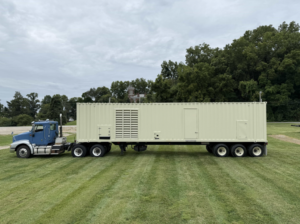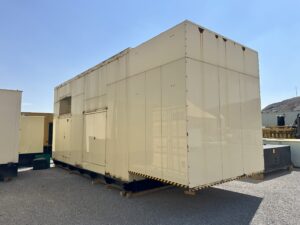
We get the natural gas vs diesel generator question every week — and after 25 years of selling both, the answer is almost always the same: diesel for standby, natural gas for prime power. The fuel cost math favors natural gas at roughly $0.12/kWh vs $0.30–$0.37/kWh for diesel, but only when you can guarantee the gas line stays live during an outage — and you can’t always do that. Power Generation Enterprises stocks 140+ natural gas generators and thousands of diesel units in Santa Clarita. Call us at (818) 484-8550 and we’ll tell you which fuel type actually fits your project.
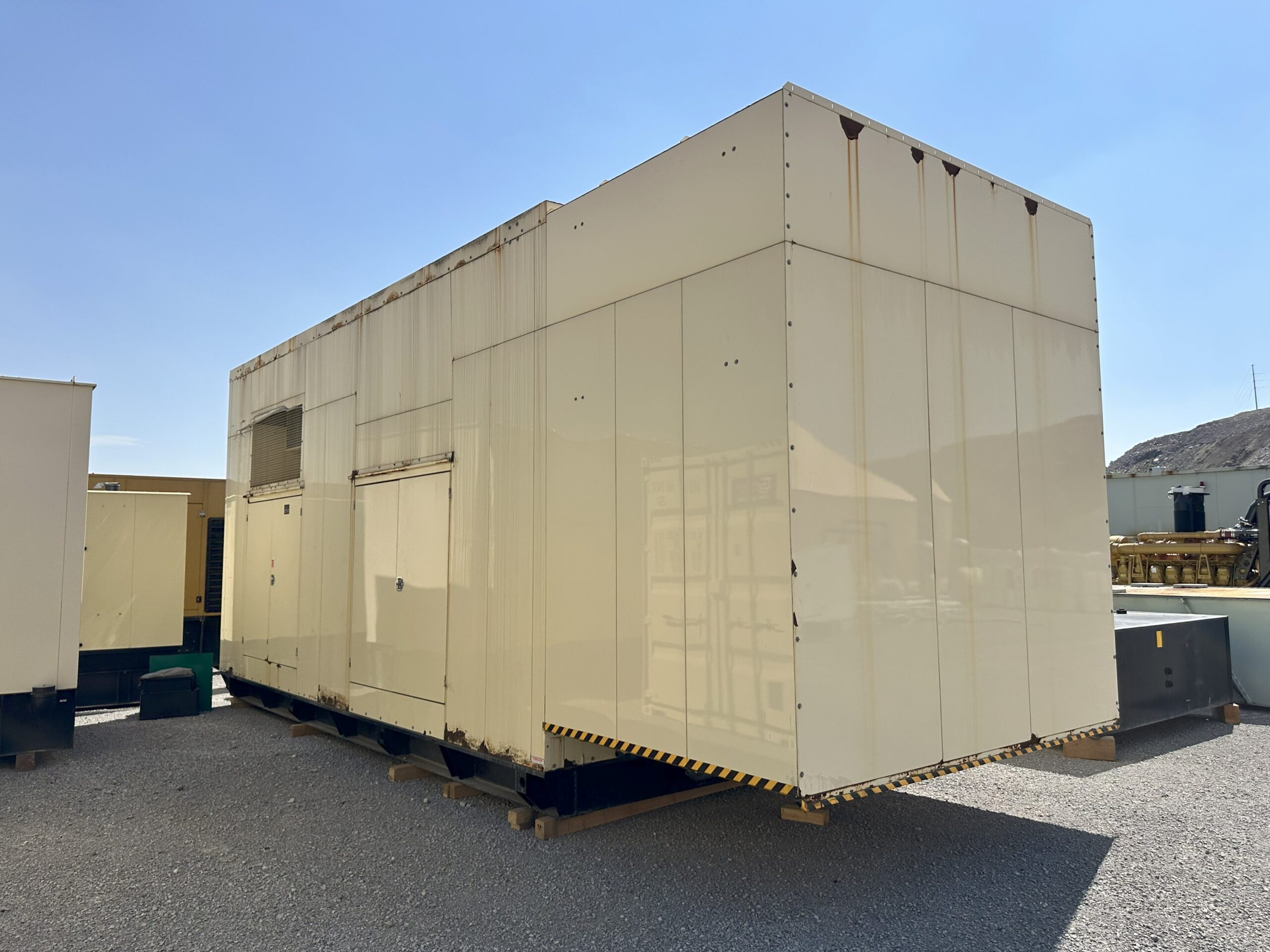
Half our buyers don’t realize they’ve already made the fuel-type decision before they call us. A hospital picking a backup generator for the ICU has no real choice — it’s diesel, full stop, and NFPA 110 essentially codifies that. A wastewater treatment plant that needs 2 MW running 8,000 hours a year has almost no reason to buy diesel when a Waukesha L7044GSI or a CAT G3516 will run cleaner, cheaper, and longer between oil changes.
The middle cases are where people get confused. Peak-shaving systems at manufacturing facilities. Data center supplemental power. Agricultural operations with both long run-hours and occasional outage requirements. These are the applications where the fuel-type decision actually deserves a real analysis — and where we see buyers get it wrong most often.
Let’s put the actual numbers on the table.
The rule we use internally: if the unit runs more than 1,500 hours per year and fuel cost matters, natural gas wins almost every time. If the unit needs to start in 10 seconds and carry 100% of a critical load during a utility outage of unknown duration, diesel wins almost every time. Most facilities have one of those two requirements, not both. When a facility genuinely has both — we talk about a hybrid approach, which we’ll get to.
One more thing before we get into the math. Dual-fuel and bi-fuel systems exist, and buyers ask about them regularly. They’re real, they work, and they add complexity and cost. We’ll cover those separately in the FAQ at the end. For this post, we’re treating diesel and natural gas as distinct choices, because that’s how 90% of the purchases we process actually play out.
This is where the conversation usually starts, and where buyers often use the wrong assumptions. Here’s how to run it correctly.
A diesel generator running at 75% load burns approximately 0.067 gallons per kWh. That number varies by engine platform — older Tier 2 engines run closer to 0.072 gal/kWh, modern Tier 4 Final units can get down to 0.060 — but 0.067 is a solid middle-ground assumption for fleet averaging.
Diesel spot prices fluctuate, but for planning purposes we use $4.50–$5.50/gallon for #2 diesel delivered to site. Factor in taxes and delivery surcharges and the high end of that range is realistic for most of California.
The math:
Natural gas heat content is approximately 100,000 BTU per therm. A natural gas generator at 75% load needs roughly 10,000 BTU per kWh of output — that’s 0.10 therms/kWh, or 10 therms per 100 kWh produced.
Industrial and commercial natural gas rates vary considerably by region and utility. For Southern California, $1.10–$1.30/therm is a reasonable planning assumption for 2025–2026. We’ll use $1.20/therm as our midpoint.
The math:
That’s a $0.18–$0.25/kWh difference in fuel cost alone. The gap is real and it is large.
Let’s put that against actual operating scenarios. We’ll use a 1,000 kW nameplate unit running at 75% load — so 750 kW average output.
Scenario A: Emergency standby, 200 hours/year (utility outages + load testing)
| Fuel | kWh/year | Cost/kWh | Annual Fuel Cost |
|---|---|---|---|
| Diesel | 150,000 | $0.335 avg | $50,250 |
| Natural Gas | 150,000 | $0.12 | $18,000 |
Annual savings with natural gas: $32,250. Not trivial, but at 200 hours/year the payback calculation on a $50,000 premium for gas infrastructure may take 5+ years.
Scenario B: Prime power / peak shaving, 8,000 hours/year
| Fuel | kWh/year | Cost/kWh | Annual Fuel Cost |
|---|---|---|---|
| Diesel | 6,000,000 | $0.335 avg | $2,010,000 |
| Natural Gas | 6,000,000 | $0.12 | $720,000 |
Annual savings with natural gas: $1,290,000. That pays for a lot of gas line infrastructure and a premium engine in year one.
This is why we tell prime power buyers who are still shopping diesel to call us back. We sold a Waukesha VHP P9390GSI to a co-generation project outside Fresno — 1,500 hours into the first year they had recovered more than half the unit cost in fuel savings versus their previous diesel setup. That’s not a rounding error.
One caution: get your actual local utility gas rate before you run these numbers for your project. In parts of the country where gas is $0.80/therm, the advantage is even larger. In areas with supply constraints or winter peaking surcharges, rates can spike to $2.00+/therm and change the calculus considerably.
When the utility goes dark, a natural gas generator faces an immediate problem: the utility gas distribution system depends on electric pumping and compression to maintain pressure. In a grid-wide or regional outage, your gas line pressure can drop within hours. The generator keeps running until the pressure falls below the engine’s minimum fuel inlet pressure — and then it stops.
Some sites have interruptible gas service agreements that explicitly permit the utility to cut gas supply during demand peaks or emergencies. If your site is on interruptible gas, a natural gas generator is not a reliable emergency standby. Full stop.
Even if your gas service is firm (non-interruptible), the physical infrastructure of the gas distribution grid is outside your control in a way that your diesel tank is not. You own the tank. You own the fuel. Nobody can shut off your diesel supply remotely.
A standard base-tank diesel installation gives you 24 hours of runtime. Extended tanks — a common configuration for hospitals, data centers, and municipal facilities — give you 72 hours at full load. Day tanks with bulk storage can extend this to weeks. We’ve configured setups for remote sites with 30-day fuel supply on-site. Try doing that with a natural gas generator.
This matters less to most buyers than runtime, but it matters a lot in specific applications. Diesel engines respond to a full-load step — say, 100% of rated load applied instantly — in approximately 10 electrical cycles (167 milliseconds at 60 Hz). Most modern diesel gensets with electronic governors can hit this. A well-tuned CAT 3516 will not drop voltage or frequency out of spec on a cold start with full block load if the setup is right.
Natural gas spark-ignition engines respond more slowly. The combustion cycle is different. Fuel metering on a gas engine relies on throttle body and mixture control that doesn’t respond as quickly as a diesel injection system. Realistic load step response for a gas genset is 30 cycles or more — sometimes 50+ on older platforms. That’s 500–833 milliseconds.
In most prime power applications this doesn’t matter. The load is not applied in a single block step. But for critical facilities that need to pick up 100% of a critical bus in a single event — data centers with UPS switchover timings, for instance — diesel’s faster transient response is a real operational advantage.
Hospitals have learned this the hard way. NFPA 110 Level 1 emergency power supply systems (EPSS) require the generator to reach full voltage and frequency within 10 seconds of utility failure and maintain it for the test duration. Diesel reliably meets this. Natural gas can too, technically — but the combination of slower response, potential gas pressure variability, and utility interruptibility concerns has kept diesel as the default for healthcare emergency power.
For applications running 3,000–8,760 hours per year, the calculus flips completely. The fuel cost advantage is massive, as shown above. But there are two other advantages buyers often underestimate.
First, maintenance intervals. A well-maintained Waukesha or Jenbacher natural gas engine has oil change intervals of 1,500–2,000 hours compared to 500–750 hours for most diesel platforms at prime power loads. Over an 8,000-hour year, that’s the difference between 4–5 oil changes and 11–16. On a large engine, each oil change involves 50–100+ gallons of oil. The savings are real.
Second, heat recovery. Natural gas gensets in combined heat and power (CHP) applications can achieve total system efficiency of 70–85% by recovering exhaust and jacket water heat for process heating or HVAC. Diesel CHP exists but is less common and the economics are worse. We sold a CAT G3520 to a food processing plant in the Central Valley specifically for CHP — the waste heat from the engine now handles their hot water and space heating. Their net energy cost per unit of production dropped by more than 20%.
Diesel fuel storage is regulated primarily under NFPA 30 (Flammable and Combustible Liquids Code) and NFPA 110 (Standard for Emergency and Standby Power Systems). The key rules buyers need to know:
Site space for a diesel tank is not trivial. A 10,000-gallon above-ground tank is roughly 10 feet in diameter and 30 feet long. Secondary containment around it adds footprint. For urban installations with tight site constraints, this becomes a real problem — and it’s one reason some urban facilities look at natural gas even for applications where diesel would otherwise be preferred.
Natural gas generators require a gas line of sufficient capacity to deliver fuel at full engine load. This is where buyers consistently underestimate the infrastructure requirements.
A 1,000 kW natural gas generator at full load needs approximately 10,000,000 BTU/hour of gas input (accounting for thermal efficiency). At standard pipeline pressure of 0.25 psi (7 inches water column — typical residential/light commercial pressure), a standard 2-inch service cannot deliver that volume. Large gensets typically need a medium-pressure service (2–5 psi or higher) with a dedicated regulator and meter at the generator.
Gas line sizing depends on:
We’ve had buyers purchase a gas generator and then discover that their existing gas service is undersized by a factor of 3. The gas line upgrade cost $40,000–$80,000 and took four months with the utility. Budget for this before you commit to a gas generator purchase.
The other infrastructure item that catches buyers off guard: the gas utility interconnection agreement. For generators above a certain size (varies by utility — SoCalGas has specific thresholds), you need a formal interconnection study and agreement before they’ll install the upgraded service. Allow 60–120 days for this process in California.
There is no equivalent delay for diesel. You buy the tank, you get it permitted, and fuel is delivered by truck. The infrastructure timeline for a diesel installation is typically 4–8 weeks versus 3–6 months for a new gas service installation on a large generator.
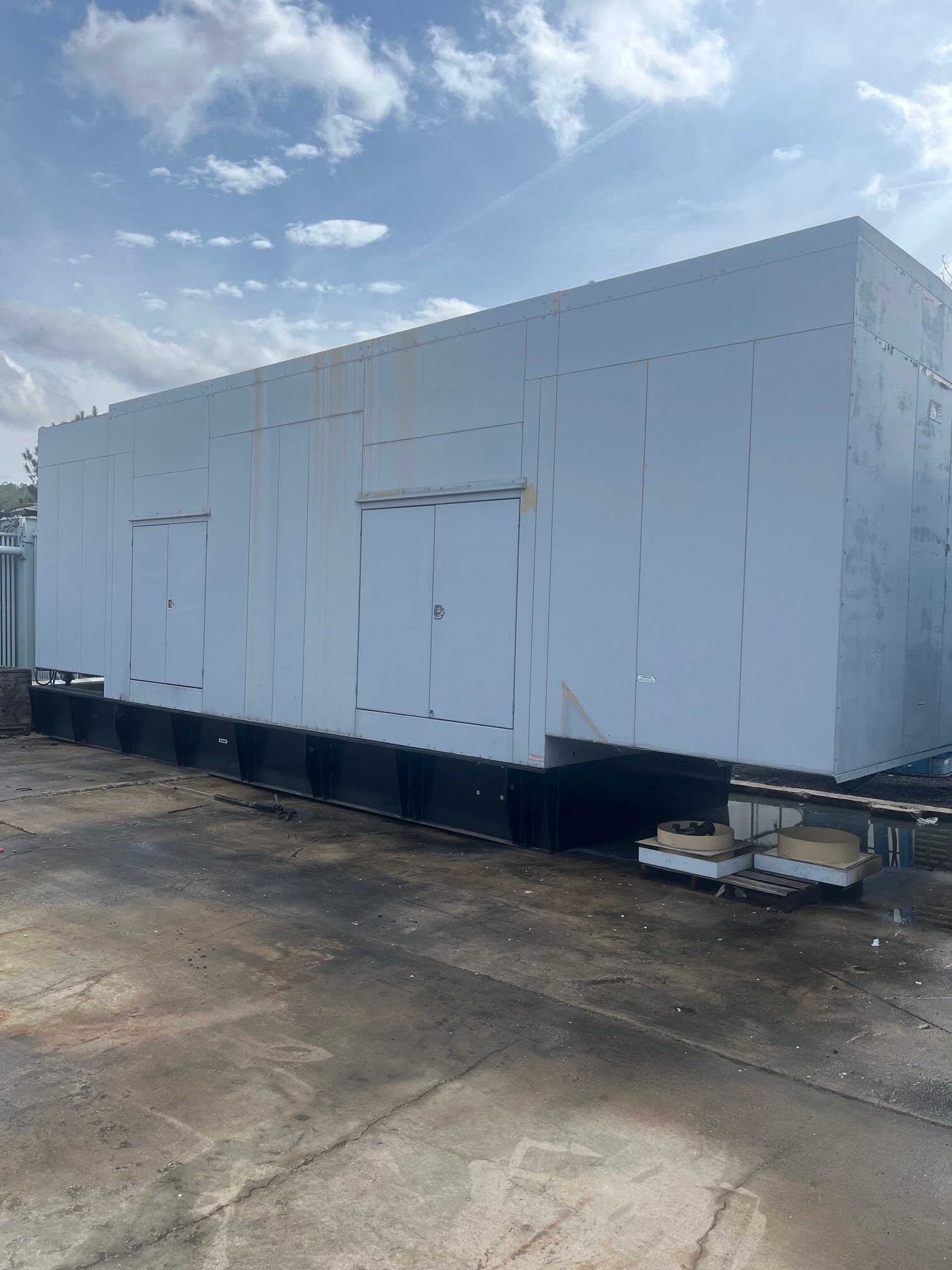
| Factor | Diesel | Natural Gas | Best For |
|---|---|---|---|
| Fuel cost per kWh | $0.30–$0.37/kWh (at $4.50–$5.50/gal diesel) | ~$0.12/kWh (at $1.20/therm NG) | Natural gas wins decisively on fuel cost |
| Runtime during outage | Days to weeks (fuel stored on-site in tanks you own) | Hours to unknown (depends on gas line pressure staying live) | Diesel — no dependency on utility gas grid |
| Load step response | ~10 electrical cycles (167ms at 60Hz) | 30–50+ electrical cycles (500–833ms) | Diesel for critical block-load applications |
| Site infrastructure | NFPA 30/110 tank + secondary containment; truck-delivered fuel; 4–8 week install | Gas line sized for full-load BTU/hr; utility meter upgrade; 60–120 day utility interconnect process | Diesel for speed of installation; gas for urban sites with limited tank space |
| Emissions (Tier/SI category) | EPA Tier 1–4 Final (compression-ignition); Tier 4 DPF+SCR required on new engines | EPA RICE NESHAP Subpart ZZZZ (spark-ignition stationary); lean-burn NOx 0.5–1.0 g/bhp-hr vs 4–6 for uncontrolled diesel Tier 2 | Natural gas in non-attainment areas and high run-hour applications |
| Maintenance interval | 500–750 hr oil changes at prime power loads | 1,500–2,000 hr oil changes (Waukesha, Jenbacher lean-burn platforms) | Natural gas wins on maintenance interval at high run-hours |
| Capital cost (used market) | Wide availability; CAT 3516 and Cummins QSK60 most liquid; lower price competition | Less price competition on specific platforms; Waukesha L7044GSI $87K; CAT G3516 $100–$180K used | Diesel for widest selection and most price competition |
The emissions picture for generators is more complicated than most buyers realize, and the Tier system does not apply the same way to diesel and natural gas engines. This is one of the most common points of confusion we see.
EPA’s nonroad diesel engine emissions standards — Tier 1 through Tier 4 Final — apply to compression-ignition (diesel) engines used in nonroad applications, which includes stationary generators. These tiers set progressively tighter limits on particulate matter (PM), nitrogen oxides (NOx), and hydrocarbons.
Tier 4 Final is the current standard for new diesel engines above 56 kW. It requires a roughly 90% reduction in PM and NOx versus Tier 1 and typically requires Diesel Particulate Filter (DPF) and Selective Catalytic Reduction (SCR) aftertreatment.
Used diesel generators are not required to be Tier 4 Final at the time of sale. A used Tier 2 diesel generator is legal to purchase and operate — but your local air district may impose additional requirements based on hours of operation, project type, or attainment status for ozone and PM2.5. In the South Coast Air Quality Management District (SCAQMD), which covers the Los Angeles basin, diesel standby generators face some of the tightest operating restrictions in the country. Rule 1470 limits NOx emissions from stationary generators, with requirements that vary by engine vintage and permit type.
Natural gas generators are spark-ignition engines. They are not subject to EPA’s nonroad compression-ignition Tier standards. Instead, they fall under EPA’s National Emission Standards for Hazardous Air Pollutants for Stationary Reciprocating Internal Combustion Engines (RICE NESHAP, 40 CFR Part 63 Subpart ZZZZ) and potentially the Standards of Performance for Stationary Spark Ignition RICE (40 CFR Part 60 Subpart JJJJ).
The practical effect: natural gas engines in California generally produce far less NOx and PM than equivalent diesel engines without aftertreatment, and they face different permit thresholds. A natural gas generator running 8,000 hours per year at a facility in a non-attainment zone is often permittable when the equivalent diesel unit would require BACT (Best Available Control Technology) review and potentially catalytic emission controls.
Lean-burn natural gas engines — which is how virtually all modern large gas gensets operate — have inherently lower NOx than rich-burn engines. The Waukesha L7044GSI and the Jenbacher J620 are both lean-burn designs. NOx emissions on these platforms typically run 0.5–1.0 g/bhp-hr compared to 4–6 g/bhp-hr for an uncontrolled Tier 2 diesel engine.
If your project is in a non-attainment area with significant annual run-hours, the emissions math alone may make natural gas the only practical choice. Get your air district permit requirements before you select a fuel type — not after.
California runs its own emissions program through CARB and the regional air districts. SCAQMD Rule 1470 places specific limitations on diesel emergency generators, including:
Natural gas emergency generators in SCAQMD are subject to different rules — generally less restrictive for standby operation because the base emission rates are lower. For prime power operation, natural gas units still need an Authority to Operate (ATO) from the air district, but the pathway is typically simpler and less expensive than for a diesel prime power installation.
Outside California, the picture is less restrictive but the basic principle holds: natural gas permitting for prime power is easier than diesel permitting in most jurisdictions, and the gap widens at higher run-hours.
Not every manufacturer offers both fuel types, and the platforms that do often use entirely different engine families. Buyers who assume they can simply spec “the same generator in diesel or gas” are often surprised to find the two versions share little beyond the nameplate kW rating.
CAT is one of the few OEMs with a mature product line in both diesel and natural gas at high power levels.
On the diesel side, the 3500 series covers the range from about 1,000 kW to 3,000+ kW. The CAT 3516 is arguably the most commonly traded large diesel generator in North America — there are thousands of them in the used market and we stock them regularly. The 3512 covers 800–1,200 kW and the 3516B and 3516C reach into the 2,000+ kW range.
On the gas side, CAT’s G series (G3516, G3520) uses the same basic block architecture as the diesel 3500 series but with different heads, pistons, fuel systems, and governor/control packages for natural gas operation. The G3516 covers approximately 1,000–1,500 kW on natural gas. The G3520 goes up to roughly 2,000 kW. These are not retrofits of diesel engines — they are purpose-built gas versions of the same block.
CAT gas gensets are widely available in the used market, though not as common as the diesel equivalents. When we source a CAT G3516 we’re typically looking at 8,000–15,000 hours of runtime on a 10,000+ hour major overhaul interval.
Waukesha — now part of INNIO — makes gas engines only. They do not make diesel generators. If a buyer comes to us saying they want a Waukesha for emergency standby diesel backup, the conversation ends quickly.
What Waukesha does build is some of the most capable natural gas engine platforms available in the industrial market. The L7044GSI is a 12-cylinder engine rated at approximately 1,340 kW on natural gas. The VHP P9390GSI is a larger platform in the 1,500–2,000 kW range. Both are lean-burn designs with very strong fuel efficiency and low emission profiles.
We sold a Waukesha L7044GSI to a wastewater treatment plant in Bakersfield for $87,000. That unit replaced a diesel generator that had been burning through $180,000/year in fuel. The gas line upgrade cost them $55,000. They recovered the total investment in under 13 months.
The used Waukesha market is specialized. Parts availability requires knowing your way around the INNIO dealer network. These are not units you want to maintain without an experienced gas engine technician on staff or on retainer. But for continuous prime power in the 1,000–2,000 kW range, the Waukesha platform is hard to beat.
Cummins has two distinct platforms for high-power generator applications. The QSK series covers diesel from 1,000 kW to 4,000+ kW — the QSK60 and QSK78 are common in the 2,000–3,000 kW range. These are Tier 2 and Tier 4 variants with strong parts availability and a wide dealer network.
For natural gas, Cummins offers the QSV series. The QSV81 is a V-16 engine producing approximately 1,500 kW on pipeline natural gas. It’s a lean-burn design with solid emissions performance. The QSV series is less common in the used market than the QSK diesel platforms, partly because these engines tend to stay in service longer at their original installations before being decommissioned.
Jenbacher (INNIO) and MWM (Caterpillar) are European gas engine OEMs with no diesel offerings. They are primarily found in CHP applications, landfill gas projects, and biogas-to-power installations.
The Jenbacher J620 is a 3 MW+ natural gas engine — one of the larger single-engine gas gensets available. These units are highly engineered for high-efficiency continuous operation and are correspondingly expensive and complex to maintain. A used J620 in good condition is a significant capital purchase — typically $300,000–$600,000 depending on hours and configuration.
MWM’s TCG 2032 series covers 1,000–4,000 kW on natural gas. Like Jenbacher, these are CHP-oriented engines built for long continuous run cycles. They’re less common in the North American market than in Europe but we see them in industrial CHP installations.
For buyers who need 3 MW+ of natural gas prime power and are prepared for the maintenance program these units require, Jenbacher and MWM are worth a look. For most buyers in the 500–2,000 kW range, CAT G series or Waukesha will be easier to source, service, and finance.
We stock both fuel types in significant volume, which puts us in a position to give you an honest recommendation rather than selling you the fuel type we happen to have available.
Our natural gas inventory runs 140+ units at any given time. This includes CAT G3516 and G3520 units, Cummins QSV platforms, and the largest Waukesha inventory in the western US — 61 Waukesha units across multiple engine families including L7044GSI, P9390GSI, and smaller VHP platforms. You can browse the full natural gas inventory at /product-category/caterpillar-and-cummins-natural-gas-generators-for-sale/ and Waukesha specifically at /product-category/waukesha/.
On the diesel side, our inventory runs into the thousands of units — CAT 3512 and 3516 in multiple vintages and configurations, Cummins QSK60 and QSK78, Kohler, MTU, and Generac across the power range from 100 kW to 4,000+ kW. Diesel units turn over faster in our inventory because standby applications are more common than prime power, so availability on specific models and configurations changes frequently.
A few things worth knowing about buying used in either fuel type:
For natural gas units, run-hour documentation matters more than for diesel. A gas engine that has been run hard without proper lubrication management or on substandard fuel quality (H2S contamination is a real issue on biogas and landfill gas sites) will show it in cylinder inspection data. We inspect and document the units we sell. Ask for the inspection report.
For diesel units, emissions tier matters more for buyers in California and other regulated states than it did five years ago. A Tier 2 diesel that was perfectly fine for emergency standby in 2018 may now require SCAQMD permit documentation and hour-logging compliance that some buyers aren’t prepared for. Know your permit requirements before you buy.
We also sell load bank test data for units we’ve tested — and we test most of what we sell. A load bank test is not a substitute for a full mechanical inspection, but a generator that holds voltage and frequency through a 4-hour 100% load test gives you considerably more confidence than one sold as-is.
The fuel-type decision is not a spreadsheet exercise. It involves your site’s gas infrastructure, your air district’s permit requirements, your utility’s interruptibility policy, your run-hour profile, and your capital budget. We’ve worked through this analysis hundreds of times with facility managers, plant engineers, and project owners across the western US.
Call us at (818) 484-8550. Tell us your application — standby, prime, peak shaving, CHP — and your power requirement in kW. We’ll tell you which fuel type makes sense for your project, what platforms we have available, and what the realistic total cost of ownership looks like over a 5-year horizon.
We’re at 26764 Oak Ave, Santa Clarita, CA 91351. We have the inventory and we have the experience. The answer to gas vs diesel is usually not complicated once you have the right numbers in front of you — and we can help you get there.
NFPA 110 Level 1 emergency power supply systems — which govern life-safety power in hospitals, surgery centers, and similar facilities — do not technically prohibit natural gas. However, the standard requires the system to achieve full voltage and frequency within 10 seconds of utility failure and maintain it reliably. The challenge is that natural gas supply depends on the utility gas grid remaining pressurized during an outage. In a broad utility failure, gas pressure can drop within hours. For this reason, nearly every NFPA 110 Level 1 installation uses diesel. Some jurisdictions’ AHJs (Authorities Having Jurisdiction) have gone further and explicitly require diesel for Level 1 healthcare applications. If you’re specifying a hospital standby system, assume diesel unless your AHJ has provided written guidance otherwise.
Dual-fuel systems (sometimes called bi-fuel) can run on a mixture of natural gas and diesel, or switch between them. Bi-fuel kits from companies like Power Solutions International inject natural gas into the intake air stream of a diesel engine, displacing some diesel consumption — typically 50–70% gas substitution at full load. These systems offer a middle path: you keep diesel as the primary and guaranteed fuel source, and you reduce fuel costs during extended prime power operation by substituting gas when available. The trade-offs are real: the conversion adds $30,000–$80,000 in equipment cost, gas line infrastructure is still required, and the bi-fuel system adds complexity and potential failure modes. For most applications, a clean choice between diesel and gas is simpler and more reliable than a hybrid system. But for facilities that have an existing diesel generator and want to reduce fuel costs without replacing it, bi-fuel retrofits are worth evaluating.
Waukesha’s history is in industrial gas compression and power generation in the oil and gas industry, going back to the early 20th century. The company built its entire engineering and manufacturing competency around spark-ignition gas engines. When INNIO (formerly GE’s distributed power division) acquired the brand, they maintained that focus because the Waukesha platform is genuinely excellent in its niche — high-efficiency lean-burn gas engines for continuous-duty applications. There was never a business case for Waukesha to develop diesel engines because CAT, Cummins, and MTU already owned that market. If you need diesel, Waukesha won’t help you. If you need 1,000–2,000 kW of continuous natural gas power, Waukesha is one of the best options available.
No — not in any meaningful sense. A diesel engine is a compression-ignition engine. It fires fuel by compressing air hot enough to ignite diesel fuel injected at the end of the compression stroke. A natural gas engine is a spark-ignition engine with a completely different compression ratio, head design, piston design, fuel delivery system, and ignition system. You cannot put a natural gas fuel system on a diesel engine and expect it to work. What does exist is bi-fuel conversion kits (see above), which supplement diesel with natural gas rather than replacing it. If someone offers to “convert your diesel to natural gas,” ask them exactly what that means mechanically. In most cases it is a bi-fuel system, not a true conversion. True conversions of diesel engines to spark-ignition gas are theoretically possible as a custom engineering project but are not commercially practical.
The biggest difference is oil change intervals. At prime power loads, a diesel generator typically needs an oil change every 500–750 hours. A lean-burn gas engine like a Waukesha or Jenbacher will go 1,500–2,000 hours between oil changes. On an 8,000-hour/year operating schedule, that’s 11–16 diesel oil changes versus 4–5 gas oil changes. On a large engine with 50–100+ gallons of oil per change, plus labor and disposal costs, this adds up to $30,000–$80,000/year in maintenance cost difference at high run-hours. The other significant difference is spark plug replacement on gas engines — plugs are a wear item that diesels don’t have. A large gas engine may have 16–24 spark plugs replaced every 1,000–2,000 hours. Factor this into your maintenance budget. Overall, at high run-hours, total maintenance costs generally favor natural gas, but the gap is smaller than the fuel cost gap.
In cold climates, natural gas demand surges in winter for heating, which can drive up commercial gas rates significantly. In some northern markets, winter industrial gas rates double or triple during peak demand periods. If your prime power application is seasonal — for example, peak shaving during summer air conditioning load — cold climate gas pricing may not affect you at all. But if you’re running 8,000 hours/year through a northern winter, model your gas costs using winter peak rates, not annual average rates. Diesel pricing is less seasonally volatile (though diesel prices do trend higher in winter due to heating oil demand competing for the same distillate supply). In extreme cold, diesel fuel can gel below -20°F without fuel additives or arctic blends — a consideration for outdoor tank installations in northern climates. Natural gas is essentially unaffected by cold temperatures at the engine.
Power Generation Enterprises carries 140+ natural gas generators — including the largest Waukesha inventory in the western US — and more than 2,000 diesel units across all power ranges, from 100 kW to 4,000+ kW. We’ll help you sort the fuel-type decision, identify the right platform for your run-hour profile and emissions requirements, and find a unit that fits your budget. Call us at (818) 484-8550.