Every buyer who calls us about a used generator eventually asks the same question: “Does it have to be Tier 4?” The short answer is probably not. Most standby and emergency applications in the U.S. are exempt from Tier 4 Final requirements, the used Tier 2 market is enormous and completely legal, and adding Tier 4 aftertreatment to a generator that runs 50-150 hours a year is an expensive solution to a problem you don’t have. We sell Tier 2 generators, we sell Tier 4 generators, and we’ll tell you honestly which one fits your project. Call us at (818) 484-8550 and we’ll walk through your application in ten minutes.
Here is how the call usually goes. A facility manager is replacing an aging generator, gets a quote from a new-equipment dealer, and the spec sheet says “Tier 4 Final.” The price is $380,000 for a 1000kW unit. Then someone tells them they can buy a Tier 2 used unit for $95,000. They call us and ask: “Is that even legal? Will I get fined?” The answer depends entirely on what the generator is being used for, where it’s installed, and whether California is involved.
The confusion has a source. New diesel engines manufactured after January 1, 2015 (for the >560kW category) must meet Tier 4 Final emissions standards under 40 CFR Part 89. Generator OEMs selling new equipment have no choice — they are producing Tier 4 engines. Their marketing naturally leads with Tier 4 as a feature, and buyers internalize “Tier 4 = compliant” and “Tier 2 = old and illegal.” Neither of those is accurate.
Tier standards regulate the manufacture of new nonroad diesel engines. They do not retroactively ban existing engines from operating. A Tier 2 engine that was lawfully manufactured during its production window is lawful to operate, buy, sell, and reinstall in most jurisdictions indefinitely. We’ve sold hundreds of Tier 2 generators — CAT 3512s, Cummins QSK50s, MTU 16V4000s — to hospitals, data centers, municipalities, and universities that ran them as emergency standby units for years without an emissions violation.
There are real cases where you do need Tier 4. We’ll get to those. But the marketing pressure from new-equipment dealers does not count as one of them.
The EPA’s nonroad diesel engine emissions program under 40 CFR Part 89 (and Part 1039 for Tier 4) established a phased schedule of increasingly stringent limits on particulate matter (PM), nitrogen oxides (NOx), hydrocarbons (HC), and carbon monoxide (CO). The tiers are defined by engine power category and manufacture date, not by application type.
For the power range most industrial generator buyers care about — 560kW to 900kW — the tier timeline looks like this:
The operative word in all of these regulations is “manufacture.” The EPA sets these standards at the point of engine production. Once an engine is built and certified, its tier classification is fixed. A CAT 3512C built in 2008 is a Tier 2 engine. It was compliant when it was built, it’s compliant today, and it will be compliant when your maintenance team retires it in 2040.
One exception matters: emergency stationary engines regulated under 40 CFR Part 60, Subpart IIII have their own rules that differ from the mobile nonroad rules in Part 89. Emergency stationary engines are not subject to the same Tier-based manufacture dates in the same way — the permit and installation rules, not just the manufacture date, determine compliance for stationary installations. This is where many buyers get confused between “nonroad mobile” regulations and “stationary source” regulations. If you’re installing a generator at a fixed site as an emergency standby unit, the applicable regulation is Part 60, Subpart IIII, not just Part 89, and the requirements are significantly more permissive.
NFPA 110, the Standard for Emergency and Standby Power Systems, governs installation, testing, and maintenance requirements but does not set emissions standards. NFPA 37, Standard for the Installation and Use of Stationary Combustion Engines and Gas Turbines, governs fire safety for stationary engines. Neither of these standards creates any Tier 4 requirement. Buyers sometimes conflate “compliance” across all these documents and conclude they need Tier 4 when they don’t.
Let’s be direct about this. In most emergency standby scenarios in non-attainment areas outside California, you do not need a Tier 4 generator. Here is when you actually do.
Prime power applications. If the generator runs continuously or for extended periods — a remote mine, an off-grid industrial facility, a prime power rental fleet — the hours accumulate quickly. At 4,000-6,000 hours per year, NOx and PM emissions add up. Many states require Tier 4 for prime power permits above certain thresholds. The emissions math matters in a way that it simply doesn’t at 100 hours per year of standby operation.
Non-attainment areas with air quality permits. The EPA designates counties as non-attainment areas for ozone (NOx is a precursor) and PM2.5. In some of these areas, local air districts layer additional requirements on top of federal minimums. If you’re in a non-attainment area and your permit application triggers a threshold review, the air district may require Tier 4 or equivalent controls regardless of your application type. This is where you need to read your permit conditions, not your generator spec sheet.
Project specifications that explicitly call for it. Some federal government contracts, GSA projects, and institutional RFPs specify Tier 4 Final as a project requirement. If the spec says Tier 4, you need Tier 4. We don’t argue with project specs. We find you a Tier 4 unit that fits the budget.
California — with significant nuance. CARB and SCAQMD requirements are their own subject, covered in detail below. California is the one jurisdiction where the simple answer may not hold.
When you likely don’t need Tier 4:
Our customers ask us this every week. A hospital in Nashville bought a used Caterpillar 3512B Tier 2 unit from us in 2024 for $87,500. They verified with their air permit consultant that the installation fell under the emergency stationary engine exemption in 40 CFR 60, Subpart IIII. They saved $240,000 compared to a comparable new Tier 4 unit and got a machine with a known service history from a medical facility. That is the Tier 2 market in practice.
If you’re not sure which category your application falls into, call us before you call a new-equipment dealer. We’ll tell you honestly whether Tier 2 makes sense. If you need Tier 4, we’ll tell you that too.
Tier 4 Final emissions numbers — NMHC+NOx at 0.40 g/kWh, PM at 0.03 g/kWh — are not achievable through combustion design alone. Every major engine manufacturer achieves them the same way: a diesel particulate filter (DPF) trapping particulate matter, a selective catalytic reduction (SCR) system chemically converting NOx to nitrogen and water, and diesel exhaust fluid (DEF) as the urea reagent for the SCR reaction. On engines like the Cummins QSK60 or the MTU 16V4000 with Tier 4 certification, all three systems are stacked in series. This works. It also adds cost, complexity, and maintenance requirements that are significant for low-hour standby applications.
DEF consumption. DEF is consumed at roughly 3-5% of fuel volume. A 1000kW generator at 75% load burns approximately 50 gallons of diesel per hour. At 4% DEF consumption, that’s 2 gallons of DEF per hour of operation. For a generator that runs 100 hours per year in testing and emergencies, that’s 200 gallons of DEF annually — not catastrophic, but DEF has a shelf life of 12-18 months, freezes at 12°F, and requires heated storage in cold climates. You’re managing another fluid system for a machine that may run 100 hours in a year.
DPF regeneration. The DPF traps particulate matter and must periodically be cleaned through a regeneration process that burns off accumulated soot at high exhaust temperatures. Passive regen occurs naturally during high-load operation. Active regen (engine-initiated) requires sustained high load for 20-40 minutes. Forced or parked regen — the one your service technician initiates manually — is needed when the filter loads up during low-load or short-cycle operation. Emergency standby generators often operate at full load immediately during an outage, which helps, but test cycles at partial load can load the DPF faster than passive regen can clean it. Over a multi-year period, DPF cleaning or replacement becomes a maintenance line item. DPF cleaning runs $800-$2,500 per service. Replacement on a large-bore engine (QSK60, 3516) can run $12,000-$22,000.
SCR catalyst lifespan. SCR catalysts on heavy-duty engines are rated for approximately 300,000-500,000 hours in over-the-road truck applications operating continuously. A stationary generator running 100-200 hours per year will not wear the catalyst through operating hours — but thermal cycling and DEF crystallization from short-run events can degrade the catalyst over time. Catalyst replacement on a large generator engine is a $6,000-$15,000 service depending on engine platform.
DEF system freeze and pump failures. In cold climates, DEF freezes at 12°F (-11°C). Tier 4 systems include heated DEF tanks and lines, but these systems add electrical load and failure points. A failed DEF heater in a Wisconsin winter, discovered when the generator starts on a cold night, is a real operational scenario. The engine will derate or shut down to protect the SCR system from operating without DEF flow. For emergency standby, this is not a theoretical concern — it’s a failure mode you have to engineer around.
Add it up across a 5-year period for a generator running 150 hours per year: DEF fluid cost (~$1,200), DPF cleaning (1-2 services, ~$3,000), SCR catalyst inspection ($800), DEF system servicing ($500-$1,200). You’re looking at $5,500-$6,200 in aftertreatment-specific maintenance over five years on top of normal PM. For a Tier 2 unit running the same hours, those line items don’t exist. That $5,500-$6,200 is real money. Over 15 years — the typical service life of a well-maintained industrial generator — it compounds.
None of this means Tier 4 is bad engineering. For prime power at 4,000+ hours per year, the emissions reduction is genuine and the maintenance cost per operating hour is manageable. For 150 hours per year of emergency standby, it’s aftertreatment burden you’re paying for and maintaining but not really using to its designed purpose. That’s the honest trade-off.

| EPA Tier | Years Regulated | Power Range | Aftertreatment Required | Best Use Case |
|---|---|---|---|---|
| Tier 1 | 1996-2000 | All nonroad diesel | None | Oldest operational units; limited to grandfathered applications |
| Tier 2 | 2001-2006 | All nonroad diesel | None | Emergency standby, most U.S. standby installs, prime candidate for used market |
| Tier 3 | 2006-2008 | 75kW-560kW only | None (some EGR) | Mid-size standby; >560kW category skipped Tier 3 entirely |
| Tier 4 Interim | 2011-2014 | >560kW (phased by power band) | DPF or EGR depending on engine | Transitional; less common on used market; step toward Tier 4 Final |
| Tier 4 Final | 2015-present | All nonroad diesel | DPF + SCR + DEF required | Prime power, non-attainment permits, CA/SCAQMD new installs, explicit project specs |
California is the one place where the simple “Tier 2 standby is fine” answer needs significant qualification. If your generator is going in California — particularly in the South Coast Air Quality Management District (SCAQMD) or the Bay Area AQMD — you need to talk to a permit consultant before you buy anything. The rules are more restrictive than federal minimums, they change, and the penalties for non-compliance are real.
CARB’s Airborne Toxic Control Measure (ATCM) for stationary diesel engines (title 17, California Code of Regulations, section 93116) restricts operating hours for emergency standby engines based on engine tier. The general framework: older, lower-tier engines are allowed fewer operating hours per year than newer Tier 4 engines. In many CARB districts, a Tier 2 emergency standby engine may be permitted for 200-500 hours per year for emergency use plus required testing. That is usually sufficient for a true standby application.
SCAQMD Rule 1470 governs stationary diesel engines in the South Coast district. Under Rule 1470, engines above 50 brake horsepower installed after specific dates must meet CARB or EPA Tier standards based on permit category. Emergency standby engines have specific exemptions and limits. The rule has been updated multiple times, and the current version includes provisions that can require Tier 4 or equivalent BACT (Best Available Control Technology) for new or modified installations above 500 kW in certain non-attainment areas of the South Coast. We are not permit consultants. If your project is in Los Angeles, Orange, Riverside, or San Bernardino counties, hire one before you buy the generator.
What we can tell you from selling into California for 25 years: a significant number of California standby installs use Tier 2 generators under permit conditions that allow it, especially for replacements of existing permitted equipment. Facilities replacing a Tier 1 unit with a Tier 2 unit often qualify for a permit by rule with documented operating hour limits. New ground-up installations in non-attainment areas are where Tier 4 is most commonly required by SCAQMD or CARB.
We’re at 26764 Oak Ave, Santa Clarita, CA 91351. We’re in Los Angeles County. We deal with SCAQMD permit questions regularly. Call (818) 484-8550 and tell us your county and your application. We can tell you whether Tier 2 is a realistic path or whether you need to budget for Tier 4, and we can point you toward permit consultants who specialize in diesel engine permitting in the South Coast district.
The Tier 4 Final used market exists and is growing, but it’s thinner than the Tier 2 market and the price premiums are real. Here’s why: Tier 4 Final production for large generators started in 2015. Units built in 2015-2018 are now 8-11 years old — still young for an industrial generator — but they haven’t accumulated enough hours to flood the used market yet. The large-bore Tier 4 units that do appear used come primarily from rental fleets, data center decommissions, and a handful of industrial sites.
Cummins QSK50 and QSK60 Tier 4 Final units are the most common platform we see on the used market. The QSK60 at Tier 4 Final produces up to 2250kW and requires the full DPF+SCR+DEF stack — Cummins calls it the “Emission Solutions” package. Used QSK60 Tier 4 Final units in the 1500-2000kW range trade in the $250,000-$450,000 range depending on hours and condition. That is a significant premium over comparable Tier 2 QSK60 units, which we have sold in the $85,000-$165,000 range.
The CAT 3512 at Tier 4 Final is the CAT 3512E — the third generation of the 3512 platform, incorporating CAT’s ACERT aftertreatment architecture. CAT 3516 Tier 4 Final units appear occasionally from rental fleet disposals. These are well-engineered machines, but the aftertreatment servicing is specific to CAT’s dealer network and the parts cost reflects it.
MTU’s 16V4000 with Tier 4 Final certification exists in the generator market through MTU Onsite Energy, primarily in the 2000kW-3000kW range. These are exceptional prime power and standby engines — we have great respect for the 4000-series platform — but Tier 4 Final versions are rare on the used market and price accordingly.
Kohler’s large industrial Tier 4 units, including the Kohler 2000REOZMD platform, represent the 2000kW class. Kohler built Tier 4 Final versions of this platform starting around 2015. The trade-off is honest: Kohler’s dealer and service network for large industrial gensets is smaller than CAT’s or Cummins’. If your facility is in a major metro area, Kohler has coverage. If you are in a remote location, parts and factory-trained technicians for Tier 4 aftertreatment service may take longer to reach you than for a CAT or Cummins unit.
If you have a specific project requirement for Tier 4 Final, we can source it. We have relationships with rental fleet operators and industrial asset liquidators across the country. Most Tier 4 sourcing takes 2-6 weeks depending on the kW range. The inventory isn’t sitting in our yard the way Tier 2 is, but we can find it.
Tier 2 is what we stock heavily, and for good reason: it’s the dominant used industrial generator tier, the pricing is where most buyers’ budgets actually are, and for the vast majority of standby applications in the U.S., it’s exactly what the application calls for.
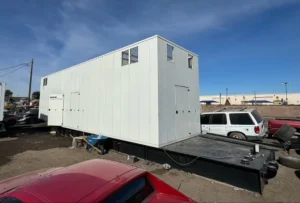
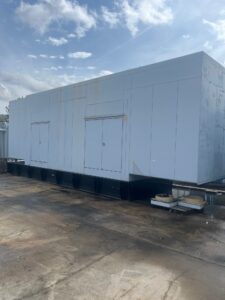
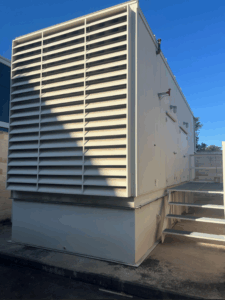
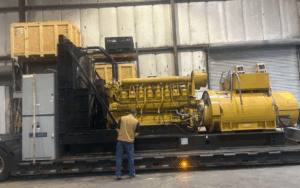
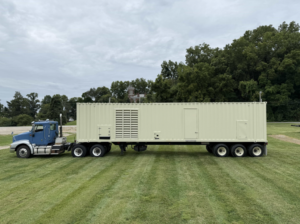
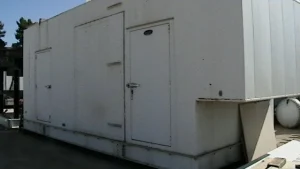
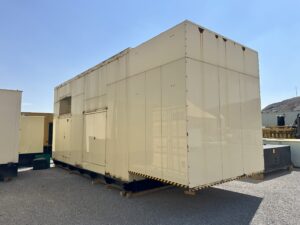
Here’s what we have in the yard right now and what these machines are:
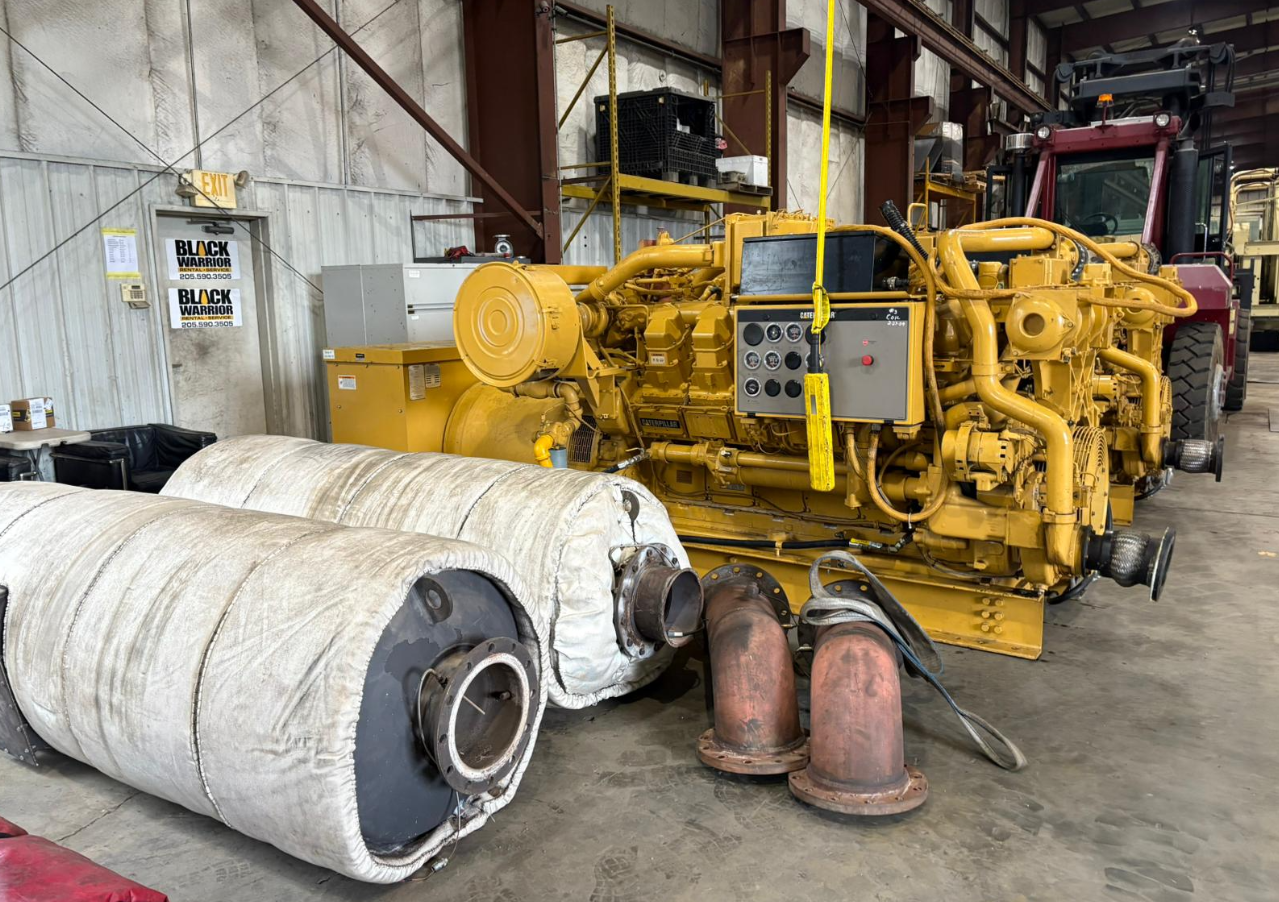
CAT 3512 platform — The 3512 is a V12, 51.8-liter displacement engine that CAT has built in various configurations since the 1970s. The 3512B and 3512C variants cover roughly 900-1125kW in generator configuration. These are Tier 2 units. No DPF. No SCR. No DEF. Service intervals are straightforward: coolant, oil, fuel filters, injectors, and valve adjustments at manufacturer-specified intervals. CAT’s dealer network is dense — in any major metro, a CAT dealership can service one of these within 24-48 hours. We’ve sold more 3512Bs than any other single generator platform. They run. See our Caterpillar inventory for current stock.
Cummins QSK60 — GS4864 and GS4845 — The QSK60 is a 60-liter, 16-cylinder engine producing 1500-2250kW in generator configuration. Our GS4864 and GS4845 units are Tier 2 machines. The QSK60 at Tier 2 is a proven prime power and standby workhorse — we’ve sold these to data centers, hospitals, water treatment facilities, and industrial plants. They have the power density and fuel efficiency that makes them competitive with any large-bore engine on the market. The Tier 2 QSK60 has no aftertreatment to maintain, which matters when you’re budgeting for a 20-year service life. Browse our Cummins inventory for availability.
Kohler 2000REOZMD — GS4806 — The 2000REOZMD is Kohler’s 2000kW generator set, built on the MTU 16V4000 engine platform. Our GS4806 unit is Tier 2. The 16V4000 is one of the best large-bore diesel engines ever built — MTU’s V-configuration, twin-turbo design achieves exceptional power density and fuel efficiency. At 2000kW, this is the machine for a large data center, campus, or industrial facility that needs substantial backup power from a single unit. Tier 2 means you’re not managing DEF, DPF regen cycles, or SCR catalyst health on a machine that may sit on test cycles for most of its life. This specific unit is available; call us for pricing and current condition details.
Beyond these flagship platforms, we regularly stock CAT 3516 units in the 1500-2000kW range, Cummins QSK50 units in the 1000-1500kW range, and smaller platforms from 250kW up. See our full diesel generator inventory for current listings. Inventory moves — if you see something you want, call before it’s gone.
One practical note on used generator condition: every unit in our yard goes through a pre-sale inspection that includes a load bank test, fluid analysis, and visual inspection of major components. We’re not moving paper on generators we haven’t physically seen. When we tell you a unit has 4,200 hours and good compression, we have the test data to back that up. Buy from a dealer who can show you the load test results.
If you’ve read this far, you know more about Tier standards than 80% of the buyers we talk to. That’s the point. The market is full of misinformation, and most of it costs buyers money. Tier 4 marketing pressure sells expensive new units to buyers who don’t need them. The used Tier 2 market is legal, proven, and delivers the same emergency standby function at a fraction of the cost.
We’re not anti-Tier 4. If you need it — prime power, California non-attainment with restrictive permit conditions, a project spec that calls for it — we’ll find you one and help you understand what the aftertreatment maintenance adds to your 5-year operating cost. We’d rather you go in with clear numbers than get surprised by a DPF cleaning bill two years in.
What we are is honest about the used industrial generator market. We’ve been at it for over 25 years from our Santa Clarita yard. We know which platforms hold up, which ones have known failure modes to inspect for, and which tier makes sense for which application. That’s not something you get from a new-equipment catalog.
Call us at (818) 484-8550. Tell us the application, the location, the kW requirement, and whether California is involved. We’ll give you a straight answer. If a Tier 2 unit works for your project, we’ll tell you that and show you what we have. If you need Tier 4, we’ll tell you that and start sourcing. We don’t have a quota on Tier 4 sales. We have a reputation for giving buyers the right answer.
Power Generation Enterprises is located at 26764 Oak Ave, Santa Clarita, CA 91351. We ship nationwide. If you want to come look at units in person, call ahead and we’ll have the specific machines ready for walkthrough.
Yes. Tier 2 engines were manufactured to EPA standards during their production window and remain fully legal to buy, sell, and operate. The EPA’s Tier standards regulate the manufacture of new engines, not the ongoing operation of existing lawfully manufactured engines. In most U.S. states, a Tier 2 emergency standby generator can be installed today under the emergency stationary engine provisions of 40 CFR Part 60, Subpart IIII. The one significant exception is California, where CARB and local air districts may impose additional operating hour restrictions. If you’re outside California and operating an emergency standby application, Tier 2 is legal and is the dominant segment of the used industrial generator market. See our diesel generator inventory for currently available Tier 2 units.
Under EPA 40 CFR Part 1039, Tier 4 Final engines in the 560-900kW power category must meet a combined NMHC+NOx limit of 0.40 g/kWh and a PM limit of 0.03 g/kWh. These limits apply to engines manufactured after January 1, 2015. Achieving 0.40 g/kWh NMHC+NOx is not possible through combustion optimization alone — it requires a full aftertreatment stack including SCR with DEF injection and a DPF for particulate control. This is why every Tier 4 Final large generator on the market — CAT, Cummins, MTU, Kohler — includes DEF tanks, DPF housings, and SCR catalyst modules as part of the basic package.
No. NFPA 110, Standard for Emergency and Standby Power Systems, does not specify a tier requirement. NFPA 110 governs installation, transfer switch requirements, fuel storage, testing intervals (monthly exercise and 30-minute annual load test at minimum), battery maintenance, and system classification (Type 10, Type 60, Type 120 based on acceptable transfer time). None of these requirements are linked to EPA emission tiers. The emission tier question is answered by your air permit and applicable EPA regulations, not by NFPA 110. A Tier 2 generator properly installed and maintained meets NFPA 110 requirements as readily as a Tier 4 unit. Review our generator enclosure and installation guide for related installation considerations.
For a large standby generator running 150 hours per year, plan for $1,200-$1,800 per year in DEF fluid, $800-$2,500 per DPF cleaning (typically needed every 2-4 years), $6,000-$15,000 for eventual SCR catalyst service, and $500-$1,500 per year in DEF system maintenance (heaters, pumps, lines). Over 10 years, that’s a realistic range of $18,000-$32,000 in aftertreatment-specific costs on top of normal PM. A comparable Tier 2 unit running the same hours adds $0 in aftertreatment costs. The delta is $18,000-$32,000 over a decade — real money that belongs in your capital planning, not just the purchase price comparison. Our CAT Tier 2 inventory represents generators with zero aftertreatment burden.
Sometimes, with permit qualification. CARB’s ATCM and local air district rules (particularly SCAQMD Rule 1470 in the South Coast) impose operating hour restrictions on lower-tier engines and may require Tier 4 or BACT for new installations in non-attainment areas above certain thresholds. However, replacement of existing permitted equipment, small facility applications, and installations in attainment portions of California can often proceed with Tier 2 under permit-by-rule provisions with annual hour limits. We are located in Santa Clarita (Los Angeles County) and sell into California regularly — call us at (818) 484-8550 and tell us your specific county and application. We’ll tell you whether a Tier 2 path is realistic or whether you need to budget for Tier 4 before you spend time speccing something that won’t get permitted.
Tier 4 Interim (approximately 2011-2014 for the >560kW range) was a transitional standard that required significant reductions in PM and NOx from Tier 2 levels but did not require the full aftertreatment stack of Tier 4 Final. Many Tier 4 Interim engines used EGR (exhaust gas recirculation) to reduce NOx and a DPF for PM, but not all required SCR with DEF. Tier 4 Final (2015-present) tightened the NMHC+NOx limit to 0.40 g/kWh, which as a practical matter mandates the full DPF+SCR+DEF stack on all large engines. Tier 4 Interim units are relatively uncommon on the used market — they sit in a price band above Tier 2 and below Tier 4 Final and don’t always offer the best value proposition. If a project spec calls for “Tier 4,” confirm whether it means Tier 4 Interim or Tier 4 Final — this matters for sourcing and cost. See our Cummins QSK60 guide for a platform that exists in both Tier 2 and Tier 4 Final configurations.
We have Tier 2 industrial generators from 250kW to 2000kW in our Santa Clarita yard, available for inspection, load-bank tested, and ready to ship nationwide. If your application qualifies for Tier 2 — and most U.S. standby applications do — you can save $150,000-$300,000 compared to new Tier 4 equipment on comparable power ratings. Call us at (818) 484-8550 and we’ll match your application to a specific unit in stock.