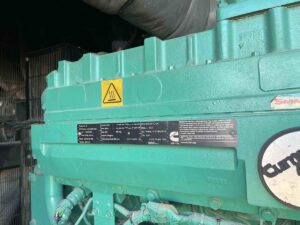
Choosing between an open skid, enclosed, or containerized generator changes your project cost by 60-120%, your noise footprint by up to 35 dB(A), and your installation timeline by weeks. This guide breaks down real-world noise data (with OSHA exposure limits), weight and rigging numbers, NFPA code requirements, cooling derating factors, and total installed cost comparisons so you can pick the right configuration for your engine, your site, and your budget.
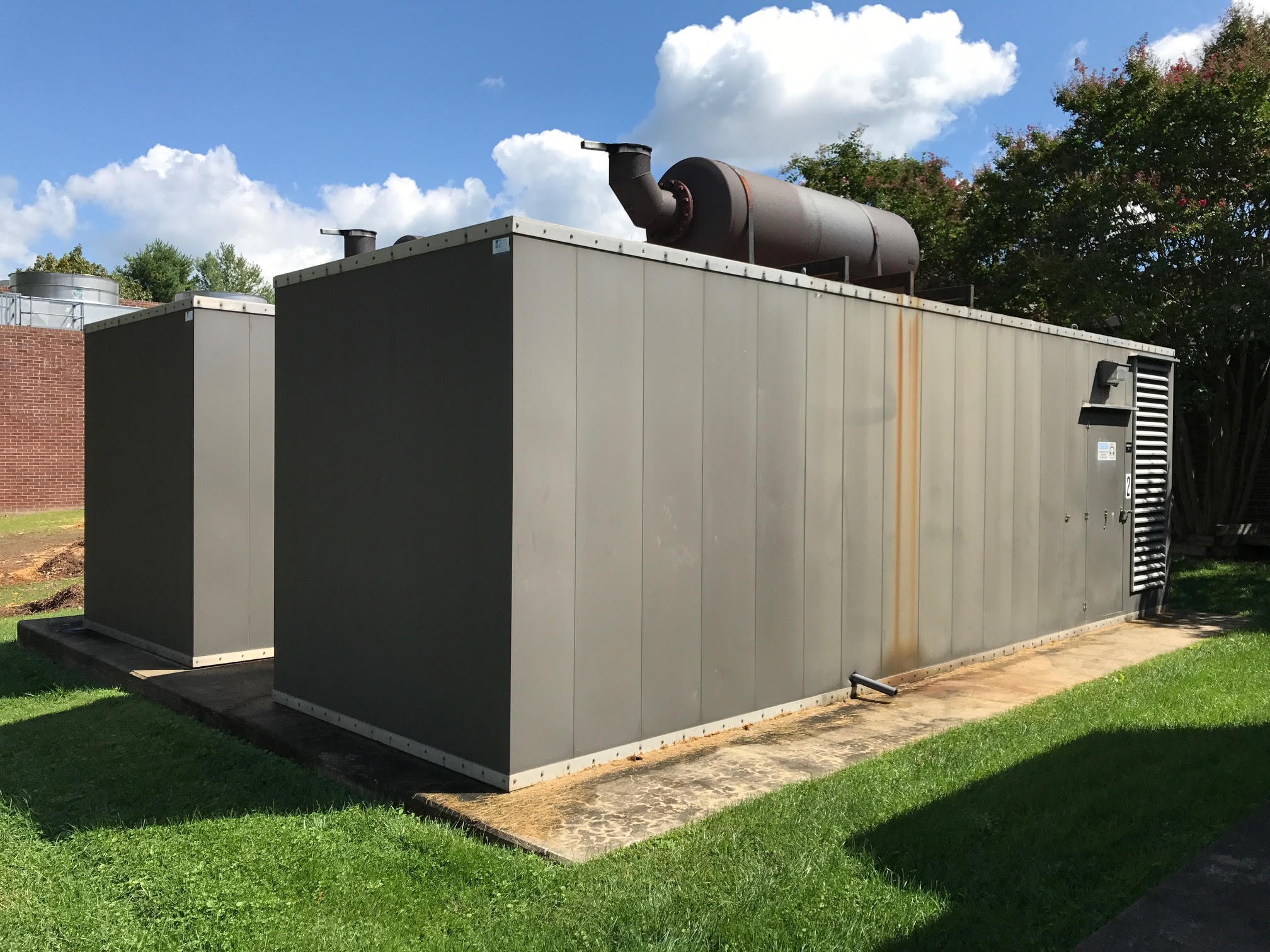
You’ve already picked your engine platform and your kW rating. A CAT 3516, a Cummins QSK60, whatever it is. Now comes the decision that most buyers blow past until it bites them: how is this thing packaged?
Open skid. Sound-attenuated enclosure. ISO container. The engine is identical. The alternator is identical. But the packaging choice will change what you spend, where you can legally install it, how loud it is during a test or an outage, and how your maintenance techs feel about working on it for the next 15 years.
Here is why this matters more than most people think.
Take a 500kW unit as a baseline. A CAT C15 open skid at that rating runs roughly $75,000 on the used market. Add a weather-protective enclosure and you’re at $90,000 to $95,000, a 20-27% bump. Step up to a Level 1 sound-attenuated enclosure and the price climbs to $95,000-$110,000. Level 2 or Level 3 sound attenuation pushes you to $110,000-$150,000. A containerized ISO unit at 500kW sits around $120,000-$165,000, a 60-120% premium over the bare skid.
Those numbers make the open skid look like the obvious budget play. It is not.
If that open skid goes indoors, NFPA 110 requires a 2-hour fire-rated generator room with dedicated ventilation (no fire dampers permitted in the airflow path), emergency lighting, and fire suppression. Only EPSS equipment can be in the room. Depending on your building, that room costs $50,000 to $200,000 or more to construct. Your $75,000 open skid just became a $125,000 to $275,000 installed system.
A containerized unit on a concrete pad? Total site prep runs $10,000 to $40,000. Pour the pad, set the container, connect fuel and electrical. The “expensive” containerized option is often the cheapest path to a fully code-compliant, weather-protected installation. This is the math that catches people off guard.
Noise is where the configuration choice hits hardest, and where the technical data matters more than marketing claims. All measurements below are at 7 meters from the unit, full load.
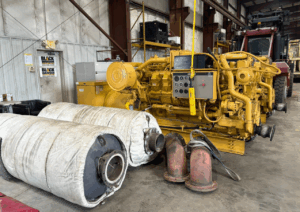
An open skid generator produces 95-105 dB(A). That is jackhammer territory. Stand 23 feet from a running open-frame diesel genset and you are getting hit with sound pressure that OSHA says is too loud for an 8-hour work shift. The OSHA Permissible Exposure Limit (PEL) is 90 dB(A) over 8 hours. The action level that triggers mandatory hearing conservation programs is 85 dB(A). A 2000kW open skid pushing 103 dB(A) blows past both limits for anyone working nearby during an extended outage or load bank test.
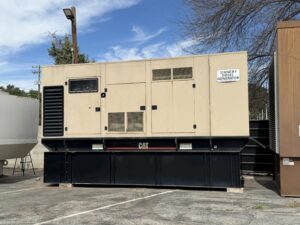
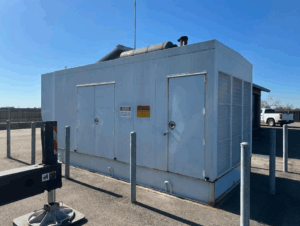
A basic weather-protective enclosure (the sheet metal box with louvers that keeps rain off the engine) drops you to 80-90 dB(A). Better, but still above the OSHA action level at the high end.
Level 1 sound-attenuated enclosures bring noise down to 75-85 dB(A). Level 2 hits 70-78 dB(A). Level 3 sound attenuation, the serious acoustic treatment with double-wall panels, lined intake and exhaust plenums, and critical-grade silencers, gets you to 65-70 dB(A). That is the sound level of a quiet office conversation.
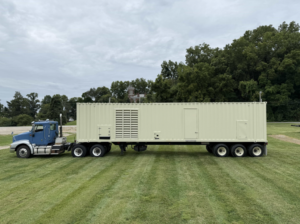
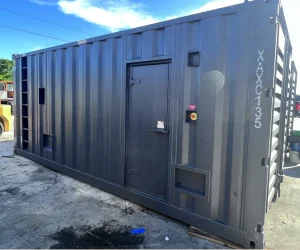
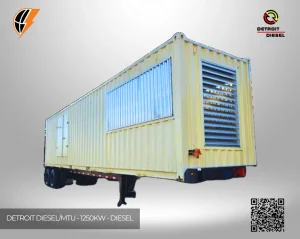
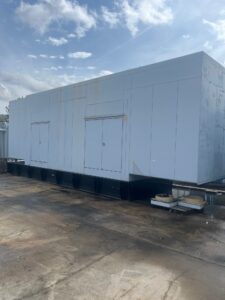
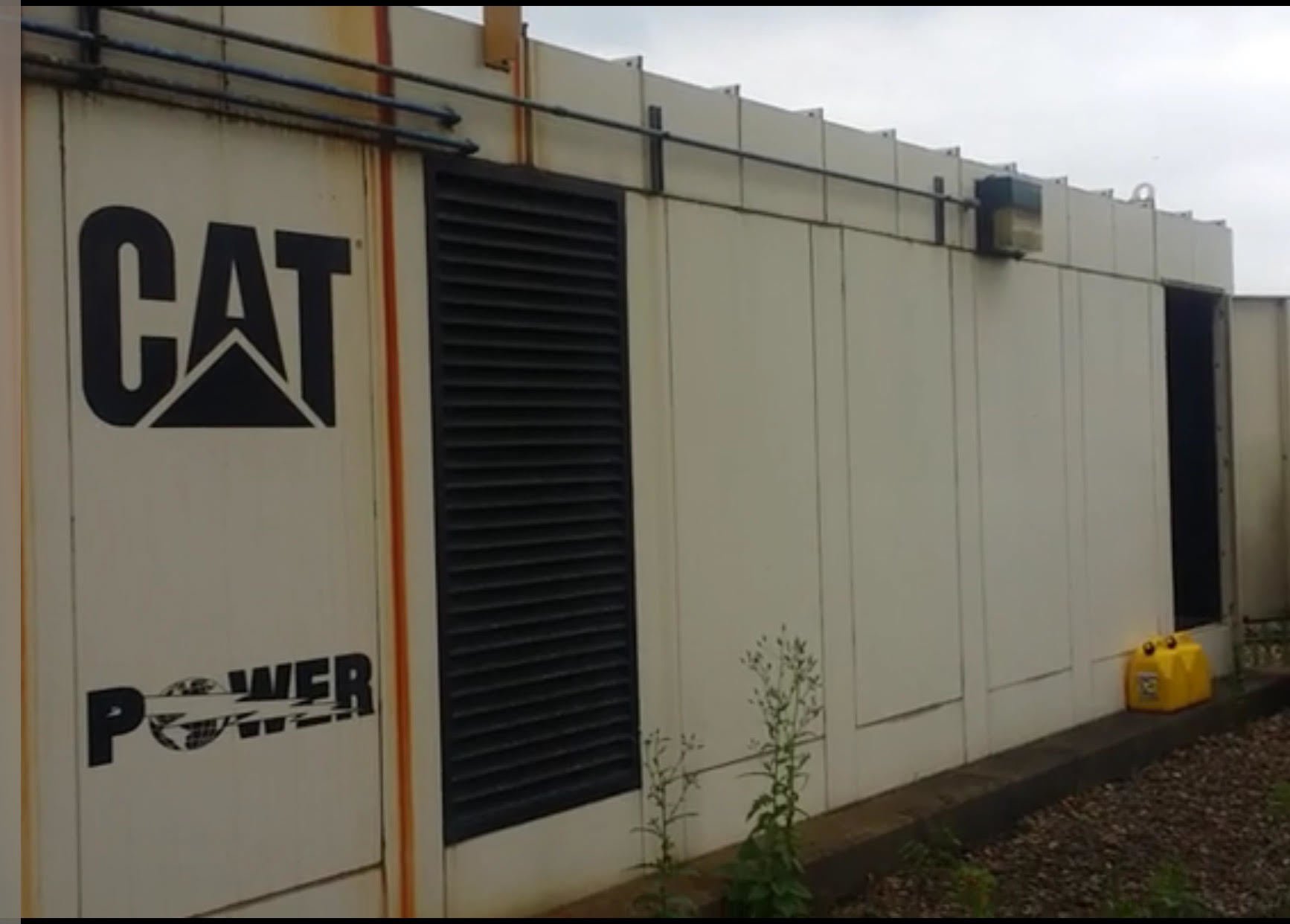
Containerized ISO generators, when fully lined with acoustic insulation, typically measure 70-75 dB(A) at 7 meters. Comparable to a Level 2 enclosure, with the added benefit of structural protection and portability.
Here is a reference point that makes these numbers real: every 10 dB reduction is perceived by the human ear as cutting the loudness in half. So a Level 3 enclosure at 67 dB(A) sounds roughly one-eighth as loud as a bare open skid at 100 dB(A). Three doublings. Same engine, same load, completely different experience for everyone within earshot.
If your generator sits 50 feet from an occupied building, a hospital wing, a school, or a residential property line, noise is not optional. It is a zoning and liability issue. Many municipalities enforce noise ordinances in the 65-75 dB(A) range at the property boundary. An open skid will not pass. A weather enclosure probably will not pass. You need Level 2 or better, or a containerized setup with proper acoustic treatment.
Packaging adds steel, and steel adds weight. This matters for rigging, transport, foundation design, and site access.
Using the same 500kW benchmark: a CAT C15 open skid weighs approximately 9,850 lbs. Add a sound-attenuated enclosure and you’re at roughly 11,180 lbs, a 13.5% increase. Manageable with the same crane and truck.
Containerized is a different animal. A 500kW containerized unit weighs approximately 20,440 lbs. That is a 107% increase over the open skid. You went from a unit that rides on a standard flatbed to one that needs a bigger trailer and a larger crane.
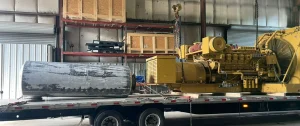
Scale up and the weight gets serious. A 1500kW containerized generator tips the scales at around 46,480 lbs. A 2000kW containerized unit like our CAT 3516C 2000kW containerized set weighs approximately 76,400 lbs. That is 38 tons. You are not moving that with a pickup truck and a prayer. You need a proper rigging plan, engineered crane lifts, and a foundation designed for that point load.
The flip side: containerized units are designed for transport. ISO corner castings, forklift pockets, and standardized lifting points mean that a rigging crew who has moved shipping containers (and every rigging crew has moved shipping containers) can handle the job without custom spreader bars or specialized equipment. Open skids, ironically, can be trickier to rig because lifting points vary by manufacturer and age.
For rooftop installations, which are common for hospitals and high-rise commercial buildings, the weight penalty of containerization is usually a non-starter. Structural engineers spec the roof loads, and every pound counts. Enclosed units on skids are the standard play for rooftop gensets.
| Configuration | Noise at 7m (Full Load) | Weight Premium (500kW) | Cost Premium (500kW) | Best Application |
|---|---|---|---|---|
| Open Skid | 95-105 dB(A) | Baseline (9,850 lbs) | Baseline (~$75K) | Indoor installations with existing fire-rated rooms, temporary/construction sites |
| Weather Protective Enclosure | 80-90 dB(A) | +5-8% | +20-27% (~$90-95K) | Light commercial standby, mild climates, budget-conscious outdoor installs |
| Level 1-2 Sound Attenuated | 70-85 dB(A) | +10-18% | +27-100% (~$95-150K) | Commercial standby, hospitals, urban sites with noise ordinances |
| Level 3 Sound Attenuated | 65-70 dB(A) | +20-25% | +47-100% (~$110-150K) | Hospitals, schools, residential-adjacent sites, noise-sensitive facilities |
| Containerized (ISO) | 70-75 dB(A) | +107% (~20,440 lbs) | +60-120% (~$120-165K) | Data centers, oil/gas, mining, remote sites, modular deployments |
Code compliance is where configuration choice stops being a preference and becomes a requirement. Two NFPA standards drive most generator installation decisions: NFPA 37 (Standard for the Installation and Use of Stationary Combustion Engines and Gas Turbines) and NFPA 110 (Standard for Emergency and Standby Power Systems).
NFPA 37 basics for outdoor installations: Any generator placed outdoors must maintain a 5-foot clearance from building openings (doors, windows, intake vents) and combustible walls. This applies regardless of configuration. A containerized unit, an enclosed unit, and an open skid all need that 5-foot buffer.
NFPA 110 Level 1 systems (hospitals, data centers, high-rise buildings, and other facilities where power loss endangers life or critical operations) impose the strictest requirements:
For indoor installation, the generator must be housed in a 2-hour fire-rated room. Ventilation serving that room cannot include fire dampers. Only emergency power supply system (EPSS) equipment is permitted in the room. You need emergency lighting. You need fire suppression. The room must have a separate fuel supply path. This is the $50,000-$200,000+ construction cost referenced above. For reference, our hospital generator replacement guide covers NFPA 110 requirements for healthcare facilities in detail.
For outdoor installation under NFPA 110, the unit must be in a weather-tight enclosure maintained at a minimum of 40 degrees F. Block heaters alone typically are not sufficient to meet this requirement in cold climates; you need thermostatically controlled enclosure heaters. Containerized units handle this well because the insulated walls retain heat from the block heater and optional space heaters. Open skids with weather enclosures may need supplemental heating systems.
The practical takeaway: if you are installing a Level 1 EPSS system and you have the option to go outdoors, a containerized or enclosed unit on a concrete pad is almost always faster, cheaper, and simpler to get through permitting than building a fire-rated indoor room.
Every enclosure traps heat. This is physics, not a design flaw. The question is how much heat and what it costs you in capacity.
Enclosures typically reduce effective cooling by 8-10 degrees C compared to an open skid in free air. Even with doors open, radiator-cooled units derate by 5-7 degrees C due to restricted airflow patterns. CAT’s installation guidance recommends that generator rooms (and by extension, enclosure interiors) should not exceed 49 degrees C (120 degrees F).
The derating math: generators lose approximately 3% of their kVA rating for every 10 degrees C above 40 degrees C ambient. In Phoenix, where summer ambient temperatures routinely hit 46-48 degrees C (115-118 degrees F), you are already 6-8 degrees C above the 40 degrees C baseline before the enclosure adds its 8-10 degrees C penalty. Stack those up and you could be looking at 14-18 degrees C above baseline. That is a 4.2-5.4% kVA derating.
On a 2000kW unit, 5% derating means you lose 100kW of available capacity. If you sized your generator to run at 80% load (1600kW on a 2000kW unit), you are fine. If you sized it to run at 95% load because someone was trying to save money on a smaller genset, you might not be able to carry your full load on a 115 degrees F day. This is exactly the situation where the configuration choice made during procurement creates a problem two years later during a summer peak outage.
Containerized units generally handle cooling better than tight-fitting enclosures because ISO containers have more internal volume and can accommodate larger ventilation openings. The walk-in design also allows for remote radiator configurations, where the radiator is mounted outside the container on the roof or on a separate stand, eliminating the enclosure heat penalty entirely.
Over a 20-year service life, your maintenance crew will spend thousands of hours on this generator. How the unit is packaged determines whether a 2-hour oil change stays a 2-hour oil change or becomes a 3-hour ordeal.
Open skids offer the fastest hands-on access. Walk up, start wrenching. No panels to remove, no confined-space considerations, no reaching through access doors. The trade-off is that an exposed engine in an outdoor environment collects more dirt, moisture, and UV degradation, which means you are doing that maintenance more often. Electrical connections corrode faster. Belts and hoses degrade from sun exposure. Control panels take weather hits.
Enclosed generators add 15-30 minutes per service event for panel removal and reinstallation. On smaller units with tight enclosures, simple tasks like checking the valve lash or replacing an injector can become awkward contortion exercises. Many enclosures have removable roof panels for crane-assisted component removal (pulling a turbo, replacing an alternator), but that adds crane rental cost to what would otherwise be a straightforward job on an open skid.
Containerized walk-in designs offer the best of both worlds for maintenance access, at the highest purchase cost. A technician opens the personnel door, steps inside, and has room to work around the engine. Tools, parts, and lighting are all contained. Weather is irrelevant. The controlled environment also means the engine itself stays cleaner between service intervals.
After 25 years of selling and configuring industrial generators, the pattern is clear. Application drives the right answer more than budget does.
Data centers: Containerized, almost without exception. The N+1 and 2N redundancy architectures used in Tier III and Tier IV facilities benefit from modular deployment. Containers ship pre-tested, drop onto pads, and connect. Expansion means adding another container, not building another fire-rated room. Our data center generator guide covers the decommissioning side when those containers come out of service.
Hospitals and healthcare: Enclosed units, usually on a rooftop or a dedicated concrete pad adjacent to the building. NFPA 110 Level 1 compliance is mandatory. Sound attenuation is typically Level 2 or Level 3 because hospitals need quiet. Weight constraints on rooftops usually rule out containerized. Indoor installations in fire-rated rooms still exist at older facilities, but new construction almost always goes outdoor-enclosed.
Oil and gas, mining, remote sites: Containerized. The structural protection, transport durability, and self-contained design make containers the default for anything that moves or sits in a harsh environment. Our oil and gas generator page covers the lifecycle for these units.
Construction and temporary power: Trailer-mounted, which is essentially an open skid on a road-legal trailer with a weather cover. Portability is the priority. Noise complaints are managed by distance (big job sites) or by accepting the noise (remote locations).
Commercial standby (office buildings, retail, manufacturing): Sound-attenuated enclosed units. Level 1 or Level 2 attenuation handles most municipal noise ordinances. The enclosure protects the engine from weather. Installation is straightforward on a concrete pad with a fuel tank.
PGE carries inventory across all three configurations. We have containerized units like the CAT 3516C 2000kW (GS4826), Cummins QST30 1000kW (GS4750), and Spectrum/MTU 1250kW (GS4711). Enclosed units including the CAT 3412C 800kW (GS4841) and Cummins KTA19 450kW (GS4838). And open skid units like the CAT 3516 2000kW (GS4822). We also stock sound-attenuated drop-over enclosures for retrofitting open skids, which is worth discussing if you already own a bare unit and need to bring it into compliance. Browse our full CAT inventory and Cummins inventory, or call us at (818) 484-8550.
Yes. Drop-over sound-attenuated enclosures are designed to retrofit onto existing open skid generators. The enclosure is built to match the footprint of the skid and drops over the top, bolting to the base frame. PGE stocks these enclosures and can match them to most major OEM skid dimensions. Expect to spend roughly 30-50% of a new enclosed unit’s premium for the retrofit enclosure alone, plus installation labor. It is a solid option if you bought a bare unit at a good price and your noise requirements changed.
Almost certainly yes. NFPA 110 Level 1 governs hospital emergency power systems, and while it does not explicitly mandate a specific dB level, hospitals have patients, and most healthcare facility engineers specify Level 2 or Level 3 sound attenuation (70-78 dB(A) or 65-70 dB(A) at 7 meters). Additionally, hospitals in urban areas face municipal noise ordinances that an open skid or basic weather enclosure cannot meet. Budget for Level 2 minimum. Our hospital generator replacement guide walks through the full NFPA 110 compliance picture.
Yes, but typically less than a tight-fitting enclosure. All enclosed generators experience some cooling penalty. Containers allow more internal volume and better ventilation design, so the derating is usually on the lower end. The rule of thumb is 3% kVA loss per 10 degrees C above 40 degrees C ambient. In a Phoenix summer at 48 degrees C with an enclosure adding 8 degrees C, you could see 4-5% derating. The best mitigation is a remote-mounted radiator, which removes the heat rejection from the enclosure entirely. Many containerized units can be specified or retrofitted with rooftop-mounted radiators.
It depends entirely on the building’s structural engineering, but containerized units are rarely suitable for rooftops because of the weight penalty. A 500kW containerized unit at 20,440 lbs is more than double the 9,850 lbs of the same rating on an open skid. Most rooftop installations use enclosed generators on skids, with the structural engineer specifying allowable point loads on the roof steel. If you are replacing an existing rooftop unit, match or reduce the weight of the original to avoid structural modifications.
In most jurisdictions, yes, and significantly so. An outdoor containerized unit on a concrete pad typically requires a mechanical permit, an electrical permit, and possibly a fire department review for fuel storage. An indoor installation in a fire-rated room triggers building permits for the room construction, fire suppression permits, dedicated ventilation engineering, and usually a more involved fire marshal review. The permitting timeline for an outdoor containerized installation is often 4-8 weeks shorter than a comparable indoor installation, and the total permitting cost is lower.
Containerized. ISO containers are built for transport. They have standardized corner castings that interface with container handling equipment worldwide, forklift pockets, and certified lifting points. Moving a containerized generator is essentially the same as moving a shipping container, which any heavy haul carrier and rigging company can handle. Enclosed generators on skids can be moved, but the enclosure panels are more fragile, the lifting points may not be standardized, and the unit usually needs to be partially disassembled for transport. If relocation is part of your plan, containerized pays for itself on the first move.
PGE stocks open skid, enclosed, and containerized generators from 100kW to 4000kW. We also carry drop-over sound-attenuated enclosures for retrofitting existing units. Tell us your application, your site constraints, and your noise requirements. We will tell you which configuration makes sense and pull units from inventory that match. Call (818) 484-8550 or request a quote online.